State Key Laboratory of Soil Erosion and Dryland Farming on the Loess Plateau, Northwest A&F University, Yangling 712100, Shaanxi, China.
Institute of Loess Plateau, Shanxi University, Taiyuan 030000, Shanxi, China.
Int J Environ Res Public Health. 2018 Aug 21;15(9):1797. doi: 10.3390/ijerph15091797.
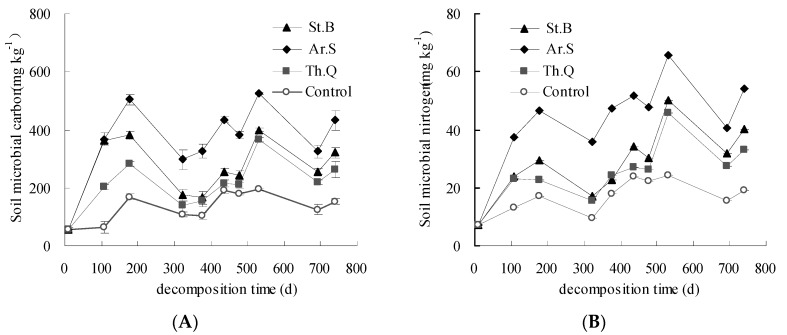
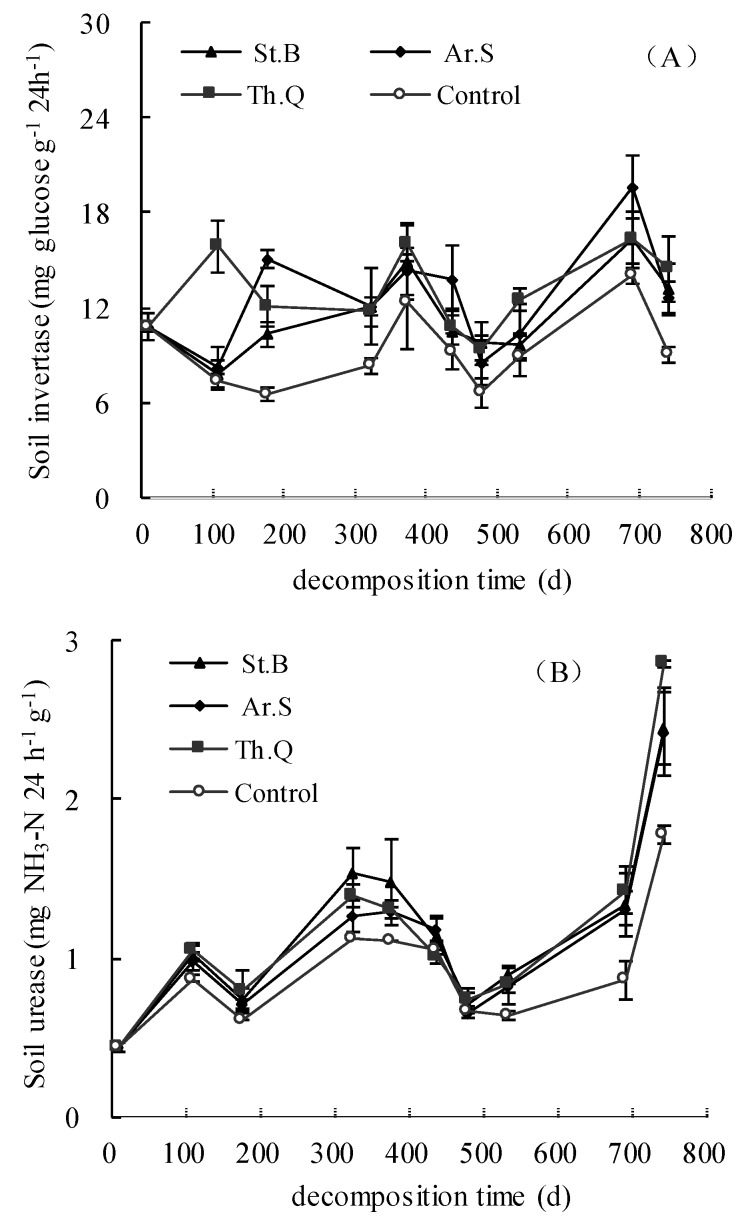
Litter, the link between soil and plant, is an important part of nutrient return to soil. Deeply understanding the effect of litter decomposition on soil microbiological properties is important for the sustainable development of grasslands. Three plants ( Celak., Trin. and ledeb.) leaf litter were selected. A simulation experiment using the nylon bag method was conducted to measure the soil microbial biomass carbon and nitrogen, and soil enzyme activity during litter decomposition. The results showed that the decomposition of three leaf litter enhanced soil microbial carbon and nitrogen. The change rate of soil microbial carbon and nitrogen decreased as Ar.S > St.B > Th.Q. The activities of soil invertase, soil urease, and soil nitrate reductase were significantly improved by the coverage of leaf litter. After 741-day litter decomposition, the change rate of soil invertase was from 16.7% to 33.2%. The change rate of soil urease was highest in the Th.Q treatment; St.B treatment and Ar.S treatment followed, and lowest in the control. The change rates of soil nitrate reductase in the St.B and Ar.S treatment were >1000% higher than those of other treatments. The response of soil enzyme activity to litter decomposition "lagged" behind the change of soil microbial biomass. The significant increase of soil microbial biomass and enzyme activity demonstrated that litter decomposition played an important role in maintaining soil ecological function.
凋落物作为连接土壤和植物的纽带,是养分归还土壤的重要组成部分。深入了解凋落物分解对土壤微生物特性的影响,对于草原的可持续发展至关重要。本研究选择了三种植物(Celak.、Trin.和ledeb.)的叶片凋落物。采用尼龙袋法模拟实验,测定凋落物分解过程中土壤微生物生物量碳氮和土壤酶活性。结果表明,三种凋落物的分解均增强了土壤微生物碳氮。土壤微生物碳氮的变化率随着 Ar.S > St.B > Th.Q 的顺序逐渐降低。土壤中蔗糖酶、脲酶和硝酸还原酶的活性均因凋落物的覆盖而显著提高。经过 741 天的凋落物分解,土壤蔗糖酶的变化率从 16.7%增加到 33.2%。在 Th.Q 处理中,土壤脲酶的变化率最高;St.B 处理和 Ar.S 处理次之,而对照处理最低。St.B 和 Ar.S 处理中土壤硝酸还原酶的变化率比其他处理高出>1000%。土壤酶活性对凋落物分解的响应“滞后”于土壤微生物生物量的变化。土壤微生物生物量和酶活性的显著增加表明凋落物分解在维持土壤生态功能方面发挥着重要作用。