Kissel Christine K, Chen Guanmin, Southern Danielle A, Galbraith P Diane, Anderson Todd J
Department of Cardiac Sciences and Libin Cardiovascular Institute of Alberta, Cumming School of Medicine, University of Calgary, Calgary, AB, Canada.
Department of Cardiology, University Heart Center, University Hospital Zurich, Rämistrasse 100, CH-8091, Zürich, Switzerland.
BMC Cardiovasc Disord. 2018 Aug 22;18(1):173. doi: 10.1186/s12872-018-0908-z.
Non-obstructive coronary artery disease (NOCAD) is a common finding on coronary angiography. Our goal was to evaluate the long-term prognosis of NOCAD patients with stable angina (SA).
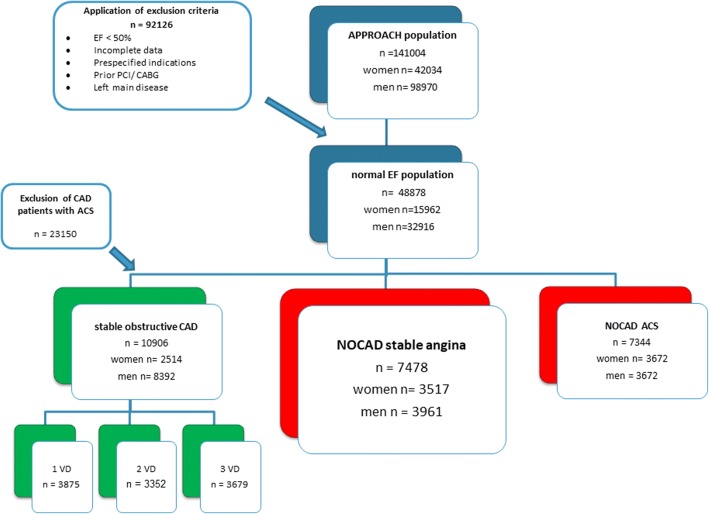
The study cohort consisted of 7478 NOCAD patients with normal EF (≥ 50%), and SA who underwent coronary angiography between 1995 and 2012. We compared NOCAD patients (stenosis< 50%) with 10,906 patients with stable obstructive CAD (≥ 50%). The primary endpoint was all-cause mortality. Secondary endpoints included repeat angiography, progressive CAD, and PCI. A second comparison group consisted of 7344 patients with NOCAD presenting with an ACS. Rates of all-cause mortality of NOCAD ACS patients were compared to NOCAD SA patients.
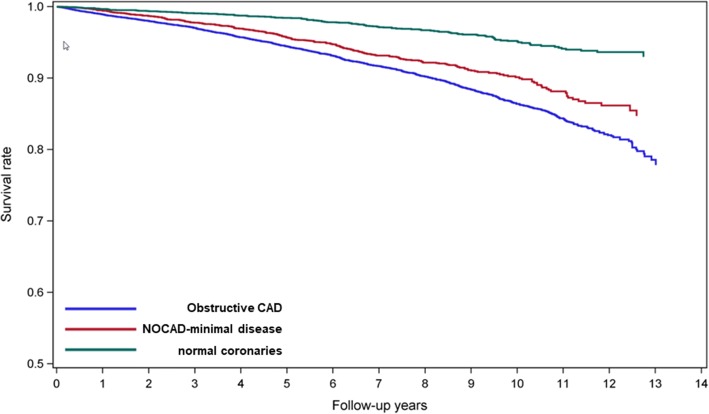
Median follow-up time was 6.5 years. NOCAD patients had a lower risk of all-cause mortality compared to CAD patients (HR CAD vs. NOCAD 1.33 (1.19-1.49); p < 0.001). This was driven by patients with normal coronary arteries (HR CAD vs. normal 1.63 (1.36-1.94), p < 0.001), whereas patients with minimal disease (> 0% and < 50%) were at similar risk as CAD patients (HR CAD vs. minimal 1.08 (0.99-1.29), p = 0.06). In NOCAD patients, the strongest predictors of all-cause mortality were age and minimal disease. SA patients with NOCAD had low rates of repeat angiography (7.3%), future CAD (2.3%) and PCI (1.7%). NOCAD ACS patients had a 41% increase in all-cause mortality risk compared to NOCAD SA patients (HR 1.41 (1.25-1.6), p < 0.001).
This study underlines the importance of minimal CAD, as it is not a benign disease entity and portends a similar risk as stable obstructive CAD.
非阻塞性冠状动脉疾病(NOCAD)是冠状动脉造影常见的表现。我们的目标是评估稳定型心绞痛(SA)的NOCAD患者的长期预后。
研究队列包括7478例左心室射血分数(EF)正常(≥50%)且患有SA并在1995年至2012年间接受冠状动脉造影的NOCAD患者。我们将NOCAD患者(狭窄<50%)与10906例稳定型阻塞性CAD患者(≥50%)进行比较。主要终点是全因死亡率。次要终点包括重复血管造影、进展性CAD和经皮冠状动脉介入治疗(PCI)。第二个比较组由7344例患有急性冠状动脉综合征(ACS)的NOCAD患者组成。将NOCAD ACS患者的全因死亡率与NOCAD SA患者进行比较。
中位随访时间为6.5年。与CAD患者相比,NOCAD患者全因死亡风险较低(CAD与NOCAD的风险比[HR]为1.33[1.19 - 1.49];p<0.001)。这是由冠状动脉正常的患者驱动的(CAD与正常的HR为1.63[1.36 - 1.94],p<0.001),而疾病轻微(>0%且<50%)的患者与CAD患者风险相似(CAD与轻微的HR为1.08[0.99 - 1.29],p = 0.06)。在NOCAD患者中,全因死亡的最强预测因素是年龄和疾病轻微。患有NOCAD的SA患者重复血管造影率(7.3%)、未来发生CAD的几率(2.3%)和PCI率(1.7%)较低。与NOCAD SA患者相比,NOCAD ACS患者全因死亡风险增加41%(HR为1.41[1.25 - 1.6],p<0.001)。
本研究强调了轻微CAD的重要性,因为它并非良性疾病实体,且预示着与稳定型阻塞性CAD相似的风险。