Robinson Anna-Lena, Schmeiser Gregor, Robinson Yohan, Olerud Claes
Department of Surgical Sciences, Uppsala University Hospital, Uppsala, Sweden.
Stockholm Spine Center, Stockholm, Sweden.
Trials. 2018 Aug 22;19(1):452. doi: 10.1186/s13063-018-2690-8.
Displaced odontoid fractures in the elderly are treated non-surgically with a cervical collar or surgically with C1-C2 fusion. Due to the paucity of evidence, the treatment decision is often left to the discretion of the expert surgeon.
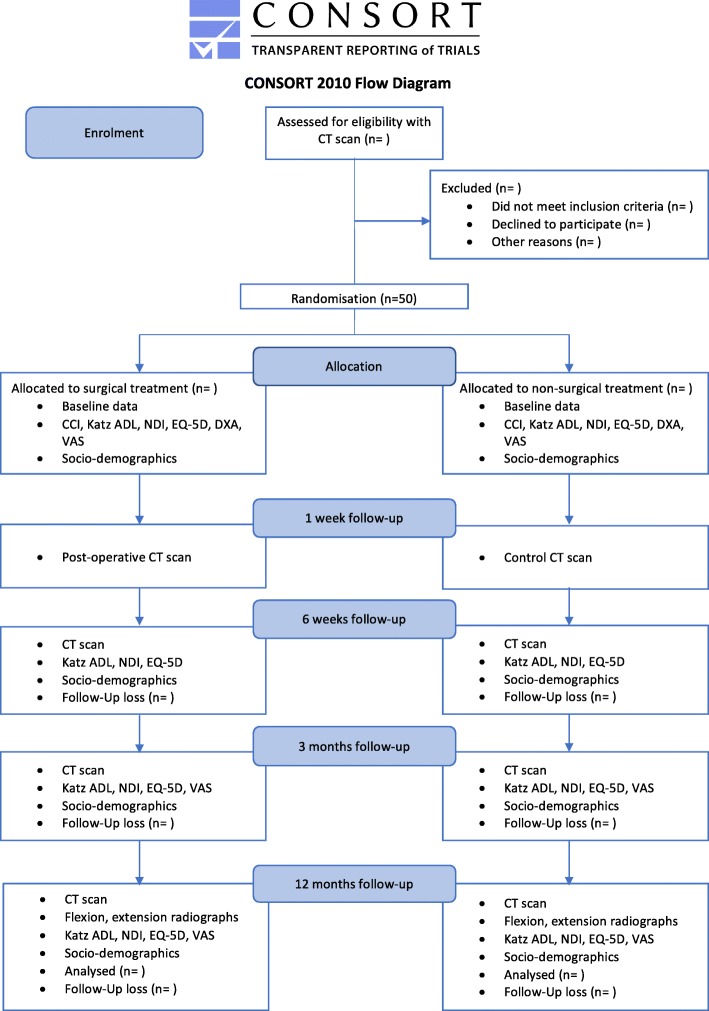
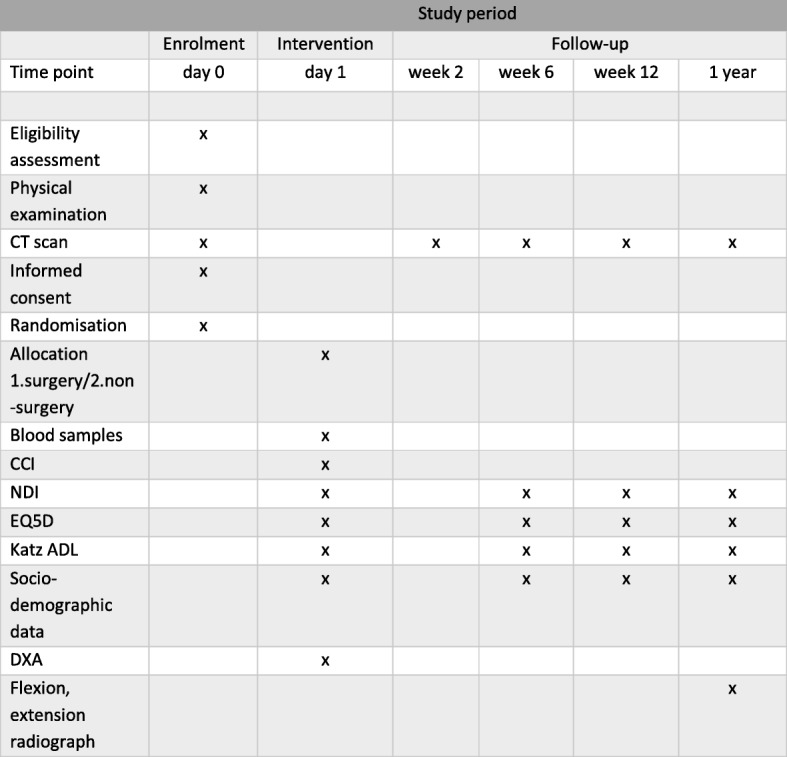
The Uppsala Study on Odontoid Fracture Treatment (USOFT) is a multicentre, open-label, randomised controlled superiority trial evaluating the clinical superiority of the surgical treatment of type-2 odontoid fractures, with a 1-year Neck Disability Index (NDI) as the primary endpoint. Fifty consecutive patients aged ≥ 75 years, with displaced type-2 odontoid fracture, are randomised to non-surgical or surgical treatment. Excluded are patients with an American Society of Anaesthesiologists (ASA) score ≥ 4, dementia nursing care or anatomical cervical anomalies. The minimal clinically important difference of the NDI is 3.5 points. A minimum of 16 patients are needed in each group to test the superiority with 80% power. By considering a 1-year mortality forecast of 29%, up to 25 participants are recruited in each group. The non-surgical group is fitted with a rigid cervical collar for 12 weeks. The surgical group is treated with a posterior C1-C2 fusion. All participants are monitored with regard to the NDI, EuroQol score (EQ-5D), socio-demographics and computed tomography (CT) at the time of injury, at 6 weeks, 3 months and 12 months. At 12 months, a dynamic radiographical investigation of upper cervical stability is performed. The secondary endpoints are: EQ-5D score, activities of daily living (ADL), bony union, upper cervical stability and mortality.
USOFT is the first randomised controlled trial comparing non-surgical and surgical management of type-2 odontoid fractures in the elderly. Using the NDI and EQ-5D as endpoints, future value-based decisions may consider quality-adjusted life years gained. Major limitations are (1) the allocation bias of the open-label study design, (2) that only higher training levels of all core specialties of spine surgery are included in the surgical treatment arm and (3) that only one type of surgical stabilisation is investigated (posterior C1-C2 fusion), while other methods are not included in this study.
ClinicalTrials.gov , NCT02789774 . Registered retrospectively on 25 August 2015.
老年患者的齿状突移位骨折,可采用颈托进行非手术治疗,或采用C1-C2融合术进行手术治疗。由于证据不足,治疗决策往往由外科专家自行决定。
乌普萨拉齿状突骨折治疗研究(USOFT)是一项多中心、开放标签、随机对照优势试验,以1年的颈部功能障碍指数(NDI)作为主要终点,评估2型齿状突骨折手术治疗的临床优势。连续纳入50例年龄≥75岁、2型齿状突移位骨折患者,随机分为非手术治疗组或手术治疗组。排除美国麻醉医师协会(ASA)评分≥4分、痴呆护理或颈椎解剖结构异常的患者。NDI的最小临床重要差异为3.5分。每组至少需要16例患者,以80%的检验效能检验优势性。考虑到1年死亡率预测为29%,每组最多招募25名参与者。非手术组佩戴硬质颈托12周。手术组采用后路C1-C2融合术治疗。所有参与者在受伤时、6周、3个月和12个月时接受NDI、欧洲生活质量量表评分(EQ-5D)、社会人口统计学和计算机断层扫描(CT)监测。在12个月时,对上颈椎稳定性进行动态影像学检查。次要终点包括:EQ-5D评分、日常生活活动能力(ADL)、骨愈合、上颈椎稳定性和死亡率。
USOFT是第一项比较老年患者2型齿状突骨折非手术和手术治疗的随机对照试验。以NDI和EQ-5D作为终点,未来基于价值的决策可能会考虑获得的质量调整生命年。主要局限性包括:(1)开放标签研究设计的分配偏倚;(2)手术治疗组仅纳入脊柱外科所有核心专业中培训水平较高的人员;(3)仅研究了一种手术稳定方法(后路C1-C2融合术),而本研究未纳入其他方法。
ClinicalTrials.gov,NCT02789774。于2015年8月25日进行回顾性注册。