School of Medicine, University of California San Diego, 9500 Gilman Drive, La Jolla, CA, 92093, USA.
Bugoye Level III Health Centre, Uganda Ministry of Health, Bugoye, Kasese District, Western Region, Uganda.
Malar J. 2018 Aug 22;17(1):305. doi: 10.1186/s12936-018-2454-7.
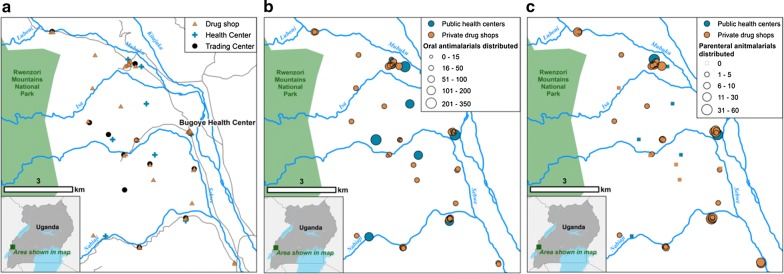
Malaria is a leading cause of paediatric morbidity and mortality in Uganda. More than half of febrile children in rural areas initially seek care at private clinics and drug shops. These shops are generally unregulated and the quality of clinical care is variable, with the potential for misdiagnosis and the development of drug resistance. There is thus an urgent need to identify rural drug shops and coordinate their malaria treatment efforts with those of the public sector. The objective of the study was to identify all drug shops in the Bugoye sub-county of Western Uganda and assess their anti-malarial dispensing practices.
This study is a cross-sectional survey of drug shops in a rural sub-county of Western Uganda. In the first phase, shop locations, licensing and shopkeeper's qualifications, and supply and pricing of anti-malarials were characterized. In the second phase, the proportion of anti-malarials dispensed by private drug shops was compared to public health facilities.
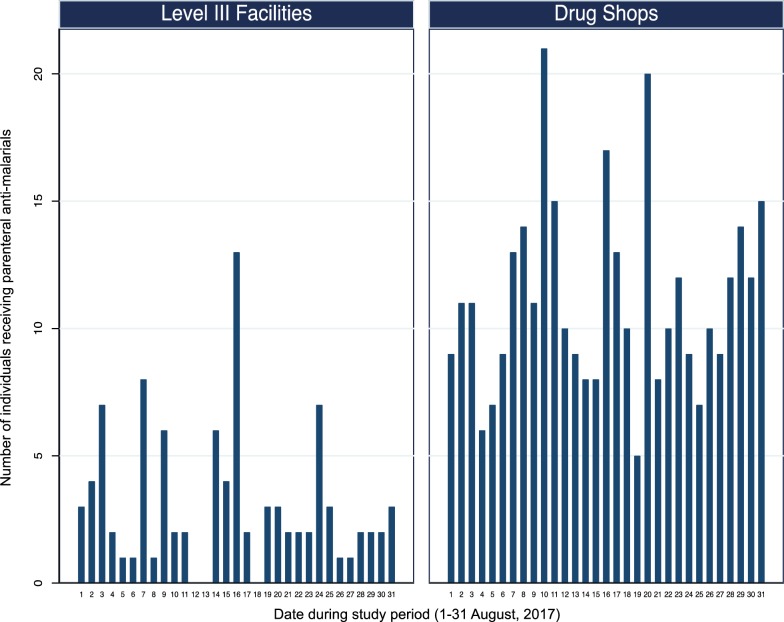
A total of 48 drug shops were identified. Only one drug shop (1 of 48, 2%) was licensed with the sub-county's records office. The drug shops stocked a variety of anti-malarials, including first-line therapies and less effective agents (e.g., sulfadoxine/pyrimethamine). Almost all drug shops (45 of 48, 94%) provided parenteral anti-malarials. Of the 3900 individuals who received anti-malarials during the study, 2080 (53.3%) purchased anti-malarials through the private sector compared to 1820 (46.7%) who obtained anti-malarials through the public sector. Drug shops were the primary source of parenteral anti-malarials. Inadequate dosing of anti-malarials was more common in drug shops.
Drug shops are major sources of parenteral anti-malarials, which should be reserved for cases of severe malaria. Strengthening malaria case management and incorporating drug shops in future interventions is necessary to optimize malaria control efforts in the sub-county, and in similarly endemic regions.
疟疾是乌干达儿童发病和死亡的主要原因之一。在农村地区,超过一半的发热儿童最初在私人诊所和药店就诊。这些商店通常不受监管,临床护理质量参差不齐,存在误诊和耐药性发展的风险。因此,迫切需要确定农村药店,并协调其与公共部门的疟疾治疗工作。本研究的目的是确定乌干达西部 Bugoye 次县的所有药店,并评估其抗疟药物配给情况。
这是一项对乌干达西部农村次县药店的横断面调查。在第一阶段,描述了药店的位置、许可证和店主的资格,以及抗疟药物的供应和定价。在第二阶段,比较了私人药店和公共卫生机构配给的抗疟药物比例。
共确定了 48 家药店。只有一家药店(48 家药店中的 1 家,占 2%)在次县记录办公室获得了许可证。药店库存了各种抗疟药物,包括一线治疗药物和效果较差的药物(如磺胺多辛/乙胺嘧啶)。几乎所有的药店(48 家药店中的 45 家,占 94%)都提供了注射用抗疟药物。在研究期间,3900 名接受抗疟药物治疗的人中,有 2080 人(53.3%)通过私营部门购买了抗疟药物,而 1820 人(46.7%)通过公共部门购买了抗疟药物。药店是注射用抗疟药物的主要来源。药店给药剂量不足的情况更为常见。
药店是注射用抗疟药物的主要来源,这些药物应留作严重疟疾病例使用。加强疟疾病例管理,并将药店纳入未来的干预措施中,对于优化次县乃至类似流行地区的疟疾控制工作是必要的。