Sundararajan Radhika, Mwanga-Amumpaire Juliet, Adrama Harriet, Tumuhairwe Jackline, Mbabazi Sheilla, Mworozi Kenneth, Carroll Ryan, Bangsberg David, Boum Yap, Ware Norma C
Am J Trop Med Hyg. 2015 May;92(5):933-940. doi: 10.4269/ajtmh.14-0784. Epub 2015 Mar 23.
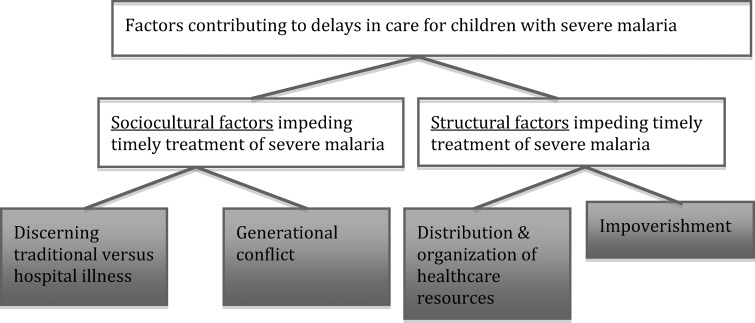
Malaria is a leading cause of pediatric mortality, and Uganda has among the highest incidences in the world. Increased morbidity and mortality are associated with delays to care. This qualitative study sought to characterize barriers to prompt allopathic care for children hospitalized with severe malaria in the endemic region of southwestern Uganda. Minimally structured, qualitative interviews were conducted with guardians of children admitted to a regional hospital with severe malaria. Using an inductive and content analytic approach, transcripts were analyzed to identify and define categories that explain delayed care. These categories represented two broad themes: sociocultural and structural factors. Sociocultural factors were 1) interviewee's distinctions of "traditional" versus "hospital" illnesses, which were mutually exclusive and 2) generational conflict, where deference to one's elders, who recommended traditional medicine, was expected. Structural factors were 1) inadequate distribution of health-care resources, 2) impoverishment limiting escalation of care, and 3) financial impact of illness on household economies. These factors perpetuate a cycle of illness, debt, and poverty consistent with a model of structural violence. Our findings inform a number of potential interventions that could alleviate the burden of this preventable, but often fatal, illness. Such interventions could be beneficial in similarly endemic, low-resource settings.
疟疾是儿童死亡的主要原因之一,乌干达是全球发病率最高的国家之一。发病率和死亡率的增加与就医延迟有关。这项定性研究旨在描述乌干达西南部疟疾流行地区患有严重疟疾的住院儿童接受及时对抗疗法治疗的障碍。对一家地区医院收治的患有严重疟疾儿童的监护人进行了结构松散的定性访谈。采用归纳和内容分析方法,对访谈记录进行分析,以确定和界定解释延迟治疗的类别。这些类别代表了两个广泛的主题:社会文化因素和结构因素。社会文化因素包括:1)受访者对“传统”疾病与“医院”疾病的区分,二者相互排斥;2)代际冲突,即期望听从推荐传统药物的长辈的意见。结构因素包括:1)医疗资源分配不足;2)贫困限制了治疗的升级;3)疾病对家庭经济的财务影响。这些因素使疾病、债务和贫困的循环持续存在,这与结构性暴力模式相符。我们的研究结果为一些可能减轻这种可预防但往往致命疾病负担的潜在干预措施提供了依据。此类干预措施在类似的疟疾流行、资源匮乏地区可能会有所帮助。