Department of Microbiology and Immunology, Peter Doherty Institute for Infection and Immunity, University of Melbourne, Melbourne, VIC, 3010, Australia.
Centre for Animal Biotechnology, Faculty of Veterinary and Agricultural Sciences, University of Melbourne, Melbourne, VIC, 3010, Australia.
Nat Commun. 2018 Aug 22;9(1):3350. doi: 10.1038/s41467-018-05202-8.
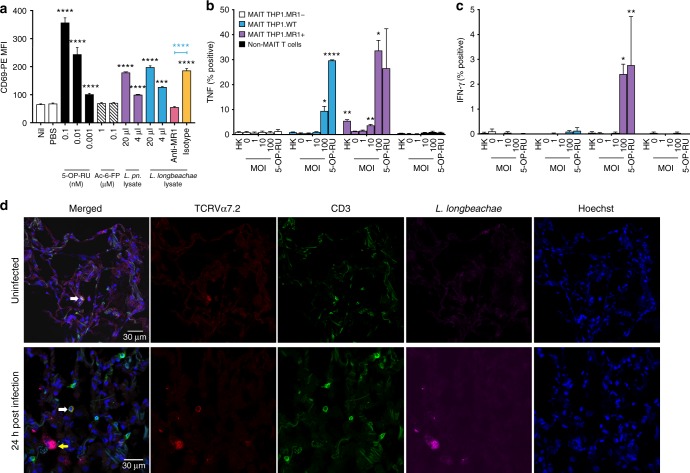
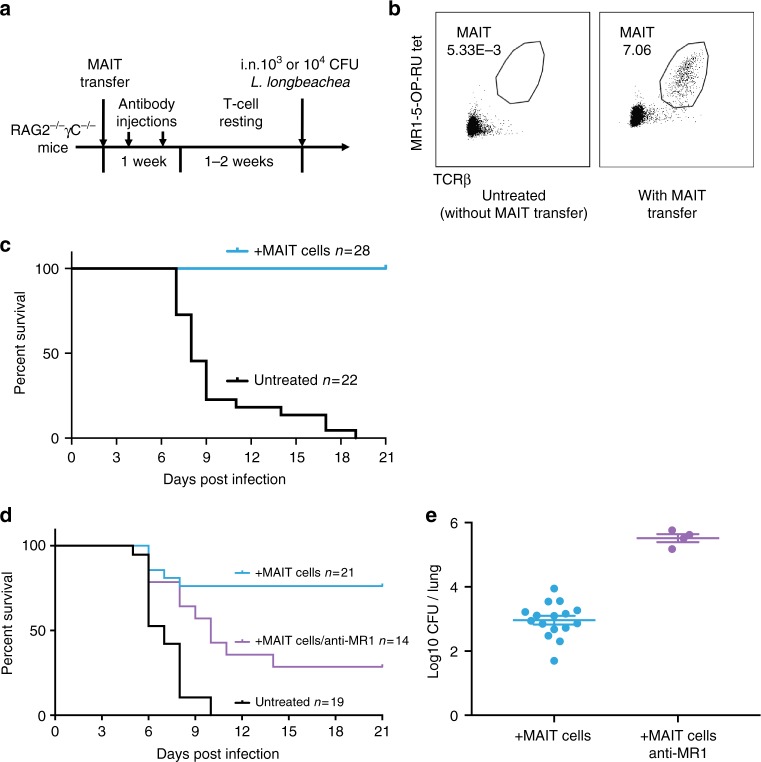
Mucosal associated invariant T (MAIT) cells recognise conserved microbial metabolites from riboflavin synthesis. Striking evolutionary conservation and pulmonary abundance implicate them in antibacterial host defence, yet their functions in protection against clinically important pathogens are unknown. Here we show that mouse Legionella longbeachae infection induces MR1-dependent MAIT cell activation and rapid pulmonary accumulation of MAIT cells associated with immune protection detectable in immunocompetent host animals. MAIT cell protection is more evident in mice lacking CD4 cells, and adoptive transfer of MAIT cells rescues immunodeficient Rag2γC mice from lethal Legionella infection. Protection is dependent on MR1, IFN-γ and GM-CSF, but not IL-17A, TNF or perforin, and enhanced protection is detected earlier after infection of mice antigen-primed to boost MAIT cell numbers before infection. Our findings define a function for MAIT cells in protection against a major human pathogen and indicate a potential role for vaccination to enhance MAIT cell immunity.
黏膜相关不变 T(MAIT)细胞识别来自核黄素合成的保守微生物代谢物。惊人的进化保守性和肺部丰富度暗示它们在抗细菌宿主防御中起作用,但它们在预防临床上重要的病原体方面的功能尚不清楚。在这里,我们表明,小鼠军团菌长滩感染诱导 MR1 依赖性 MAIT 细胞激活和 MAIT 细胞的快速肺部积累,这与免疫功能正常的宿主动物中可检测到的免疫保护有关。在缺乏 CD4 细胞的小鼠中,MAIT 细胞的保护作用更为明显,并且 MAIT 细胞的过继转移可使免疫缺陷 Rag2γC 小鼠免受致命的军团菌感染。保护作用依赖于 MR1、IFN-γ 和 GM-CSF,但不依赖于 IL-17A、TNF 或穿孔素,并且在感染前对 MAIT 细胞数量进行抗原预刺激以增强 MAIT 细胞免疫的感染小鼠中更早检测到增强的保护作用。我们的研究结果定义了 MAIT 细胞在预防主要人类病原体方面的作用,并表明接种疫苗增强 MAIT 细胞免疫的潜在作用。