Department of Surgery, Emory University, Atlanta, GA, United States.
Front Immunol. 2018 Aug 8;9:1810. doi: 10.3389/fimmu.2018.01810. eCollection 2018.
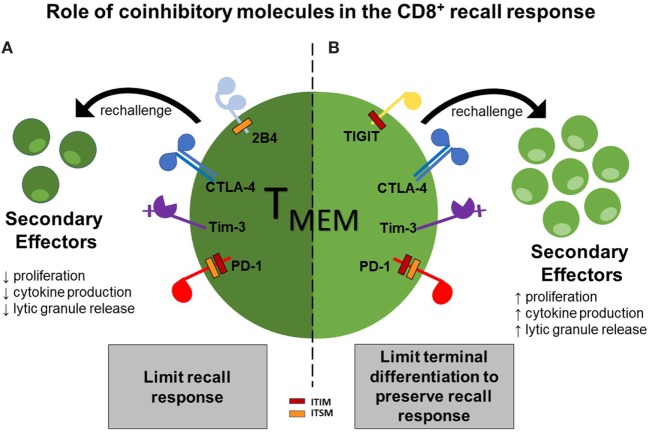
T cell co-signaling molecules play an important role in fine-tuning the strength of T cell activation during many types of immune responses, including infection, cancer, transplant rejection, and autoimmunity. Over the last few decades, intense research into these cosignaling molecules has provided rich evidence to suggest that cosignaling molecules may be harnessed for the treatment of immune-related diseases. In particular, coinhibitory molecules such as programmed-death 1, 2B4, BTLA, TIGIT, LAG-3, TIM-3, and CTLA-4 inhibit T cell responses by counteracting TCR and costimulatory signals, leading to the inhibition of proliferation and effector function and the downregulation of activation and adhesion molecules at the cell surface. While many reviews have focused on the role of coinhibitory molecules in modifying primary CD8 T cell responses, in this review, we will consider the complex role of coinhibitory molecules in altering CD8 T cell recall potential. As memory CD8 T cell responses are critical for protective memory responses in infection and cancer and contribute to potentially pathogenic memory responses in transplant rejection and autoimmunity, understanding the role of coinhibitory receptor control of memory T cells may illuminate important aspects of therapeutically targeting these pathways.
T 细胞共刺激分子在多种免疫反应(包括感染、癌症、移植排斥和自身免疫)中精细调节 T 细胞激活的强度方面发挥着重要作用。在过去的几十年中,对这些共刺激分子的深入研究提供了丰富的证据,表明可以利用共刺激分子来治疗与免疫相关的疾病。特别是,抑制性共刺激分子如程序性死亡受体 1、2B4、BTLA、TIGIT、LAG-3、TIM-3 和 CTLA-4 通过抵消 TCR 和共刺激信号来抑制 T 细胞反应,导致增殖和效应功能受到抑制,细胞表面的激活和黏附分子下调。虽然许多综述都集中在抑制性共刺激分子在调节初始 CD8 T 细胞反应中的作用,但在本综述中,我们将考虑抑制性共刺激分子在改变 CD8 T 细胞记忆潜能方面的复杂作用。由于记忆 CD8 T 细胞反应对于感染和癌症中的保护性记忆反应至关重要,并有助于移植排斥和自身免疫中的潜在致病性记忆反应,因此了解抑制性受体对记忆 T 细胞的控制作用可能阐明靶向这些途径的治疗方法的重要方面。