Kakizaki Toshikazu, Sakagami Hiroyuki, Sakimura Kenji, Yanagawa Yuchio
Department of Genetic and Behavioral Neuroscience, Gunma University Graduate School of Medicine, Maebashi 371-8511, Japan.
Department of Anatomy, Kitasato University School of Medicine, Sagamihara 228-8555, Japan.
IBRO Rep. 2017 Aug 8;3:9-16. doi: 10.1016/j.ibror.2017.07.002. eCollection 2017 Dec.
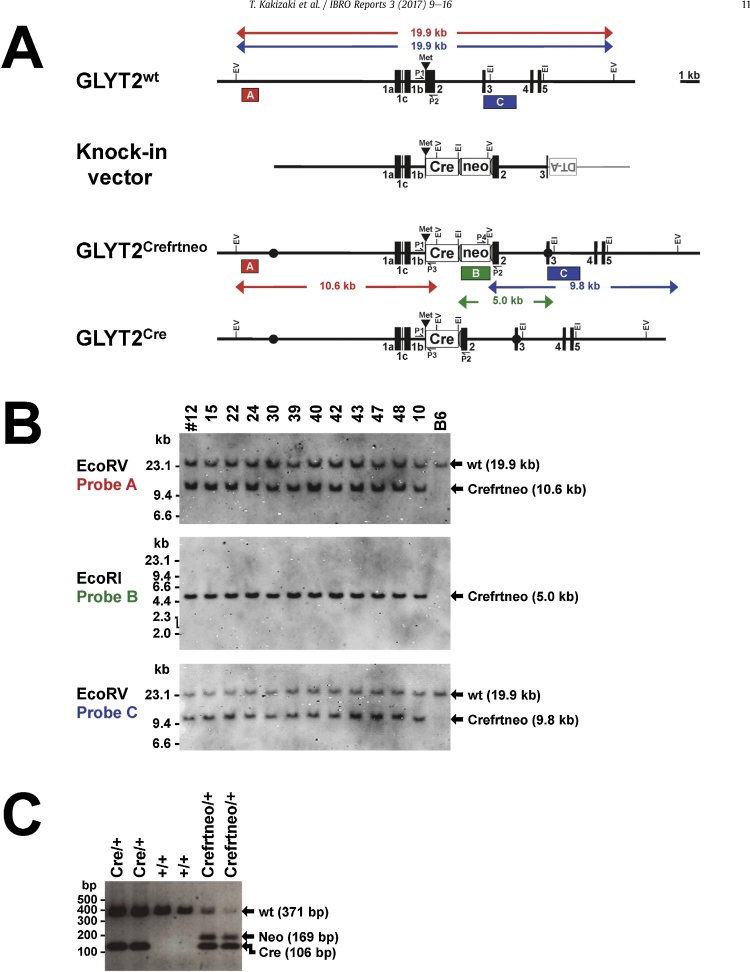
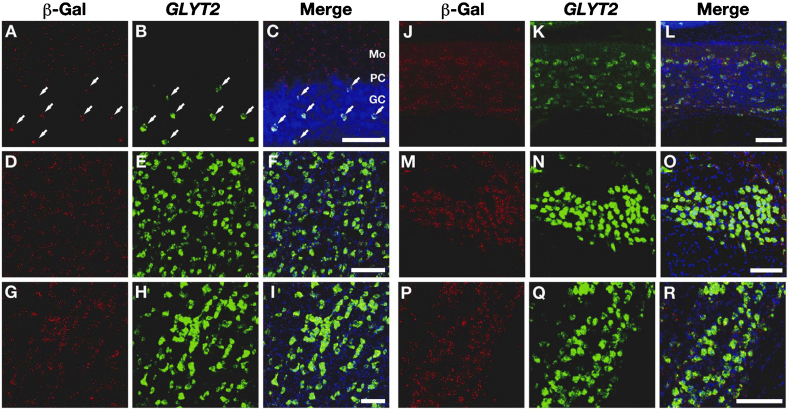
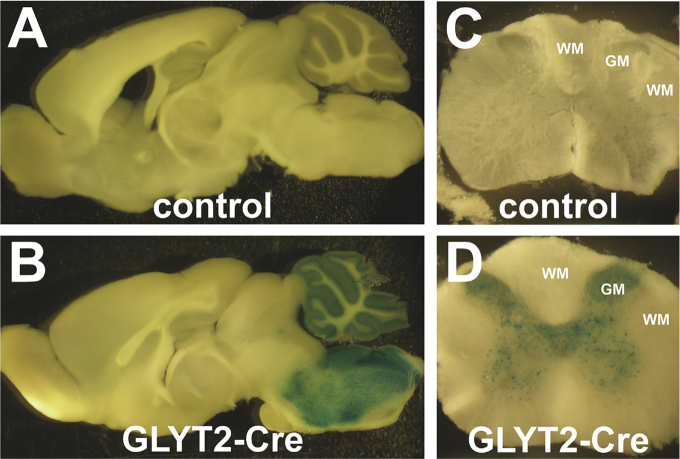
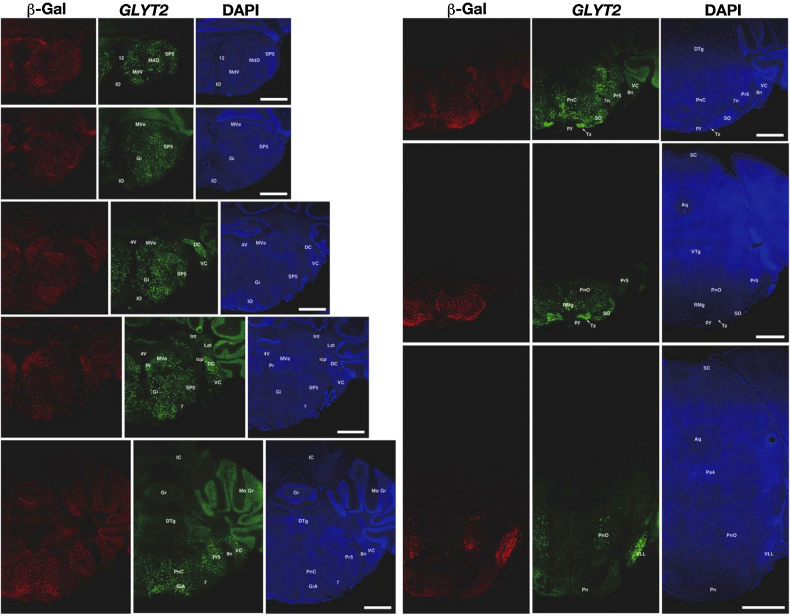
Glycine is an inhibitory neurotransmitter in the brainstem and spinal cord. Glycine transporter 2 (GLYT2) is responsible for the uptake of extracellular glycine. GLYT2 is specifically expressed in glycinergic neurons and thus has been used as a marker of glycinergic neurons. Here, we generated GLYT2 promotor-driven Cre recombinase (Cre)-expressing mice (GLYT2-Cre knock-in mice) to develop a tool for manipulating gene expression in glycinergic neurons. Cre activity was examined by crossing the GLYT2-Cre knock-in mice with a Cre reporter mouse line, R26R, which express β-galactosidase (β-gal) in a Cre-dependent manner. X-gal staining of GLYT2-Cre/R26R double transgenic mouse brains and spinal cords revealed that the Cre activity was primarily distributed in the brainstem, cerebellum, and spinal cord. These areas are rich in glycinergic neurons. Furthermore, we performed immunohistochemistry for β-gal combined with hybridization for GLYT2 in the GLYT2-Cre/R26R double transgenic mouse brains to determine whether Cre activity is specifically localized to glycinergic neurons. The β-gal protein and GLYT2 mRNAs were colocalized in the cerebellar Golgi cells, dorsal cochlear nucleus, gigantocellular reticular nucleus, spinal trigeminal nucleus, nucleus of the trapezoid body, and lateral lemniscus. More than 98% of the GLYT2 mRNA-expressing cells in these brain regions also expressed β-gal, whereas 90-98% of the β-gal-positive cells expressed the GLYT2 mRNAs. Thus, Cre activity is specifically localized to glycinergic neurons with high fidelity in the GLYT2-Cre knock-in mice. The GLYT2-Cre knock-in mouse line will be a useful tool for studying glycinergic neurons and neurotransmission.
甘氨酸是脑干和脊髓中的一种抑制性神经递质。甘氨酸转运体2(GLYT2)负责摄取细胞外甘氨酸。GLYT2在甘氨酸能神经元中特异性表达,因此一直被用作甘氨酸能神经元的标志物。在此,我们构建了GLYT2启动子驱动的表达Cre重组酶(Cre)的小鼠(GLYT2-Cre敲入小鼠),以开发一种用于操纵甘氨酸能神经元中基因表达的工具。通过将GLYT2-Cre敲入小鼠与Cre报告基因小鼠品系R26R杂交来检测Cre活性,R26R以Cre依赖性方式表达β-半乳糖苷酶(β-gal)。对GLYT2-Cre/R26R双转基因小鼠的脑和脊髓进行X-gal染色,结果显示Cre活性主要分布在脑干、小脑和脊髓。这些区域富含甘氨酸能神经元。此外,我们在GLYT2-Cre/R26R双转基因小鼠的脑中进行了β-gal免疫组织化学结合GLYT2杂交,以确定Cre活性是否特异性定位于甘氨酸能神经元。β-gal蛋白和GLYT2 mRNA在小脑高尔基细胞、蜗背侧核、巨细胞网状核、三叉神经脊束核、斜方体核和外侧丘系中共同定位。这些脑区中超过98%表达GLYT2 mRNA的细胞也表达β-gal,而90 - 98%的β-gal阳性细胞表达GLYT2 mRNA。因此,在GLYT2-Cre敲入小鼠中,Cre活性以高保真度特异性定位于甘氨酸能神经元。GLYT2-Cre敲入小鼠品系将成为研究甘氨酸能神经元和神经传递的有用工具。