Dahiya A S, Boubenia S, Franzo G, Poulin-Vittrant G, Mirabella S, Alquier D
GREMAN UMR 7347 Université de Tours, CNRS, INSA Centre Val de Loire, 16 rue Pierre et Marie Curie, 37071, Tours CEDEX2, France.
MATIS IMM-CNR and Dipartimento di Fisica e Astronomia, Universita' di Catania, via S. Sofia 64, 95123, Catania, Italy.
Nanoscale Res Lett. 2018 Aug 22;13(1):249. doi: 10.1186/s11671-018-2665-4.
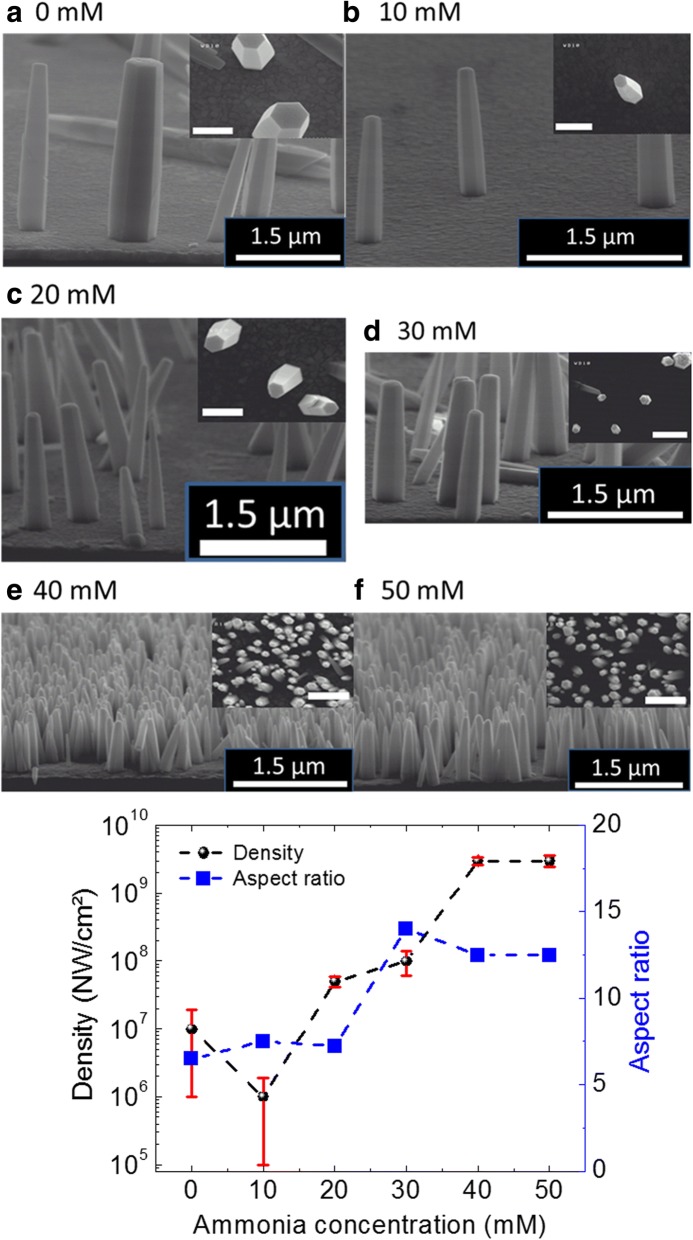
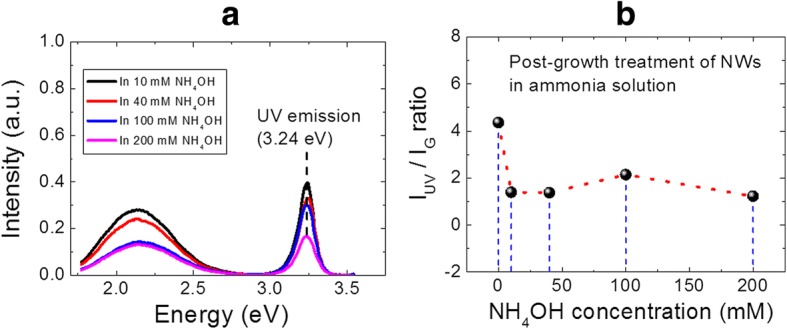
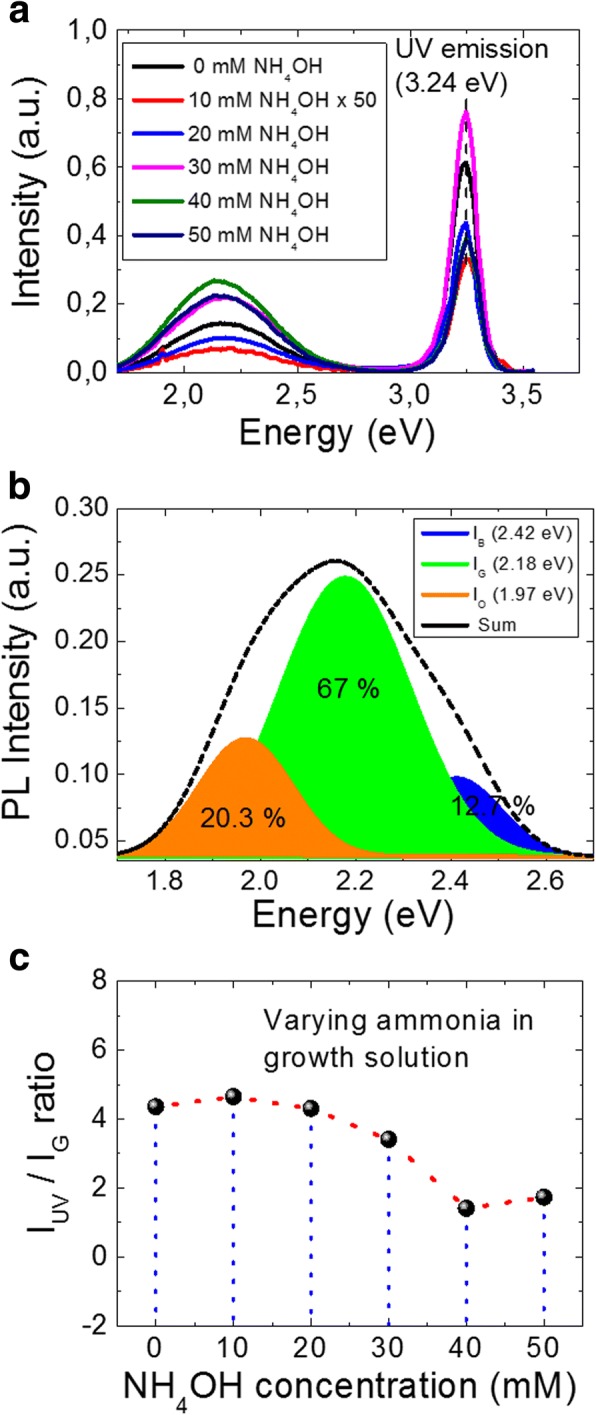
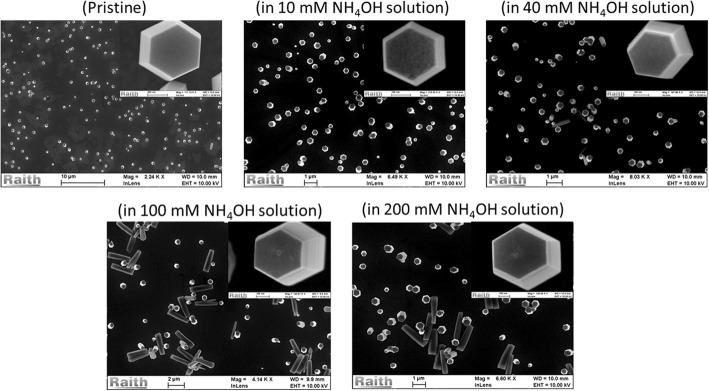
We report the influence of ammonium hydroxide (NHOH), as growth additive, on zinc oxide nanomaterial through the optical response obtained by photoluminescence (PL). A low-temperature hydrothermal process is employed for the growth of ZnO nanowires (NWs) on seedless Au surface. A more than two order of magnitude change in ZnO NW density is demonstrated via careful addition of NHOH in the growth solution. Further, we show by systematic experimental study and PL characterization data that the addition of NHOH can degrade the optical response of ZnO NWs produced. The increase of growth solution basicity with the addition of NHOH may slowly degrade the optical response of NWs by slowly etching its surfaces, increasing the point defects in ZnO NWs. The present study demonstrates the importance of growth nutrients to obtain quality controlled density tunable ZnO NWs on seedless conducting substrates.
我们通过光致发光(PL)获得的光学响应,报道了作为生长添加剂的氢氧化铵(NHOH)对氧化锌纳米材料的影响。采用低温水热法在无籽金表面生长氧化锌纳米线(NWs)。通过在生长溶液中小心添加NHOH,氧化锌NW密度出现了超过两个数量级的变化。此外,我们通过系统的实验研究和PL表征数据表明,添加NHOH会降低所制备的氧化锌NWs的光学响应。随着NHOH的添加,生长溶液碱度的增加可能会通过缓慢蚀刻其表面,增加氧化锌NWs中的点缺陷,从而缓慢降低NWs的光学响应。本研究证明了生长营养物质对于在无籽导电基底上获得质量可控、密度可调的氧化锌NWs的重要性。