Zhang Bao-Liang, Fan Yue-Shan, Wang Ji-Wei, Zhou Zi-Wei, Wu Yin-Gang, Yang Meng-Chen, Sun Dong-Dong, Zhang Jian-Ning
Department of Neurosurgery, Tianjin Medical University General Hospital; Tianjin Neurological Institute; Key Laboratory of Post-trauma Neuro-repair and Regeneration in Central Nervous System, Ministry of Education; Tianjin Key Laboratory of Injuries, Variations and Regeneration of Nervous System, Tianjin, China.
Neural Regen Res. 2018 Oct;13(10):1753-1758. doi: 10.4103/1673-5374.238618.
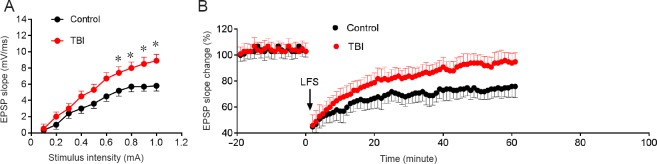
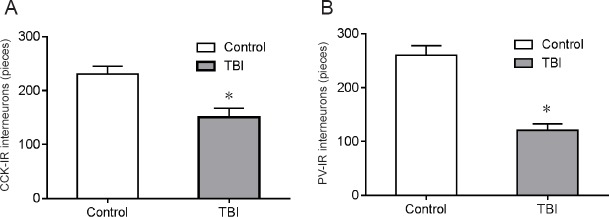
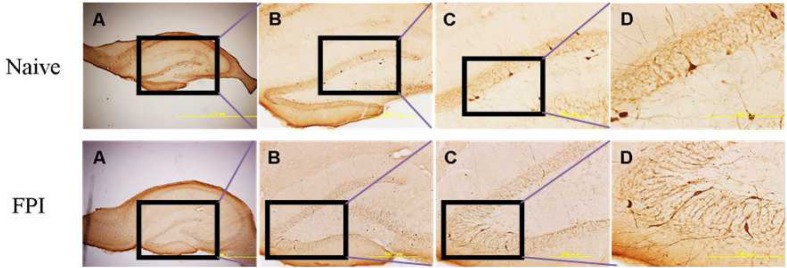
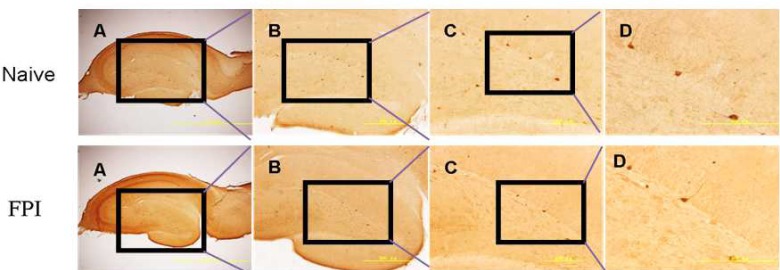
Traumatic brain injury can cause loss of neuronal tissue, remote symptomatic epilepsy, and cognitive deficits. However, the mechanisms underlying the effects of traumatic brain injury are not yet clear. Hippocampal excitability is strongly correlated with cognitive dysfunction and remote symptomatic epilepsy. In this study, we examined the relationship between traumatic brain injury-induced neuronal loss and subsequent hippocampal regional excitability. We used hydraulic percussion to generate a rat model of traumatic brain injury. At 7 days after injury, the mean modified neurological severity score was 9.5, suggesting that the neurological function of the rats was remarkably impaired. Electrophysiology and immunocytochemical staining revealed increases in the slope of excitatory postsynaptic potentials and long-term depression (indicating weakened long-term inhibition), and the numbers of cholecystokinin and parvalbumin immunoreactive cells were clearly reduced in the rat hippocampal dentate gyrus. These results indicate that interneuronal loss and changes in excitability occurred in the hippocampal dentate gyrus. Thus, traumatic brain injury-induced loss of interneurons appears to be associated with reduced long-term depression in the hippocampal dentate gyrus.
创伤性脑损伤可导致神经元组织丧失、远隔症状性癫痫和认知缺陷。然而,创伤性脑损伤影响的潜在机制尚不清楚。海马兴奋性与认知功能障碍和远隔症状性癫痫密切相关。在本研究中,我们研究了创伤性脑损伤诱导的神经元丢失与随后海马区域兴奋性之间的关系。我们使用液压冲击法建立了创伤性脑损伤大鼠模型。损伤后7天,平均改良神经功能严重程度评分为9.5,表明大鼠神经功能明显受损。电生理学和免疫细胞化学染色显示,大鼠海马齿状回兴奋性突触后电位的斜率和长时程抑制(表明长期抑制减弱)增加,胆囊收缩素和小白蛋白免疫反应性细胞数量明显减少。这些结果表明,海马齿状回发生了中间神经元丢失和兴奋性变化。因此,创伤性脑损伤诱导的中间神经元丢失似乎与海马齿状回长时程抑制的降低有关。