Department of Medical Oncology, Sapporo Medical University School of Medicine, Sapporo, Japan.
Department of Community Medicine for Gastroenterology and Oncology, Tokushima University Graduate School of Biomedical Sciences, Tokushima, Japan.
Cancer Sci. 2018 Nov;109(11):3554-3563. doi: 10.1111/cas.13772. Epub 2018 Sep 25.
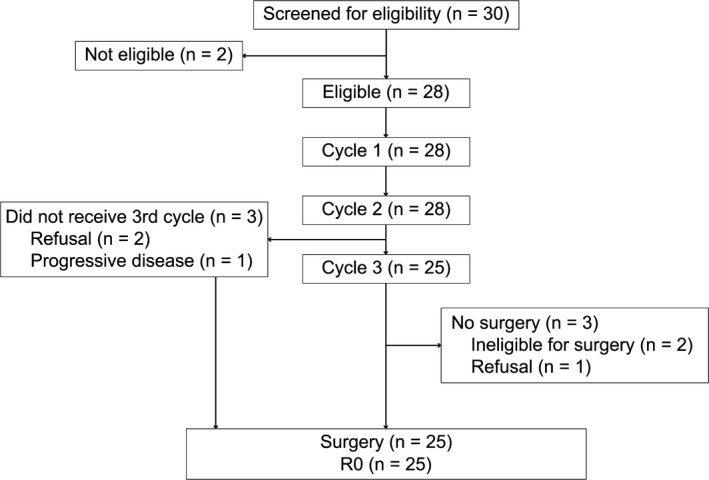
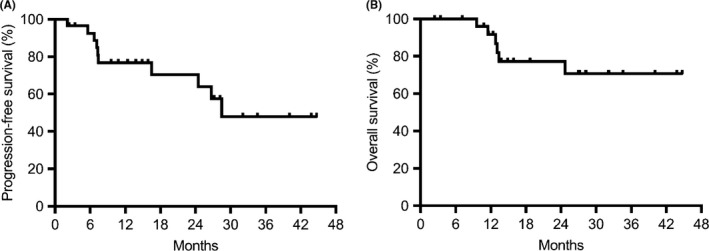
Cisplatin plus 5-fluorouracil is regarded as standard neoadjuvant chemotherapy for esophageal squamous cell carcinoma (ESCC) in Japan, but the prognosis remains poor. We have previously described how definitive chemoradiotherapy with docetaxel, nedaplatin, and 5-fluorouracil (DNF) led to a very high response rate and promising survival times. We therefore undertook a phase II trial to evaluate the feasibility and efficacy of neoadjuvant DNF. The study included patients with clinical stage Ib-III ESCC. Chemotherapy consisted of i.v. docetaxel (30 mg/m ) and nedaplatin (50 mg/m ) on days 1 and 8, and a continuous infusion of 5-fluorouracil (400 mg/m /day) on days 1-5 and 8-12, every 3 weeks. After three courses of chemotherapy, esophagectomy was carried out. The primary end-point was the completion rate of the protocol treatment. Twenty-eight patients were enrolled (cStage Ib/II/III, 2/3/23) and all received at least two cycles of chemotherapy. Twenty-five patients underwent surgery, all of whom achieved an R0 resection, leading to a completion rate of 89.3%. The overall response rate was 87.0%. A pathological complete response was confirmed in eight (32.0%) cases. Grade 3/4 adverse events included leukopenia (32.1%), neutropenia (39.3%), febrile neutropenia (10.7%), thrombocytopenia (10.7%), and diarrhea (14.3%), but were manageable. Treatment-related deaths and major surgical complications did not occur. Estimated 2-year progression-free and overall survival rates were 70.4% and 77.2%, respectively. Thus, DNF therapy was well tolerated and deemed feasible, with a strong tumor response in a neoadjuvant setting for ESCC. This trial is registered with the University Hospital Medical Information Network (UMIN ID: 000014305).
顺铂联合 5-氟尿嘧啶被认为是日本食管鳞状细胞癌(ESCC)的标准新辅助化疗方案,但预后仍较差。我们之前描述了多西他赛、奈达铂和 5-氟尿嘧啶(DNF)的根治性放化疗如何导致非常高的缓解率和有希望的生存时间。因此,我们进行了一项 II 期临床试验,以评估新辅助 DNF 的可行性和疗效。该研究纳入了临床分期 Ib-III 期 ESCC 患者。化疗包括静脉注射多西他赛(30mg/m )和奈达铂(50mg/m ),于第 1 天和第 8 天;5-氟尿嘧啶(400mg/m /天)持续输注,于第 1-5 天和第 8-12 天,每 3 周一次。三个疗程化疗后行食管切除术。主要终点是方案治疗的完成率。共纳入 28 例患者(cStage Ib/II/III,2/3/23),所有患者均至少接受了两个周期的化疗。25 例患者接受了手术,均达到了 R0 切除,完成率为 89.3%。总体缓解率为 87.0%。8 例(32.0%)患者病理完全缓解。3/4 级不良事件包括白细胞减少(32.1%)、中性粒细胞减少(39.3%)、发热性中性粒细胞减少(10.7%)、血小板减少(10.7%)和腹泻(14.3%),但均可控。无治疗相关死亡和重大手术并发症。预计 2 年无进展生存率和总生存率分别为 70.4%和 77.2%。因此,DNF 治疗具有良好的耐受性和可行性,在 ESCC 的新辅助治疗中具有较强的肿瘤反应。本试验在大学医院医疗信息网络(UMIN ID:000014305)注册。