
可手术食管癌个体化新辅助治疗模式的探索:一项监测、流行病学和最终结果数据库分析
Exploration of individualized neoadjuvant therapy model for operable esophageal cancer: A Surveillance, Epidemiology, and End Results database analysis.
作者信息
Zhou Xingyu, Xue Jiao, Chen Long, Qin Songbin, Zhao Qi
机构信息
Department of Radiation Oncology The First Affiliated Hospital of Soochow University Suzhou China.
出版信息
Precis Radiat Oncol. 2024 Dec 8;8(4):218-226. doi: 10.1002/pro6.1249. eCollection 2024 Dec.
PURPOSE
This study aimed to examine the individualized neoadjuvant therapies for operable esophageal cancer.
METHODS AND MATERIALS
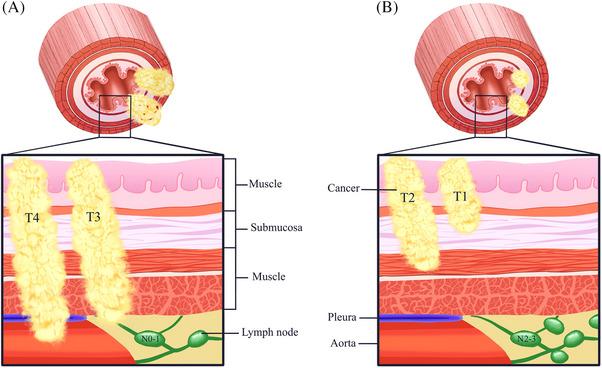
Data of 95,444 patients diagnosed with esophageal cancer between 2010 and 2017 were collected from the Surveillance, Epidemiology, and End Results database. The effectiveness of neoadjuvant chemoradiotherapy (nCRT), neoadjuvant chemotherapy (nCT), and surgery alone was compared in patients with stage II esophageal cancer. Patients with stage III disease were divided into "local invasive type" group (type I, T3N1M0, T4N0-1M0) and "regional metastatic type" group (type II, T1-2N2-3M0) according to the tumor invasion pattern. The effectiveness of nCRT and nCT in different patterns was compared.
RESULTS
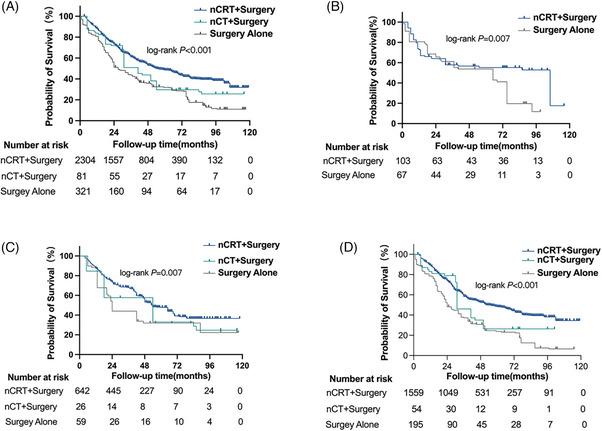
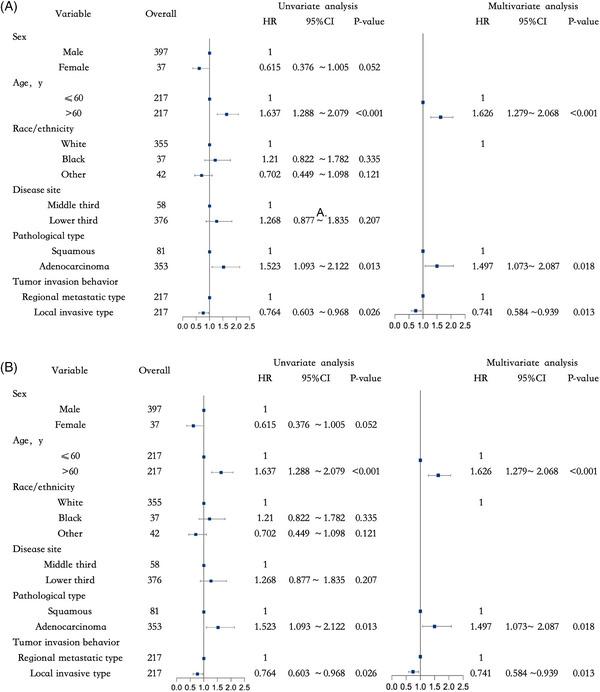
In 2,706 patients with stage II disease, a statistical difference was observed in the overall survival (OS) between nCRT (85.1%), nCT (3.0%), and surgery alone (11.9%, , median OS (mOS): 54 vs 41 vs 24 months). Meanwhile, 3,303 patients with stage III disease who received nCRT were included in the propensity score matching. A statistical difference was observed in the OS between "Type I" ( = 217) and "Type II" ( = 217, , mOS: 45 VS 28 months). Among 93 patients with stage III receiving nCT, those with "Type II" (23.7%) showed a greater potential benefit from nCT than those with "Type I" (76.3%, , mOS: 51 vs 40 months).
CONCLUSIONS
nCRT is recommended for stage II esophageal cancer. In patients with stage III, those with "local invasive type" may greatly benefit from nCRT, while those with "regional metastatic type" may greatly benefit from nCT.
目的
本研究旨在探讨可手术食管癌的个体化新辅助治疗方法。
方法和材料
从监测、流行病学和最终结果数据库中收集了2010年至2017年间诊断为食管癌的95444例患者的数据。比较了新辅助放化疗(nCRT)、新辅助化疗(nCT)和单纯手术在II期食管癌患者中的疗效。III期患者根据肿瘤侵犯模式分为“局部浸润型”组(I型,T3N1M0,T4N0 - 1M0)和“区域转移型”组(II型,T1 - 2N2 - 3M0)。比较了不同模式下nCRT和nCT的疗效。
结果
在2706例II期患者中,观察到nCRT(85.1%)、nCT(3.0%)和单纯手术(11.9%,中位总生存期(mOS):54个月vs 41个月vs 24个月)之间的总生存期(OS)存在统计学差异。同时,3303例接受nCRT的III期患者被纳入倾向评分匹配。观察到“I型”(= 217)和“II型”(= 217,mOS:45个月VS 28个月)之间的OS存在统计学差异。在93例接受nCT的III期患者中,“II型”患者(23.7%)从nCT中获得的潜在益处大于“I型”患者(76.3%,mOS:51个月vs 40个月)。
结论
推荐对II期食管癌采用nCRT。在III期患者中,“局部浸润型”患者可能从nCRT中获益巨大,而“区域转移型”患者可能从nCT中获益巨大。

 Zotero 插件