Crook Sarah, Büsching Gilbert, Keusch Stephan, Wieser Stephan, Turk Alexander, Frey Martin, Puhan Milo A, Frei Anja
Department of Epidemiology, Epidemiology, Biostatistics and Prevention Institute, University of Zurich, Zurich, Switzerland,
Pulmonary Rehabilitation, Klinik Barmelweid, Barmelweid, Switzerland.
Int J Chron Obstruct Pulmon Dis. 2018 Jul 18;13:2199-2206. doi: 10.2147/COPD.S156986. eCollection 2018.
Evidence from longitudinal studies on the impact of exacerbation symptoms on physical activity in chronic obstructive pulmonary disease (COPD) is lacking. The aim of this first exploratory study was to assess the association between exacerbation symptoms and physical activity, and to quantify the relative influence of specific symptoms.
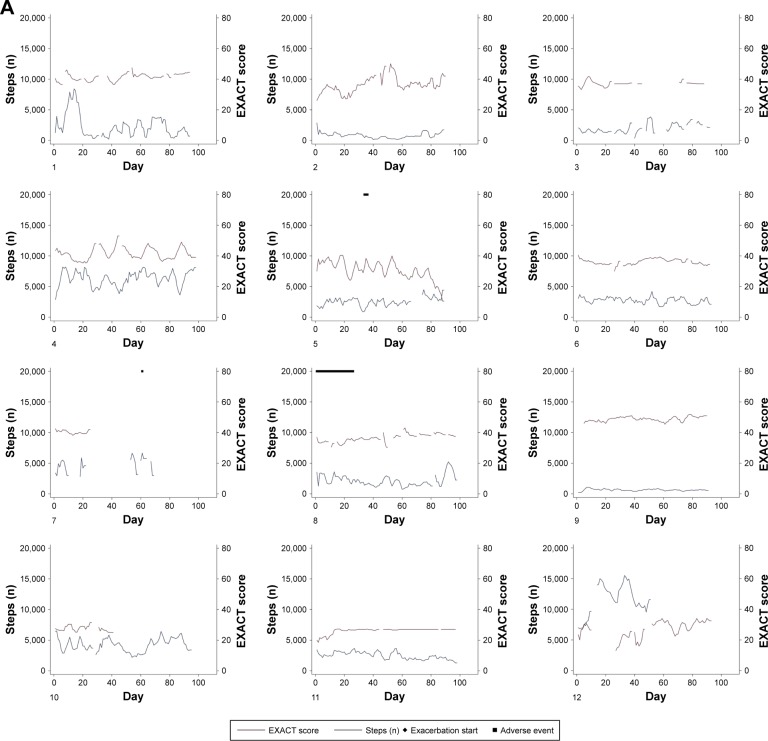
We recruited COPD patients at high risk for exacerbations from 2 pulmonary rehabilitation clinics and 1 acute care clinic in Switzerland. For 3 months after discharge, patients completed a daily symptom diary on a smartphone application, the EXAcerbations of Chronic pulmonary disease Tool (EXACT), and wore a pedometer to measure daily steps. We used mixed-effects models to determine the association of daily steps with exacerbation symptoms.
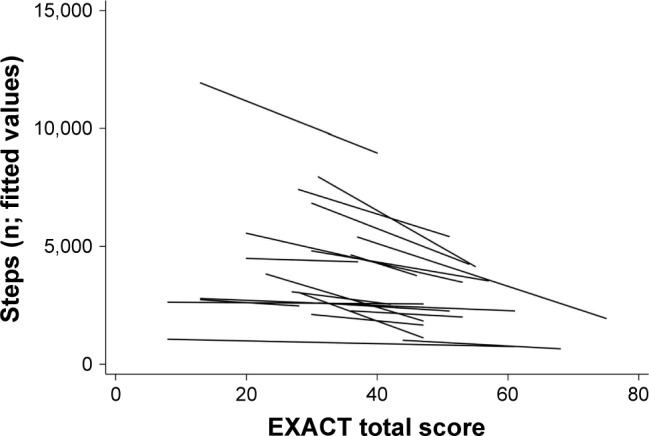
A total of 21 patients (Global Initiative for Chronic Obstructive Lung Disease grades 2-4) were enrolled for a mean of 94.4 days (standard deviation 4.2). The baseline median number of daily steps was 3,264.6 (interquartile range [IQR]: 1,851.3-4,784.1) and EXACT score was 37.0 (IQR: 30.9-41.4). A 12-point increase in EXACT score (indicating the start of an exacerbation) was statistically significantly associated with a decrease in daily steps of 653.3 (95% CI 969.7-336.9). Chest symptoms (tightness, discomfort and congestion) were more strongly associated with change in steps than breathlessness, and cough and sputum (-value -4.5 vs -2.9 and -3.0).
This is the first study to show that, in a small cohort of COPD patients, increases in exacerbation symptoms were associated with a statistically and clinically significant reduction in daily physical activity. These results underscore the importance for symptom control and exacerbation prevention in COPD patients.
关于慢性阻塞性肺疾病(COPD)急性加重症状对身体活动影响的纵向研究证据不足。这项首次探索性研究的目的是评估急性加重症状与身体活动之间的关联,并量化特定症状的相对影响。
我们从瑞士的2家肺康复诊所和1家急性护理诊所招募了急性加重风险较高的COPD患者。出院后3个月,患者通过智能手机应用程序“慢性肺病急性加重工具”(EXACT)完成每日症状日记,并佩戴计步器测量每日步数。我们使用混合效应模型来确定每日步数与急性加重症状之间的关联。
共纳入21例患者(慢性阻塞性肺疾病全球倡议分级为2-4级),平均随访94.4天(标准差4.2)。每日步数的基线中位数为3264.6(四分位间距[IQR]:1851.3-4784.1),EXACT评分为37.0(IQR:30.9-41.4)。EXACT评分增加12分(表明急性加重开始)与每日步数减少653.3显著相关(95%CI 969.7-336.9)。胸部症状(紧绷、不适和充血)与步数变化的关联比呼吸困难、咳嗽和咳痰更强(P值为-4.5 vs -2.9和-3.0)。
这是第一项表明,在一小群COPD患者中,急性加重症状增加与每日身体活动在统计学和临床上显著减少相关的研究。这些结果强调了COPD患者症状控制和急性加重预防的重要性。