Yoo Jinil, Villanueva Hugo, Kaliamurthy Manimaran, Kang John, Lwin Lin
Montefiore Medical Center, Wakefield Campus, Bronx, NY, USA.
New York Medical College, Metropolitan Hospital, New York, NY, USA.
Case Rep Nephrol. 2018 Jul 24;2018:6746473. doi: 10.1155/2018/6746473. eCollection 2018.
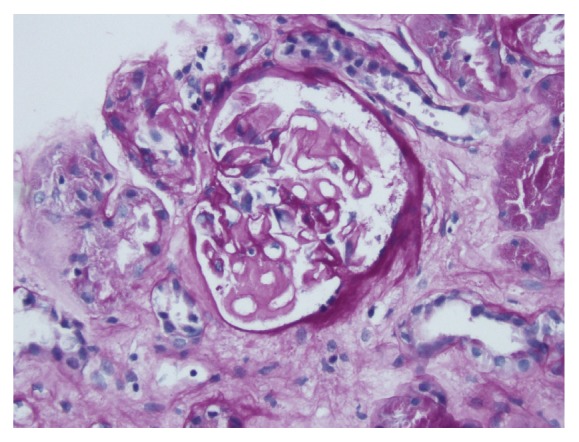
Antiphospholipid antibody syndrome (APS) may occur in a primary form or in association with SLE and seldom presents with nephrotic syndrome (NS). We present a case with APS who developed recurrent NS 6 years apart. The first episode of NS occurred with biopsy findings consistent with lupus nephritis (LN) class V (membranous) with no clear evidence of SLE, and responded to a remission with steroids and MMF. On the 2 episode, the biopsy revealed negative immunofluorescent (IF) study for immune complexes and EM findings of complete effacement of foot processes and acellular debris in thickened capillary walls, compatible with healed previous episode of membranous LN and minimal change disease (MCD), a nonimmune complex podocytopathy. The 2 episode responded to a partial remission, primarily with a short-term steroid therapy, and subsequently developed serologic evidence of SLE. Now there is growing evidence that a subset of SLE patients with NS are found to have MCD, likely due to podocyte injury caused by nonimmune complex pathway, called lupus podocytopathy. In LN, serial kidney biopsies often show transformation from one to another class of immune complex-induced glomerular lesions; however there are rare reports describing transformation of an immune complex to a nonimmune complex LN. Since the pathogenic mechanism of lupus podocytopathy is not delineated, and so far there are no reports on transformation of membranous LN, an immune complex nephropathy, to a nonimmune complex lupus podocytopathy, it still remains as a question whether our case with APS overlapping SLE had a concomitant membranous LN and lupus podocytopathy, or consequential membranous LN and lupus podocytopathy 6 years apart.
抗磷脂抗体综合征(APS)可呈原发性形式出现,或与系统性红斑狼疮(SLE)相关,很少表现为肾病综合征(NS)。我们报告一例APS患者,其肾病综合征复发间隔6年。首次肾病综合征发作时,活检结果符合狼疮性肾炎(LN)V型(膜性),但无明确的SLE证据,经类固醇和霉酚酸酯治疗后缓解。第二次发作时,活检显示免疫复合物免疫荧光(IF)研究阴性,电镜检查发现足突完全消失,增厚的毛细血管壁有细胞外碎片,符合既往膜性LN发作愈合及微小病变病(MCD),一种非免疫复合物性足细胞病。第二次发作经短期类固醇治疗后部分缓解,随后出现SLE的血清学证据。现在越来越多的证据表明,一部分患有NS的SLE患者被发现患有MCD,可能是由于非免疫复合物途径导致的足细胞损伤,称为狼疮性足细胞病。在LN中,系列肾脏活检常显示从一类免疫复合物诱导的肾小球病变转变为另一类;然而,很少有报告描述免疫复合物性LN转变为非免疫复合物性LN。由于狼疮性足细胞病的致病机制尚未明确,且迄今为止尚无膜性LN(一种免疫复合物性肾病)转变为非免疫复合物性狼疮性足细胞病的报告,我们这位APS重叠SLE的患者是同时患有膜性LN和狼疮性足细胞病,还是间隔6年先后出现膜性LN和狼疮性足细胞病,仍然是个问题。