Lord Justin, Davlyatov Ganisher, Thomas Kali S, Hyer Kathryn, Weech-Maldonado Robert
1 Louisiana State University Shreveport, USA.
2 The University of Alabama at Birmingham, USA.
Inquiry. 2018 Jan-Dec;55:46958018793285. doi: 10.1177/0046958018793285.
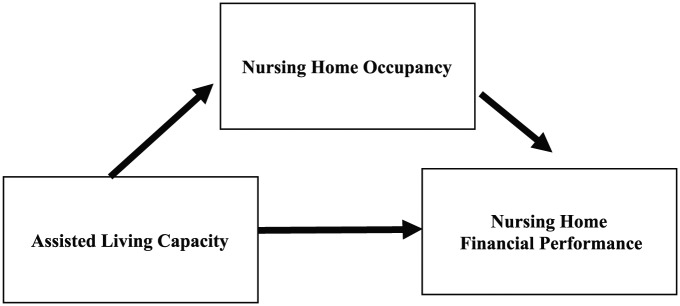
The rapid growth of the assisted living industry has coincided with decreased levels of nursing home occupancy and financial performance. The purpose of this article is to examine the relationships among assisted living capacity, nursing home occupancy, and nursing home financial performance. In addition, we explore whether the relationship between assisted living capacity and nursing home financial performance is mediated by nursing home occupancy. This research utilized publicly available secondary data, for the state of Florida from 2003 through 2015. General descriptive statistics were used to assess the relationships among financial performance, assisted living capacity, and occupancy. To explore the relationships among financial performance, assisted living capacity and occupancy, and test potential mediation of occupancy, we followed Baron and Kenny's approach and estimated 3 models examining the relationships between (1) assisted living capacity and nursing home financial performance, (2) assisted living capacity and nursing home occupancy, and (3) nursing home occupancy and financial performance after assisted living capacity is included in the model. We used generalized estimating equations, to adjust for repeated measures and to model the above relationships. Year fixed effects control for time trend. The independent variable, assisted living beds, was lagged for 1 year to account for the potential influence on financial performance. The final analytic sample consisted of 7688 nursing home-year observations from 657 unique nursing homes. Our findings suggest that assisted living capacity does have a negative impact on nursing homes' financial performance. Even though, assisted living capacity seems not to significantly decrease nursing home occupancy. The relationship between assisted living capacity and financial performance was not mediated through occupancy. These findings suggest that assisted living communities may not be able to significantly reduce nursing home occupancy; however, the presence of assisted living communities may create additional financial/competitive pressures that result in decreased nursing home financial performance.
辅助生活行业的快速发展与养老院入住率及财务表现的下降同时出现。本文旨在研究辅助生活容量、养老院入住率和养老院财务表现之间的关系。此外,我们还探讨了辅助生活容量与养老院财务表现之间的关系是否通过养老院入住率来介导。本研究利用了2003年至2015年佛罗里达州公开可得的二手数据。使用一般描述性统计来评估财务表现、辅助生活容量和入住率之间的关系。为了探究财务表现、辅助生活容量和入住率之间的关系,并检验入住率的潜在中介作用,我们采用了巴伦和肯尼的方法,估计了3个模型,分别检验(1)辅助生活容量与养老院财务表现之间的关系,(2)辅助生活容量与养老院入住率之间的关系,以及(3)在模型中纳入辅助生活容量后养老院入住率与财务表现之间的关系。我们使用广义估计方程来调整重复测量,并对上述关系进行建模。年份固定效应控制时间趋势。自变量辅助生活床位滞后1年,以考虑对财务表现的潜在影响。最终分析样本包括来自657家独特养老院的7688个养老院年度观察值。我们的研究结果表明,辅助生活容量确实对养老院的财务表现有负面影响。尽管如此,辅助生活容量似乎并没有显著降低养老院的入住率。辅助生活容量与财务表现之间的关系并非通过入住率来介导。这些研究结果表明,辅助生活社区可能无法显著降低养老院的入住率;然而,辅助生活社区的存在可能会带来额外的财务/竞争压力,导致养老院财务表现下降。