Division of Endocrinology and Metabolism, Department of Internal Medicine, Yeungnam College of Medicine, Daegu, Republic of Korea.
PLoS One. 2018 Aug 24;13(8):e0202757. doi: 10.1371/journal.pone.0202757. eCollection 2018.
Low urine pH (UpH) and high serum uric acid are considered evidence of metabolic disorders. The effect of low UpH on the development of metabolic syndrome (MetS) is less clear than that of high serum uric acid. We investigated the association between low UpH on the development of MetS and its components: central obesity, dyslipidemia, hypertension, and dysglycemia.
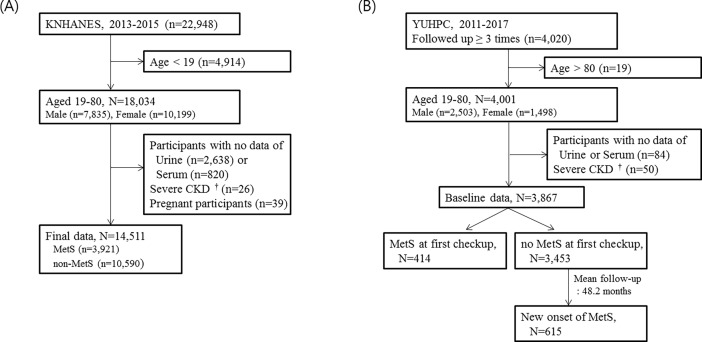
Two studies were conducted based on 2 datasets. The cross-sectional study included 14,511 subjects aged 19-80 years, based on the Korea National Health and Nutrition Examination Survey in 2013-2015. The retrospective cohort study included 3,453 subjects aged 19-80 years without MetS at the first checkup, who underwent at least 3 health checkups at a single tertiary hospital between 2011 and 2017. UpH was measured using an automatic urine analyzer in the range of 5.0-9.0 at first visit.
In the cross-sectional study, low UpH (= 5.0) was associated with the prevalence of MetS (odds ratio [OR] = 1.480, 95% confidence interval [CI] 1.334-1.643, p<0.001), particularly central obesity, dyslipidemia, and dysglycemia (OR ranges 1.282-1.422, p<0.001, all). In the retrospective cohort study, compared with the highest UpH subgroup, the lowest UpH subgroup (= 5.0) was associated with higher risk of MetS development (hazard ratio = 1.394, 95% CI 1.096-1.772, p = 0.007). The incident risk of MetS increased from the highest to lowest UpH subgroups (p for trend = 0.020), among which dyslipidemia and dysglycemia increased (p for trend <0.01, all).
Low UpH can be used as a surrogate marker of MetS and affects the development of MetS, associative with the increase of dyslipidemia and dysglycemia in those without MetS. If UpH is ≤5.0, efforts to prevent metabolic disorders are warranted.
低尿 pH 值(UpH)和高血清尿酸被认为是代谢紊乱的证据。低 UpH 值对代谢综合征(MetS)发展的影响不如高血清尿酸明显。我们研究了低 UpH 值与 MetS 及其组成部分(中心性肥胖、血脂异常、高血压和糖代谢异常)发展之间的关系。
基于两个数据集进行了两项研究。横断面研究包括 2013-2015 年韩国国家健康和营养检查调查中的 14511 名 19-80 岁的受试者。回顾性队列研究包括 3453 名年龄在 19-80 岁、初次检查时无 MetS 的受试者,他们在 2011 年至 2017 年期间在一家三级医院至少进行了 3 次健康检查。初次就诊时使用自动尿液分析仪测量 UpH 值,范围为 5.0-9.0。
在横断面研究中,低 UpH 值(=5.0)与 MetS 的患病率相关(比值比[OR] =1.480,95%置信区间[CI] 1.334-1.643,p<0.001),尤其是中心性肥胖、血脂异常和糖代谢异常(OR 范围为 1.282-1.422,p<0.001,均)。在回顾性队列研究中,与最高 UpH 亚组相比,最低 UpH 亚组(=5.0)与 MetS 发生风险较高相关(风险比=1.394,95%CI 1.096-1.772,p=0.007)。MetS 的发病风险从最高到最低 UpH 亚组增加(趋势 p 值=0.020),其中血脂异常和糖代谢异常增加(趋势 p 值<0.01,均)。
低 UpH 值可用作 MetS 的替代标志物,影响 MetS 的发生,与无 MetS 者血脂异常和糖代谢异常的增加有关。如果 UpH 值≤5.0,则需要努力预防代谢紊乱。