Sono Takashi, Fujibayashi Shunsuke, Izeki Masanori, Shimizu Yu, Masamoto Kazutaka, Morizane Kazuaki, Otsuki Bungo, Tanida Shimei, Nagao Miki, Ichiyama Satoshi, Matsuda Shuichi
Department of Orthopaedic Surgery, Graduate School of Medicine, Kyoto University, Kyoto Department of Orthopaedic Surgery, Medical Research Institute, Kitano Hospital, Osaka Department of Infection Control and Prevention/Infection Control Team, Kyoto University Hospital, Japan.
Medicine (Baltimore). 2018 Aug;97(34):e12010. doi: 10.1097/MD.0000000000012010.
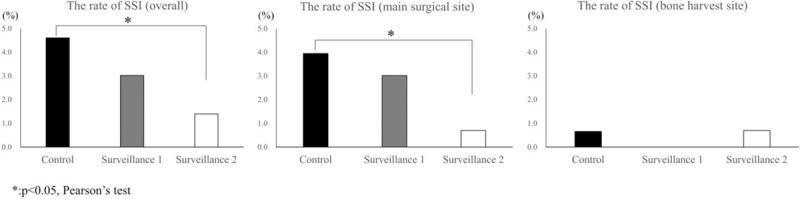
Surgical site infections (SSIs) increase the risk of mortality, postsurgery, extend hospital stay, and increase the costs of healthcare. Our aim in this study was to evaluate the effectiveness of a multidisciplinary, evidence-based, surveillance program combined with intrawound application of vancomycin in lowering the incidence rate of SSI after spinal surgery with instrumentation.We conducted a retrospective analysis of 637 patients who underwent spinal fusion with instrumentation in our institution at 3 different time periods: prior to our surveillance program (control group), surveillance only (surveillance group 1), and surveillance combined with intrawound vancomycin application (surveillance group 2). The following covariates were considered in the evaluation of between-group differences in SSI rate: sex, age, surgical site, National Nosocomial Infection Surveillance (NNIS) risk index, American Society of Anesthesiologists (ASA) physical status classification, and other health comorbidities. The causative organism in cases of SSI was confirmed in all cases.The rate of SSI was significantly lower in the surveillance group 2 (1.4%) than in the control group (4.6%; P = .04). On multivariate logistic regression analysis, steroid use (adjusted odd's ratio (OR), 6.06; 95% confidence interval (CI), 1.45-23.6) and operative time (adjusted OR.1.01; 95% CI, 1.00-1.01) were identified as independent risk factors of SSI. Staphylococcus species and Propionibacterium acnes were the principal causative organisms.A bundled approach that includes surveillance and intrawound application of vancomycin is an effective strategy to lower the risk of SSI after spinal fusion with instrumentation. The use of steroid and longer operative time are risk factors of SSI.Our findings support the implementation of a program of surveillance, combined with intrawound vancomycin application, to reduce the incidence rate of SSIs in spinal surgery.
手术部位感染(SSIs)会增加死亡率、术后风险、延长住院时间并增加医疗保健成本。本研究的目的是评估多学科、循证监测计划联合伤口内应用万古霉素在降低脊柱内固定手术后SSI发生率方面的有效性。我们对在本机构3个不同时间段接受脊柱融合内固定手术的637例患者进行了回顾性分析:在我们的监测计划实施之前(对照组)、仅进行监测(监测组1)以及监测联合伤口内应用万古霉素(监测组2)。在评估组间SSI发生率差异时考虑了以下协变量:性别、年龄、手术部位、国家医院感染监测(NNIS)风险指数、美国麻醉医师协会(ASA)身体状况分类以及其他健康合并症。所有SSI病例的致病微生物均得到确认。监测组2的SSI发生率(1.4%)显著低于对照组(4.6%;P = 0.04)。多因素逻辑回归分析显示,使用类固醇(调整后的比值比(OR)为6.06;95%置信区间(CI)为1.45 - 23.6)和手术时间(调整后的OR为1.01;95% CI为1.00 - 1.01)被确定为SSI的独立危险因素。葡萄球菌属和痤疮丙酸杆菌是主要的致病微生物。包括监测和伤口内应用万古霉素的综合方法是降低脊柱融合内固定手术后SSI风险的有效策略。使用类固醇和较长的手术时间是SSI的危险因素。我们的研究结果支持实施监测计划并联合伤口内应用万古霉素,以降低脊柱手术中SSI的发生率。