Faculty of Medicine, University of Porto, Porto, Portugal.
Internal Medicine Department, Hospital CUF, Porto, Portugal.
ESC Heart Fail. 2018 Dec;5(6):1017-1022. doi: 10.1002/ehf2.12301. Epub 2018 Aug 24.
Growth differentiation factor (GDF)-15 mirrors inflammation and oxidative stress in cardiovascular diseases. Brain natriuretic peptide (BNP) is associated with cardiomyocyte stretch in heart failure (HF). The objective of this study was to evaluate the prognostic impact of plasma GDF-15 and BNP in acute HF.
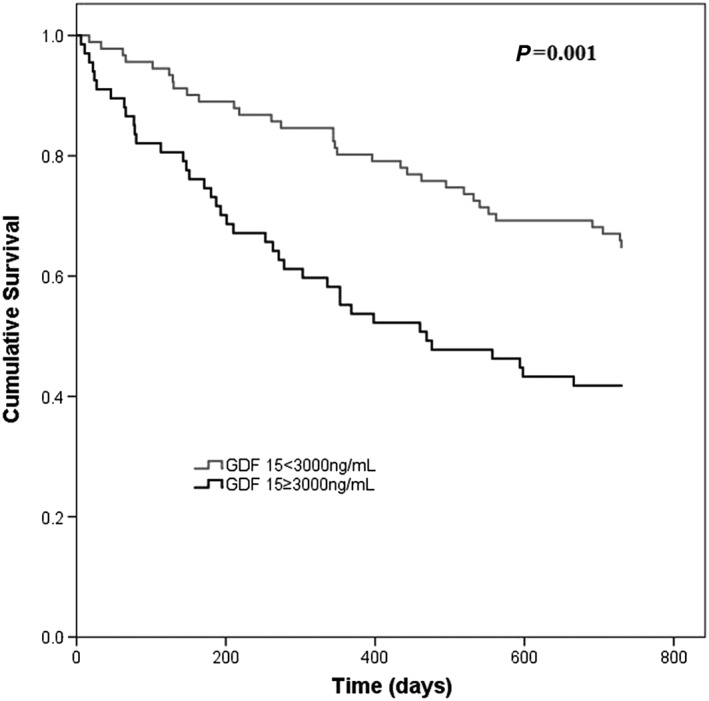
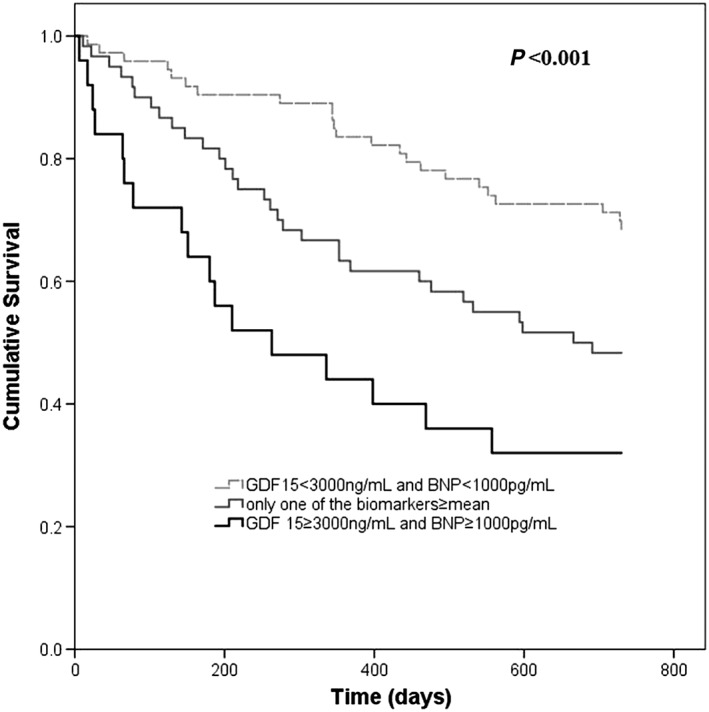
We studied a subgroup of patients prospectively recruited in an acute HF registry (follow-up: 2 years; endpoint: all-cause mortality). Cox regression multivariate models were built to study the association of GDF-15 and mortality. Further cross-classification according to discharge GDF-15 (mean) and BNP (mean) and association with mortality was studied. We studied 158 patients: seventy-nine were male, mean age was 75 years, 55.1% had left ventricular ejection fraction < 40%, mean discharge BNP was 1000 pg/mL, and mean GDF-15 was 3013 ng/mL. Higher BNP and GDF-15 predicted 2-year mortality. Patients with GDF-15 ≥ 3000 ng/mL had a multivariate adjusted 2-year death risk of 1.86 (1.08-3.18). Patients discharged with both BNP and GDF-15 above the mean had an adjusted hazard ratio of 4.33 (2.07-9.06) when compared with those with both <mean.
Higher GDF-15 associated with worse prognosis in acute HF independently of BNP. When both biomarkers GDF-15 and BNP were elevated at discharge, the 2-year mortality risk increased over four-fold. Biomarkers related to different pathophysiological pathways can provide incremental prognostic information in acute HF.
生长分化因子 15(GDF-15)反映心血管疾病中的炎症和氧化应激。脑钠肽(BNP)与心力衰竭(HF)中心肌细胞拉伸有关。本研究的目的是评估血浆 GDF-15 和 BNP 在急性 HF 中的预后影响。
我们前瞻性地研究了急性 HF 登记处中招募的患者亚组(随访:2 年;终点:全因死亡率)。建立 Cox 回归多变量模型来研究 GDF-15 与死亡率的相关性。进一步根据出院时 GDF-15(平均值)和 BNP(平均值)进行交叉分类,并研究与死亡率的相关性。我们研究了 158 名患者:79 名男性,平均年龄 75 岁,55.1%的左心室射血分数<40%,平均出院 BNP 为 1000pg/mL,平均 GDF-15 为 3013ng/mL。较高的 BNP 和 GDF-15 预测 2 年死亡率。GDF-15≥3000ng/mL 的患者,多变量调整后 2 年死亡风险为 1.86(1.08-3.18)。与 GDF-15 和 BNP 均<平均值的患者相比,出院时 GDF-15 和 BNP 均高于平均值的患者调整后的危险比为 4.33(2.07-9.06)。
GDF-15 升高与急性 HF 的预后不良独立相关,而与 BNP 无关。当两个生物标志物 GDF-15 和 BNP 在出院时均升高时,2 年死亡率风险增加了四倍以上。与不同病理生理途径相关的生物标志物可为急性 HF 提供额外的预后信息。