Chemistry Department, Texas A&M University, 3255 TAMU, College Station, TX 77843, USA.
Chemistry Department, Texas A&M University, 3255 TAMU, College Station, TX 77843, USA.
J Magn Reson. 2018 Oct;295:80-86. doi: 10.1016/j.jmr.2018.08.002. Epub 2018 Aug 13.
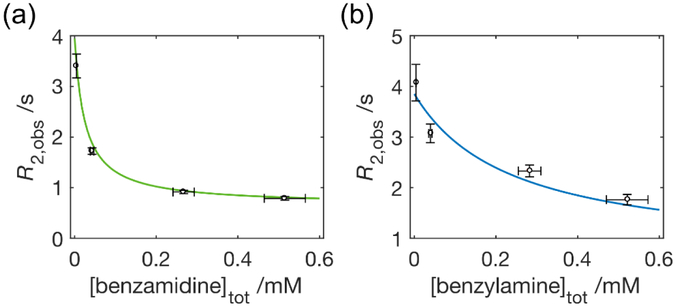
Dissolution dynamic nuclear polarization (D-DNP) is a powerful technique to improve NMR sensitivity by a factor of thousands. Combining D-DNP with NMR-based screening enables to mitigate solubility or availability problems of ligands and target proteins in drug discovery as it can lower the concentration requirements into the sub-micromolar range. One of the challenges that D-DNP assisted NMR screening methods face for broad application, however, is a reduced throughput due to additional procedures and time required to create hyperpolarization. These requirements result in a delay of several tens of minutes in-between each NMR measurement. To solve this problem, we have developed a simultaneous 4-channel detection method for hyperpolarized F NMR, which can increase throughput fourfold by utilizing a purpose-built multiplexed NMR spectrometer and probe. With this system, the concentration-dependent binding interactions were observed for benzamidine and benzylamine with the serine protease trypsin. A T relaxation measurement of a hyperpolarized reporter ligand (TFBC; CFCHCNHNH), which competes for the same binding site on trypsin with the other ligands, was used. The hyperpolarized TFBC was mixed with trypsin and the ligand of interest, and injected into four flow cells inside the NMR probe. Across the set of four channels, a concentration gradient was created. From the simultaneously acquired relaxation datasets, it was possible to determine the dissociation constant (K) of benzamidine and benzylamine without the requirement for individually optimizing experimental conditions for different affinities. A simulation showed that this 4-channel detection method applied to D-DNP NMR extends the screenable K range to up to three orders of magnitude in a single experiment.
溶解动态核极化(D-DNP)是一种强大的技术,可以将 NMR 灵敏度提高数千倍。将 D-DNP 与基于 NMR 的筛选相结合,可以减轻配体和靶蛋白在药物发现中的溶解度或可用性问题,因为它可以将浓度要求降低到亚毫摩尔范围内。然而,D-DNP 辅助 NMR 筛选方法广泛应用面临的挑战之一是由于创建极化所需的额外步骤和时间,导致通量降低。这些要求导致每次 NMR 测量之间的延迟长达几十分钟。为了解决这个问题,我们开发了一种用于超极化 F NMR 的同时 4 通道检测方法,该方法可以通过使用专门设计的多路复用 NMR 光谱仪和探头将通量提高四倍。使用该系统,观察到苯甲脒和苄胺与丝氨酸蛋白酶胰蛋白酶之间的浓度依赖性结合相互作用。使用与其他配体竞争胰蛋白酶相同结合位点的超极化报告配体(TFBC;CFCHCNHNH)进行 T 弛豫测量。将超极化 TFBC 与胰蛋白酶和感兴趣的配体混合,并注入 NMR 探头内的四个流池。在这四个通道中,创建了一个浓度梯度。从同时获得的弛豫数据集,可以确定苯甲脒和苄胺的离解常数(K),而无需单独优化不同亲和力的实验条件。模拟表明,这种应用于 D-DNP NMR 的 4 通道检测方法可以在单次实验中将可筛选的 K 范围扩展到三个数量级。