Hung Yuan-Pin, Tsai Pei-Jane, Lee Yuan-Ti, Tang Hung-Jen, Lin Hsiao-Ju, Liu Hsiu-Chuan, Lee Jen-Chieh, Tsai Bo-Yang, Hsueh Po-Ren, Ko Wen-Chien
Department of Internal Medicine, Tainan Hospital, Ministry of Health and Welfare, Tainan, Taiwan.
Department of Internal Medicine, National Cheng Kung University Hospital, Tainan, Taiwan,
Infect Drug Resist. 2018 Aug 15;11:1197-1203. doi: 10.2147/IDR.S162874. eCollection 2018.
The information of antimicrobial susceptibility, toxin gene, and ribotype distribution of toxigenic isolates in Taiwan remain limited.
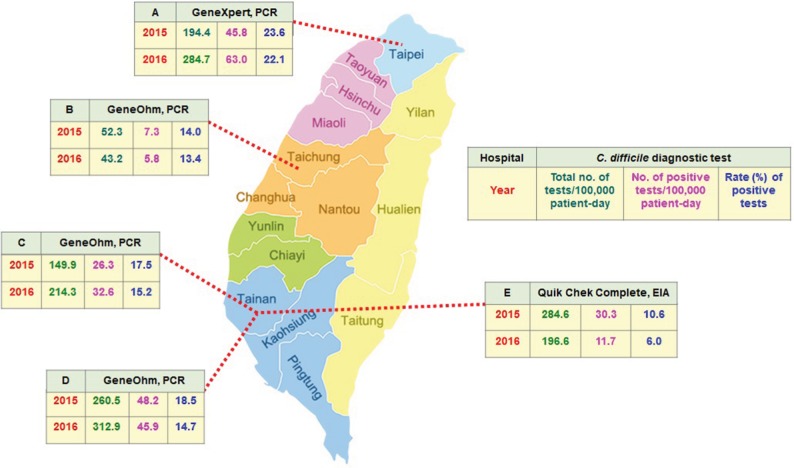
The study was conducted from January 2015 to December 2016 in 5 hospitals in Taiwan. Adults aged ≥20 years with a hospital stay for >5 days were included, and those with colectomy or intestinal infection due to other enteropathogens were excluded. Multiplex PCR was used to detect , and deletions, and antimicrobial susceptibility for metronidazole, vancomycin, doxycycline, and tigecycline was investigated. Ribotypes of those isolates with deletion and were determined.
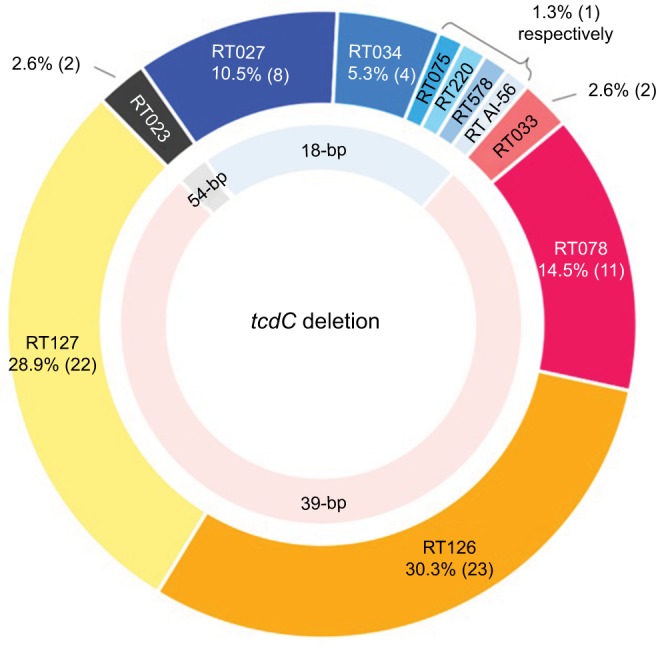
Of 1112 isolates collected from adults at 5 hospitals, 842 were toxigenic, including 749 (89.0%) tcdA+/tcdB+ isolates and 93 (11.0%) . Of the toxigenic isolates, 76 (9.0%) had a deletion and were , indicative of hypervirulence, and RT078 lineage, including RT126, RT127, and RT078, predominated (n=53, 76.3%). Similar to the susceptibility data in Asia countries, metronidazole or vancomycin resistance was rare, noted in 1.2% or 2.1%, respectively. Reduced doxycycline susceptibility (minimum inhibitory concentration [MIC] of ≥8 mg/L) was more common among RT078 lineage than non-RT078 lineage (75.9%, 44/58 vs 6.0%, 47/784; <0.001). Also reduced tigecycline susceptibility (MIC ≥0.125 mg/L) was more common among RT078 lineage (20.7%, 12/58 vs 6.5%, 51/784; <0.001).
In Taiwan, toxigenic isolates remain susceptible to metronidazole and vancomycin. RT078 lineage predominated among toxigenic isolates with , and deletion, and more often had reduced doxycycline and tigecycline susceptibility than the isolates other than RT078 lineage.
台湾产毒艰难梭菌分离株的抗菌药敏性、毒素基因及核糖分型分布信息仍然有限。
本研究于2015年1月至2016年12月在台湾的5家医院开展。纳入年龄≥20岁且住院时间超过5天的成年人,排除行结肠切除术或因其他肠道病原体导致肠道感染的患者。采用多重聚合酶链反应检测tcdA、tcdB缺失情况,并研究甲硝唑、万古霉素、强力霉素和替加环素的抗菌药敏性。对那些存在tcdA缺失和tcdB+的分离株进行核糖分型测定。
在5家医院收集的1112株艰难梭菌分离株中,842株产毒,其中749株(89.0%)为tcdA+/tcdB+分离株,93株(11.0%)为tcdA−/tcdB+。在产毒分离株中,76株(9.0%)存在tcdA缺失且为tcdB+,表明具有高毒力,RT078谱系(包括RT126、RT127和RT078)占主导(n = 53,76.3%)。与亚洲国家的药敏数据相似,甲硝唑或万古霉素耐药罕见,分别为1.2%或2.1%。RT078谱系中强力霉素敏感性降低(最低抑菌浓度[MIC]≥8 mg/L)的情况比非RT078谱系更常见(75.9%,44/58对6.0%,47/784;P<0.001)。替加环素敏感性降低(MIC≥0.125 mg/L)在RT078谱系中也更常见(20.7%,12/58对6.5%,51/784;P<0.001)。
在台湾,产毒艰难梭菌分离株对甲硝唑和万古霉素仍然敏感。RT078谱系在存在tcdA缺失和tcdB+的产毒分离株中占主导,且比非RT078谱系的分离株更常出现强力霉素和替加环素敏感性降低的情况。