González-Serrano J, Molinero-Mourelle P, Pardal-Peláez B, Sáez-Alcaide L-M, Ortega R, López-Quiles J
Departamento de Especialidades Clínicas Odontológicas, Facultad de Odontología, Universidad Complutense de Madrid, Plaza Ramón y Cajal s/n, 28040, Madrid,
Med Oral Patol Oral Cir Bucal. 2018 Sep 1;23(5):e602-e607. doi: 10.4317/medoral.22378.
A correct design is needed in short implants to improve primary stability (PS) in low quality bone. This study aimed to compare PS of double thread and single thread short implants.
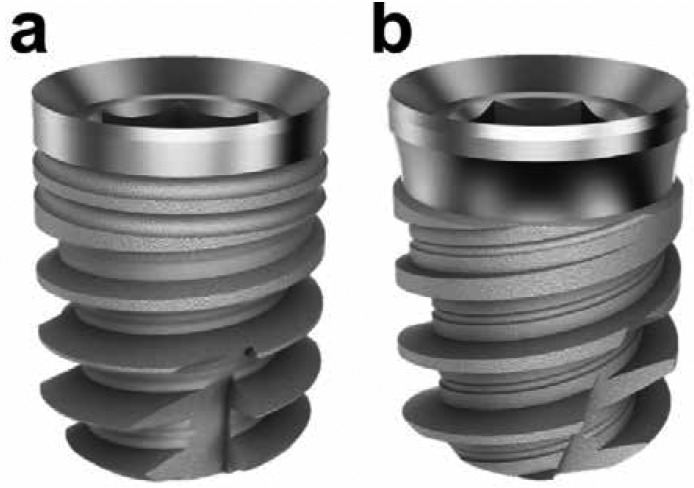
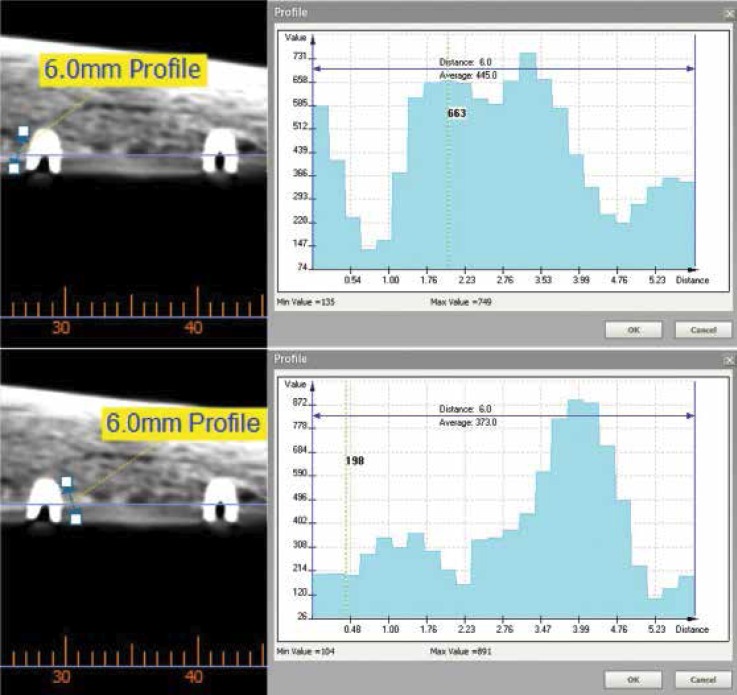
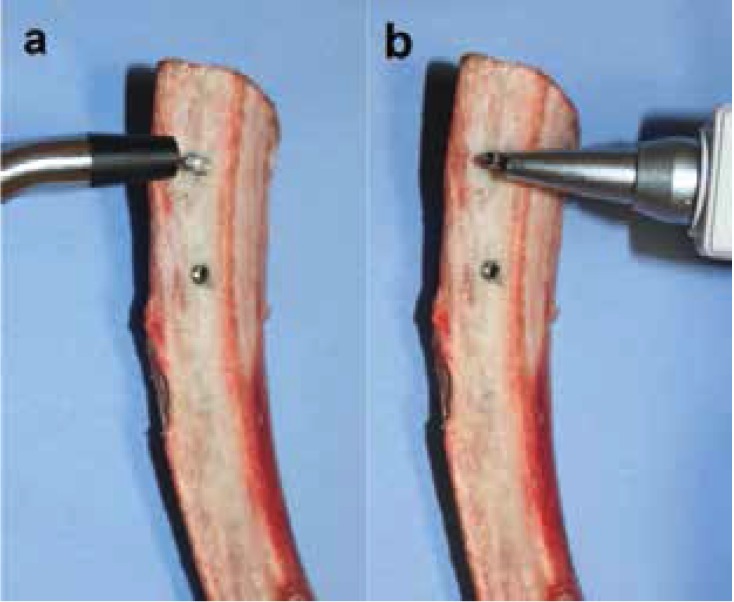
Thirty implants with single thread design (PHI/SHORT-I) and 30 implants with double thread design (PHIA/SHORT-I) (Radhex®, Inmet-Garnick S.A., Guadalajara, Spain) were placed in 30 randomly selected bovine ribs. PS was assessed in implant stability quotients (ISQ) and periotest values (PV) with Osstell™ and Periotest® devices, respectively. Computed tomographies of the ribs were taken and bone quality was evaluated in Hounsfield Units (HU) using Ez3D Plus software (Vatech Co., Korea). Only implants placed in low quality bone according to Misch and Kircos classification were selected (D3 bone: 350-850 HU; and D4 bone: 150-350 HU). Ten implants were not included in the study for being placed in D1 and D2 bone. Finally, 50 implants were selected: 17 and 9 PHI/SHORT-I in D3 and D4 bone respectively, and 15 and 9 PHIA/SHORT-I in D3 and D4 bone respectively.
The one-way ANOVA showed statistically significant differences in ISQ (61.35 ± 4.77 in PHI/SHORT-I and 66.43 ± 4.49 in PHIA/SHORT-I, P<0.005) and PV (-2.76 ± 0.8 and -4.11 ± 1.24 respectively, P<0.005) between two implant designs in D3 bone, and statistically significant differences in ISQ (53.44 ± 3.34 in PHI/SHORT-I and 60.56 ± 1.53 in PHIA/SHORT-I, P<0.0001) and PV (1.13 ± 0.95 and -2.5 ± 0.61 respectively, P<0.0001) between two groups in D4 bone.
Double thread design short implants resulted to have higher PS in comparison with single thread design short implants in D3 and D4 bone.
短种植体需要正确的设计以提高在低质量骨中的初期稳定性(PS)。本研究旨在比较双螺纹和单螺纹短种植体的初期稳定性。
将30枚单螺纹设计的种植体(PHI/SHORT-I)和30枚双螺纹设计的种植体(PHIA/SHORT-I)(Radhex®,Inmet-Garnick S.A.,西班牙瓜达拉哈拉)植入30根随机选取的牛肋骨中。分别使用Osstell™和Periotest®设备通过种植体稳定性商数(ISQ)和牙周探针值(PV)评估初期稳定性。对肋骨进行计算机断层扫描,并使用Ez3D Plus软件(韩国Vatech公司)以亨氏单位(HU)评估骨质量。仅选取根据米施(Misch)和柯尔科斯(Kircos)分类法植入低质量骨中的种植体(D3骨:350 - 850 HU;D4骨:150 - 350 HU)。有10枚种植体因植入D1和D2骨而未纳入本研究。最终,选取了50枚种植体:D3骨中有17枚PHI/SHORT-I和9枚,D4骨中有9枚PHI/SHORT-I,D3骨中有15枚PHIA/SHORT-I和9枚D4骨中的PHIA/SHORT-I。
单因素方差分析显示,在D3骨中,两种种植体设计在ISQ(PHI/SHORT-I为61.35 ± 4.77,PHIA/SHORT-I为66.43 ± 4.49,P<0.005)和PV(分别为 - 2.76 ± 0.8和 - 4.11 ± 1.24,P<0.005)方面存在统计学显著差异;在D4骨中,两组在ISQ(PHI/SHORT-I为53.44 ± 3.34,PHIA/SHORT-I为60.56 ± 1.53,P<0.0001)和PV(分别为1.13 ± 0.95和 - 2.5 ± 0.61,P<0.0001)方面存在统计学显著差异。
在D3和D4骨中,双螺纹设计的短种植体相比单螺纹设计的短种植体具有更高的初期稳定性。