Department of Medical Oncology, Dana-Farber Cancer Institute, Boston, MA.
Harvard Medical School, Boston, MA.
Blood. 2018 Nov 1;132(18):1911-1921. doi: 10.1182/blood-2018-04-843763. Epub 2018 Aug 27.
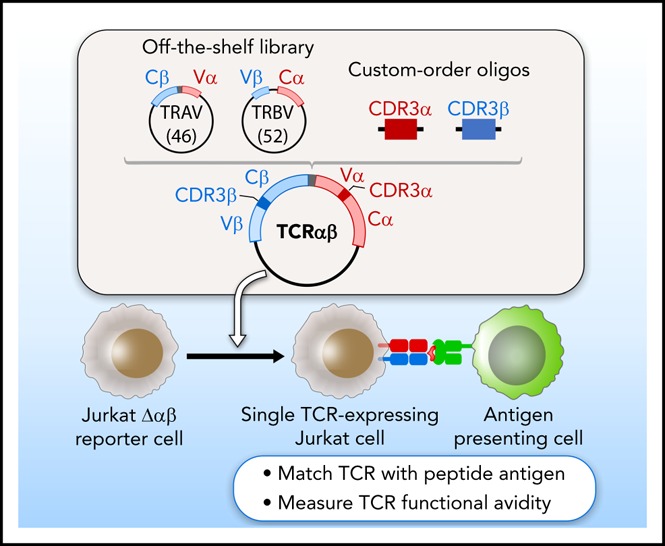
Recent studies have highlighted the promise of targeting tumor neoantigens to generate potent antitumor immune responses and provide strong motivation for improving our understanding of antigen-T-cell receptor (TCR) interactions. Advances in single-cell sequencing technologies have opened the door for detailed investigation of the TCR repertoire, providing paired information from TCRα and TCRβ, which together determine specificity. However, a need remains for efficient methods to assess the specificity of discovered TCRs. We developed a streamlined approach for matching TCR sequences with cognate antigen through on-demand cloning and expression of TCRs and screening against candidate antigens. Here, we first demonstrate the system's capacity to identify viral-antigen-specific TCRs and compare the functional avidity of TCRs specific for a given antigen target. We then apply this system to identify neoantigen-specific TCR sequences from patients with melanoma treated with personalized neoantigen vaccines and characterize functional avidity of neoantigen-specific TCRs. Furthermore, we use a neoantigen-prediction pipeline to show that an insertion-deletion mutation in a putative chronic lymphocytic leukemia (CLL) driver gives rise to an immunogenic neoantigen mut- and use this approach to identify the mut--specific TCR sequence. This approach provides a means to identify and express TCRs, and then rapidly assess antigen specificity and functional avidity of a reconstructed TCR, which can be applied for monitoring antigen-specific T-cell responses, and potentially for guiding the design of effective T-cell-based immunotherapies.
最近的研究强调了针对肿瘤新生抗原的靶向治疗,以产生有效的抗肿瘤免疫反应,并为提高我们对抗原-T 细胞受体(TCR)相互作用的理解提供了强有力的动力。单细胞测序技术的进步为 TCR 库的详细研究打开了大门,提供了 TCRα 和 TCRβ 的配对信息,这两者共同决定了特异性。然而,仍然需要有效的方法来评估发现的 TCR 的特异性。我们开发了一种通过按需克隆和表达 TCR 以及针对候选抗原进行筛选来匹配 TCR 序列与同源抗原的简化方法。在这里,我们首先证明了该系统识别病毒抗原特异性 TCR 的能力,并比较了针对给定抗原靶标的 TCR 的功能亲和力。然后,我们将该系统应用于鉴定接受个性化新生抗原疫苗治疗的黑色素瘤患者的新生抗原特异性 TCR 序列,并表征新生抗原特异性 TCR 的功能亲和力。此外,我们使用新生抗原预测管道来证明在假定的慢性淋巴细胞白血病(CLL)驱动基因中插入缺失突变会产生免疫原性新生抗原突变,并使用该方法鉴定突变特异性 TCR 序列。该方法提供了一种识别和表达 TCR 的方法,然后可以快速评估重建 TCR 的抗原特异性和功能亲和力,这可用于监测抗原特异性 T 细胞反应,并可能指导有效的基于 T 细胞的免疫疗法的设计。