Department of Nephrology, Osaka University Graduate School of Medicine, Suita 565-0871, Japan.
Int J Mol Sci. 2018 Aug 27;19(9):2532. doi: 10.3390/ijms19092532.
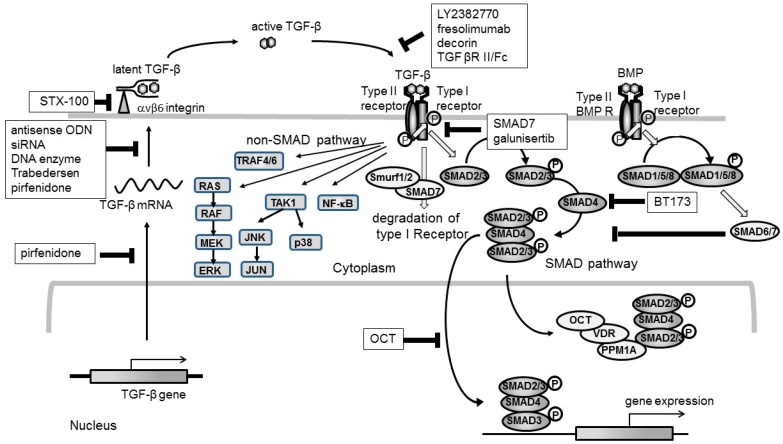
Renal fibrosis is the final common pathway of numerous progressive kidney diseases, and transforming growth factor-β (TGF-β) has an important role in tissue fibrosis by up-regulating matrix protein synthesis, inhibiting matrix degradation, and altering cell-cell interaction. Many strategies targeting TGF-β, including inhibition of production, activation, binding to the receptor, and intracellular signaling, have been developed. Some of them were examined in clinical studies against kidney fibrosis, and some are applied to other fibrotic diseases or cancer. Here, I review the approaches targeting TGF-β signaling in kidney fibrosis.
肾纤维化是许多进行性肾脏疾病的共同终末途径,转化生长因子-β(TGF-β)通过上调基质蛋白合成、抑制基质降解和改变细胞-细胞相互作用,在组织纤维化中发挥重要作用。已经开发了许多针对 TGF-β的策略,包括抑制其产生、激活、与受体结合和细胞内信号传导。其中一些已在针对肾纤维化的临床研究中进行了检查,还有一些已应用于其他纤维化疾病或癌症。在这里,我回顾了针对肾纤维化中 TGF-β信号的方法。