Department of Neurophysiology, Juntendo University School of Medicine, 2-1-1 Hongo, Bunkyo-ku, Tokyo, 113-8421, Japan.
Brain Science Institute, Tamagawa University, 6-1-1 Tamagawagakuen, Machida, Tokyo, 194-8610, Japan.
Sci Rep. 2018 Aug 27;8(1):12857. doi: 10.1038/s41598-018-31308-6.
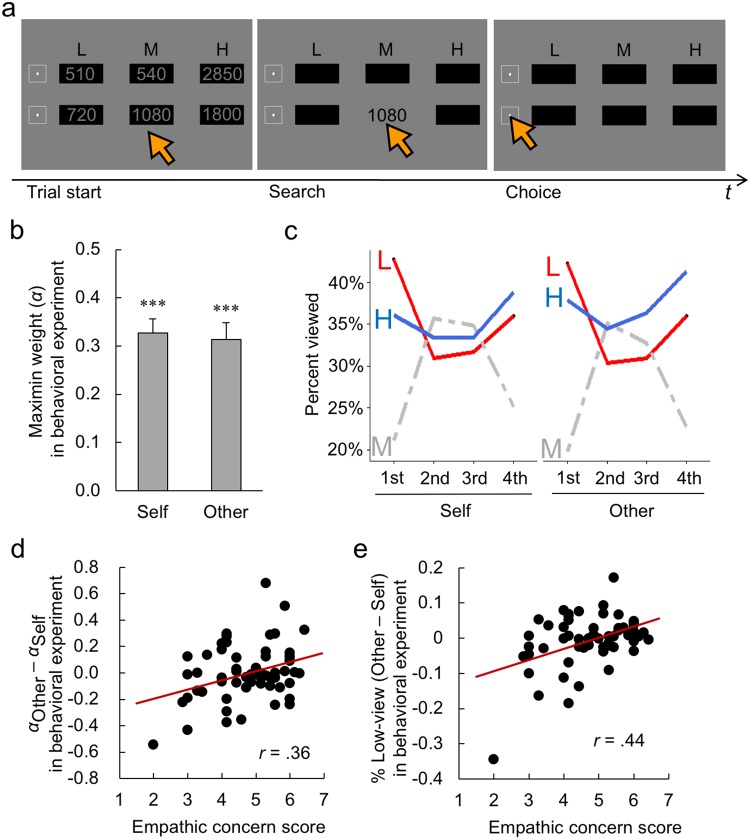
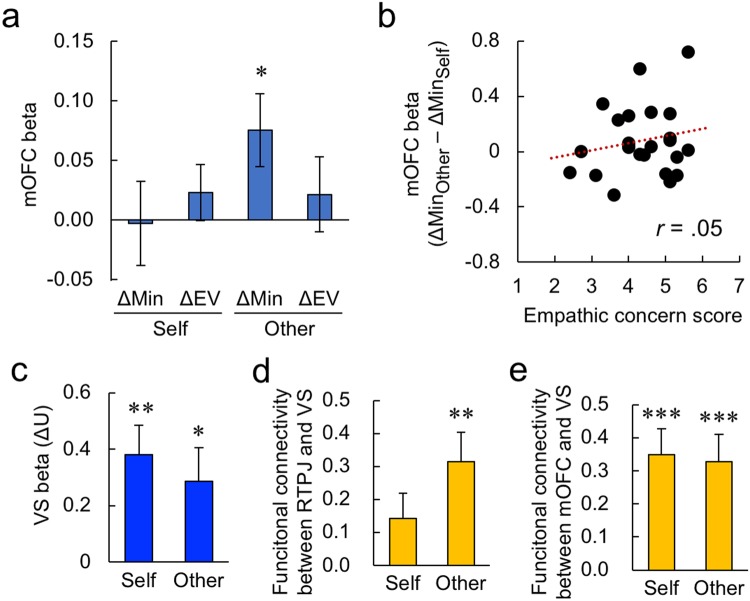
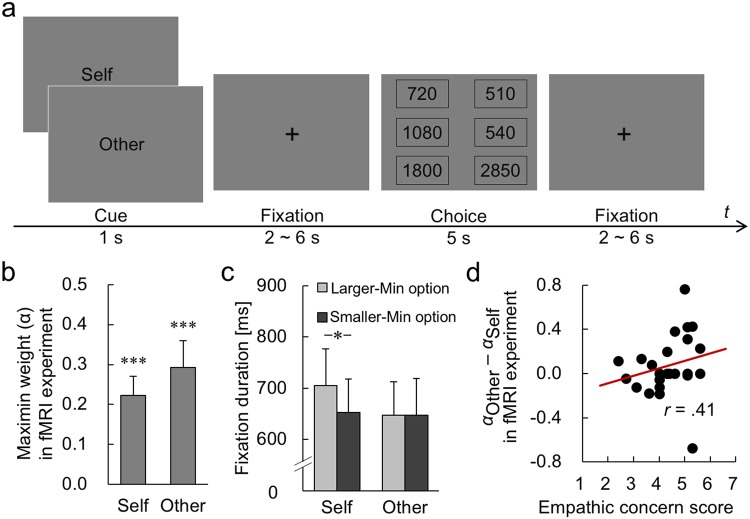
Risky decision making for others is ubiquitous in our societies. Whereas financial decision making for oneself induces strong concern about the worst outcome (maximin concern) as well as the expected value, behavioral and neural characteristics of decision making for others are less well understood. We conducted behavioral and functional magnetic resonance imaging (fMRI) experiments to examine the neurocognitive underpinnings of risky decisions for an anonymous other, using decisions for self as a benchmark. We show that, although the maximin concern affected both types of decisions equally strongly, decision making for others recruited a more risk-neutral computational mechanism than decision making for self. Specifically, participants exhibited more balanced information search when choosing a risky option for others. Activity of right temporoparietal junction (rTPJ, associated with cognitive perspective taking) was parametrically modulated by options' expected values in decisions for others, and by the minimum amounts in decisions for self. Furthermore, individual differences in self-reported empathic concern modified these attentional and neural processes. Overall, these results indicate that the typical maximin concern is attenuated in a risk-neutral direction in decisions for others as compared to self. We conjecture that, given others' diverse preferences, deciding as a neutral party may cognitively recruit such risk-neutrality.
为他人做风险决策在我们的社会中无处不在。虽然为自己做财务决策会强烈关注最坏结果(最大最小关注)以及预期价值,但为他人做决策的行为和神经特征还不太清楚。我们进行了行为和功能磁共振成像(fMRI)实验,使用自我决策作为基准,来研究为匿名他人做风险决策的神经认知基础。我们表明,尽管最大最小关注对两种决策的影响同样强烈,但为他人做决策比为自己做决策采用了更风险中性的计算机制。具体来说,参与者在为他人选择风险选项时表现出更平衡的信息搜索。右侧颞顶联合区(rTPJ,与认知视角-taking 相关)的活动在为他人做决策时,根据选项的预期值进行参数调节,在为自己做决策时,根据最低金额进行调节。此外,自我报告的同理心差异会改变这些注意力和神经过程。总的来说,这些结果表明,与自我决策相比,他人决策中的典型最大最小关注会向风险中性方向减弱。我们推测,考虑到他人的不同偏好,作为中立一方做出决策可能会在认知上引入这种风险中性。