Graduate School of Environmental Studies, Nagoya University, Nagoya, 464-8601, Japan.
Department of Earth and Atmospheric Sciences, Cornell University, Ithaca, NY, 14853, USA.
Nat Commun. 2018 Aug 27;9(1):3446. doi: 10.1038/s41467-018-05635-1.
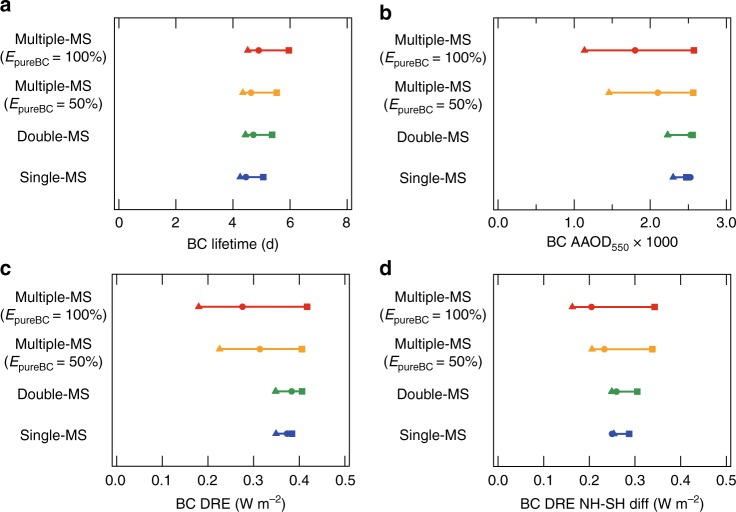
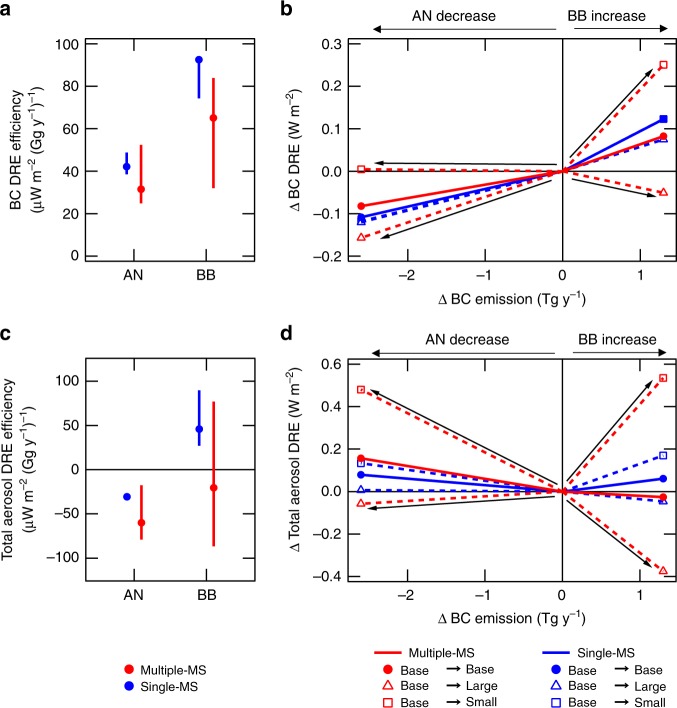
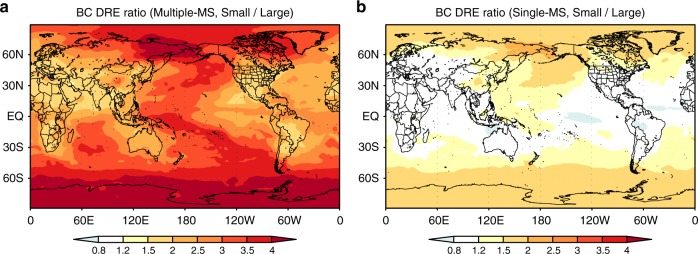
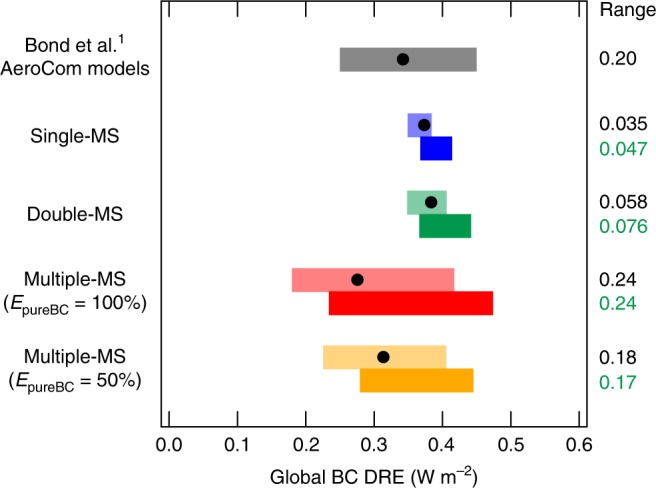
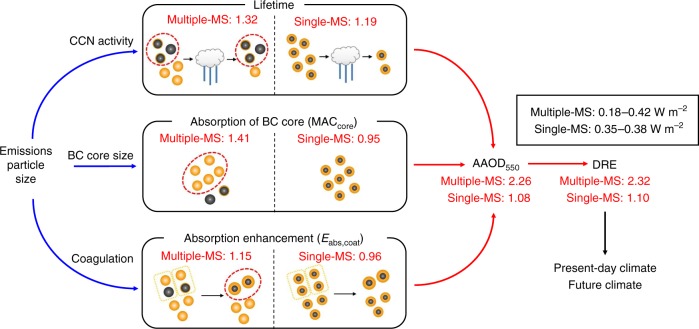
Post-industrial increases in atmospheric black carbon (BC) have a large but uncertain warming contribution to Earth's climate. Particle size and mixing state determine the solar absorption efficiency of BC and also strongly influence how effectively BC is removed, but they have large uncertainties. Here we use a multiple-mixing-state global aerosol microphysics model and show that the sensitivity (range) of present-day BC direct radiative effect, due to current uncertainties in emission size distributions, is amplified 5-7 times (0.18-0.42 W m) when the diversity in BC mixing state is sufficiently resolved. This amplification is caused by the lifetime, core absorption, and absorption enhancement effects of BC, whose variability is underestimated by 45-70% in a single-mixing-state model representation. We demonstrate that reducing uncertainties in emission size distributions and how they change in the future, while also resolving modeled BC mixing state diversity, is now essential when evaluating BC radiative effects and the effectiveness of BC mitigation on future temperature changes.
工业化后大气黑碳(BC)的增加对地球气候的变暖贡献有很大的不确定性。颗粒大小和混合状态决定了 BC 的太阳吸收效率,也强烈影响着 BC 被去除的效率,但这些因素存在很大的不确定性。在这里,我们使用了一种多混合状态的全球气溶胶微观物理模型,并表明,由于目前对排放物大小分布的不确定性,当充分解决 BC 混合状态的多样性时,目前 BC 直接辐射效应的敏感性(范围)会放大 5-7 倍(0.18-0.42 W m)。这种放大是由 BC 的寿命、核心吸收和吸收增强效应引起的,而在单一混合状态模型表示中,BC 的可变性被低估了 45-70%。我们证明,在评估 BC 辐射效应和 BC 缓解措施对未来温度变化的有效性时,现在必须降低排放物大小分布的不确定性及其未来变化的方式,同时解决模型中 BC 混合状态的多样性。