Brancalion Pedro H S, Oliveira Giancarlo C X, Zucchi Maria I, Novello Mariana, van Melis Juliano, Zocchi Silvio S, Chazdon Robin L, Rodrigues Ricardo R
Department of Forest Sciences "Luiz de Queiroz" College of Agriculture University of São Paulo Piracicaba SP Brazil.
Department of Genetics, "Luiz de Queiroz" College of Agriculture University of São Paulo Piracicaba SP Brazil.
Ecol Evol. 2018 Jul 3;8(15):7462-7475. doi: 10.1002/ece3.4248. eCollection 2018 Aug.
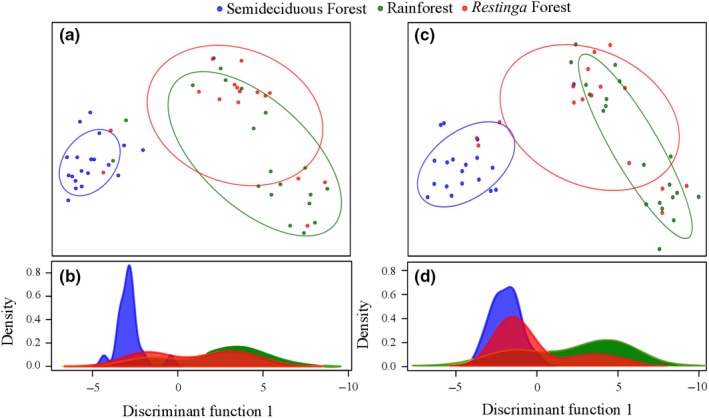
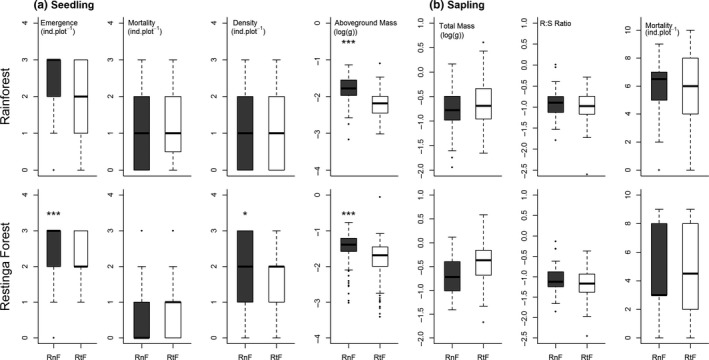
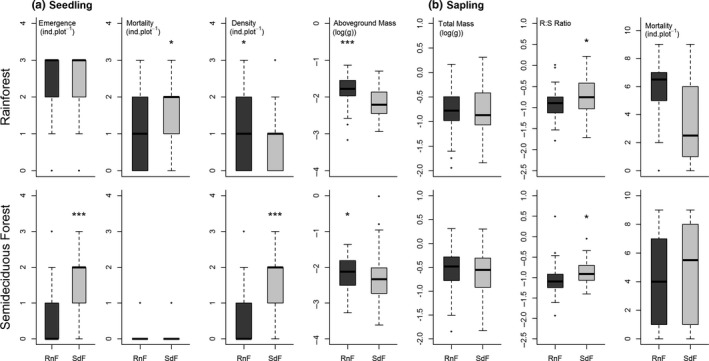
One of the most intriguing questions in plant ecology is which evolutionary strategy allows widely distributed species to increase their ecological range and grow in changing environmental conditions. Phenotypic plasticity and local adaptations are major processes governing species range margins, but little is known about their relative contribution for tree species distribution in tropical forest regions. We investigated the relative role of phenotypic plasticity and local adaptation in the ecological distribution of the widespread palm in the Brazilian Atlantic Forest. Genetic sampling and experiments were performed in old-growth remnants of two forest types with higher (Seasonal Semideciduous Forests vs. Submontane Rainforest) and lower biogeographic association and environmental similarities (Submontane Rainforest vs. Forest). We first assessed the molecular genetic differentiation among populations, focusing on the group of potentially under selection in each forest, using single-nucleotide polymorphism (SNPs) outliers. Further, we looked for potential adaptive divergence among populations in a common garden experiment and in reciprocal transplants for two plant development phases: seedling establishment and sapling growth. Analysis with outlier loci indicated that all individuals from the Semideciduous Forest formed a single group, while another group was formed by overlapping individuals from Submontane Rainforest and Forest. Molecular differentiation was corroborated by reciprocal transplants, which yielded strong evidence of local adaptations for seedling establishment in the biogeographically divergent Rainforest and Semideciduous Forest, but not for Forest and Submontane Rainforest. Phenotypic plasticity for palm seedling establishment favors range expansion to biogeographically related or recently colonized forest types, while persistence in the newly colonized ecosystem may be favored by local adaptations if climatic conditions diverge over time, reducing gene flow between populations. SNPs obtained by next-generation sequencing can help exploring adaptive genetic variation in tropical trees, which impose several challenges to the use of reciprocal transplants.
植物生态学中最引人入胜的问题之一是,哪种进化策略能使广泛分布的物种扩大其生态范围并在不断变化的环境条件下生长。表型可塑性和局部适应性是决定物种分布范围边界的主要过程,但对于它们在热带森林地区树木物种分布中的相对贡献,我们却知之甚少。我们研究了表型可塑性和局部适应性在巴西大西洋森林中广泛分布的棕榈生态分布中的相对作用。在两种具有较高(季节性半落叶林与山地雨林)和较低生物地理关联及环境相似性(山地雨林与[此处原文缺失森林类型名称]森林)的森林类型的原始残留林中进行了遗传采样和实验。我们首先评估了种群间的分子遗传分化,重点关注每个森林中可能处于选择之下的群体,使用单核苷酸多态性(SNP)异常值。此外,我们在一个共同花园实验以及针对两个植物发育阶段(幼苗建立和幼树生长)的相互移植实验中,寻找种群间潜在的适应性分化。对异常位点的分析表明,半落叶林中的所有个体形成一个单一群体,而另一个群体则由山地雨林和[此处原文缺失森林类型名称]森林中重叠的个体组成。相互移植实验证实了分子分化,该实验有力地证明了在生物地理上不同的雨林和半落叶林中,幼苗建立存在局部适应性,但在[此处原文缺失森林类型名称]森林和山地雨林中则不然。棕榈幼苗建立的表型可塑性有利于向生物地理相关或最近殖民的森林类型扩展范围,而如果气候条件随时间变化导致种群间基因流动减少,那么在新殖民的生态系统中持续存在可能有利于局部适应性。通过下一代测序获得的SNP有助于探索热带树木中的适应性遗传变异,而热带树木给相互移植实验的应用带来了诸多挑战。