Derua Yahya A, Kahindi Samuel C, Mosha Franklin W, Kweka Eliningaya J, Atieli Harrysone E, Wang Xiaoming, Zhou Guofa, Lee Ming-Chieh, Githeko Andrew K, Yan Guiyun
Kilimanjaro Christian Medical University College Tumaini University Makumira Moshi Tanzania.
National Institute for Medical Research Amani Research Centre Tanga Tanzania.
Ecol Evol. 2018 Jul 6;8(15):7563-7573. doi: 10.1002/ece3.4250. eCollection 2018 Aug.
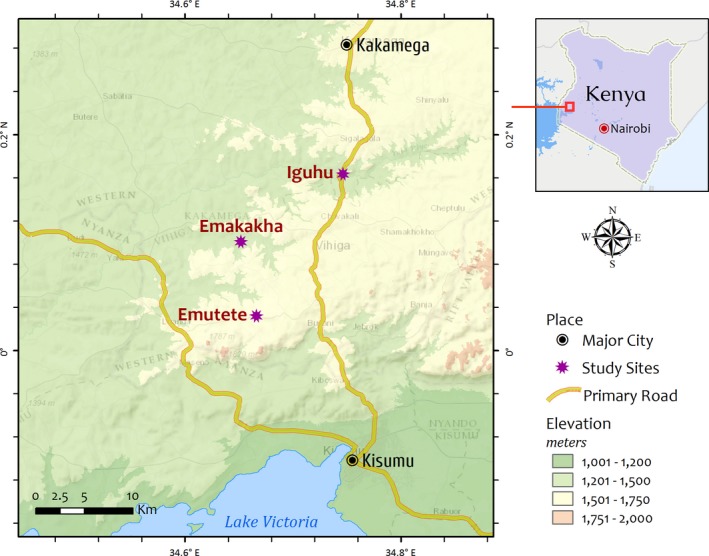
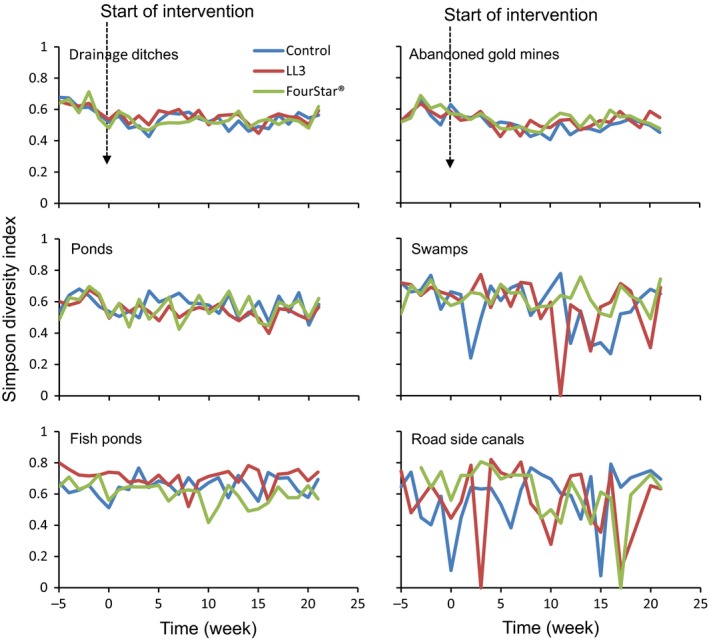
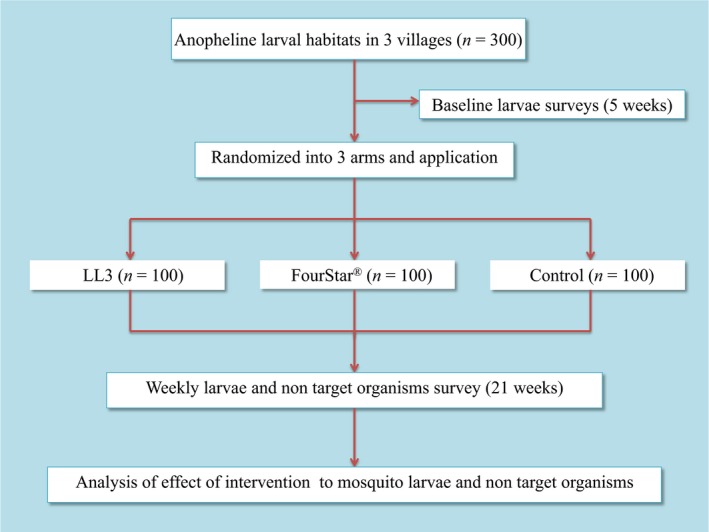
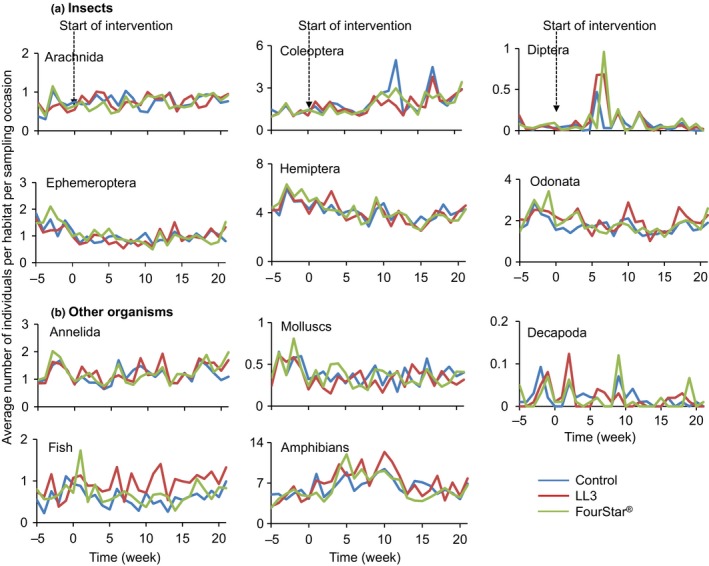
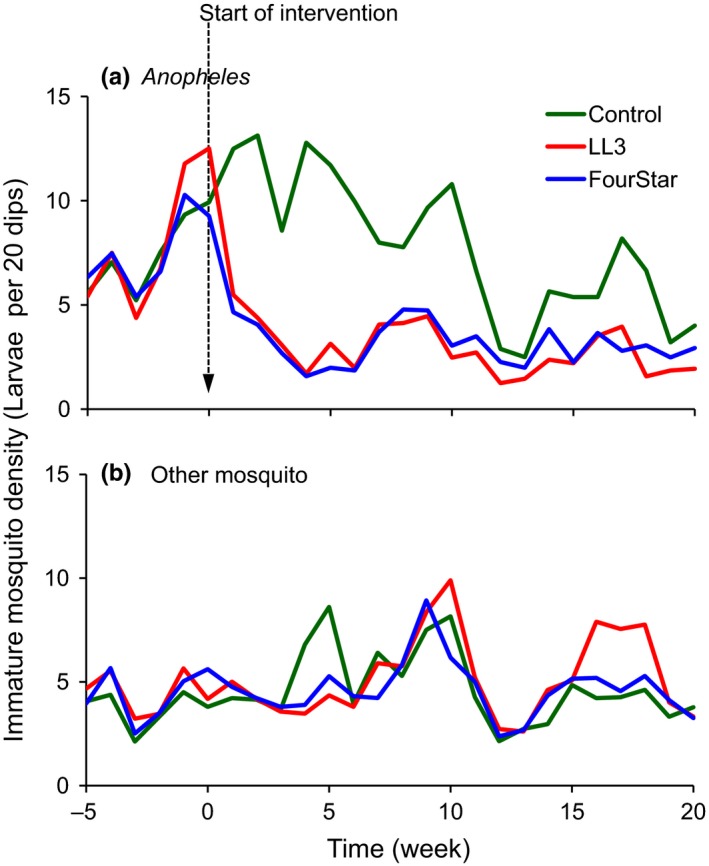
The microbial larvicides var. and have been used extensively for mosquito control and have been found to be effective and safe to non-target organisms cohabiting with mosquito larvae. Recently developed long lasting microbial larvicides (LLML), although evading the previous challenge of short duration of activity, increase the risk of persistence of toxins in the treated larval habitats. This study monitored the impact of LLML FourStar and LL3 on non-target organisms cohabiting with mosquito larvae in an operational study to control malaria vectors in western Kenya highlands. A total of 300 larval habitats were selected in three highland villages. The habitats were first monitored for 5 weeks to collect baseline data on non-target organisms cohabiting with mosquito larvae and then randomized into two treatment arms (respective FourStar and LL3) and one control arm. Non-target organisms were sampled weekly for 5 months after treatment to assess the impact of LLML intervention. Before treatment, the mean density of all non-target organisms combined in the control, LL3 and FourStar treated habitats was 1.42, 1.39 and 1.49 individuals per habitat per sampling occasion, respectively. Following treatment, this density remained fairly unchanged for 21 weeks at which time it was 1.82, 2.11, and 2.05 for the respective control, LL3 and FourStar treated habitats. Statistical analysis revealed that LL3 and FourStar did not significantly alter abundance, richness or diversity of the 11 taxa studied, when comparing the intervention and control larval habitats. However, both FourStar and LL3 significantly reduced the density of malaria vectors. In conclusion, one round of label rate application of FourStar or LL3 in natural larval habitats did not alter richness, abundance or diversity of the monitored aquatic non-target organisms cohabiting with mosquito larvae to an ecologically significant level.
微生物杀幼虫剂变种和已被广泛用于控制蚊子,并被发现对与蚊子幼虫共生的非目标生物有效且安全。最近开发的长效微生物杀幼虫剂(LLML),虽然规避了先前活性持续时间短的挑战,但增加了毒素在处理过的幼虫栖息地中持久存在的风险。本研究在肯尼亚西部高地控制疟疾媒介的一项实际研究中,监测了LLML四星和LL3对与蚊子幼虫共生的非目标生物的影响。在三个高地村庄共选择了300个幼虫栖息地。首先对这些栖息地进行了5周的监测,以收集与蚊子幼虫共生的非目标生物的基线数据,然后将其随机分为两个处理组(分别为四星和LL3)和一个对照组。处理后每周对非目标生物进行采样,持续5个月,以评估LLML干预的影响。处理前,对照组、LL3处理组和四星处理组栖息地中所有非目标生物的平均密度分别为每次采样时每个栖息地1.42、1.39和1.49个体。处理后,这种密度在21周内基本保持不变,此时对照组、LL3处理组和四星处理组栖息地的密度分别为1.82、2.11和2.05。统计分析表明,在比较干预组和对照组幼虫栖息地时,LL3和四星并没有显著改变所研究的11个分类单元的丰度、丰富度或多样性。然而,四星和LL3都显著降低了疟疾媒介的密度。总之,在自然幼虫栖息地中按标签率施用一轮四星或LL3,并没有将与蚊子幼虫共生的受监测水生非目标生物的丰富度、丰度或多样性改变到具有生态意义的水平。