Wesselbaum Sebastian, Moha Verena, Meuresch Markus, Brosinski Sandra, Thenert Katharina M, Kothe Jens, Stein Thorsten Vom, Englert Ulli, Hölscher Markus, Klankermayer Jürgen, Leitner Walter
Institut für Technische und Makromolekulare Chemie , RWTH Aachen University , Worringerweg 1 , 52074 Aachen , Germany . Email:
Institut für Anorganische Chemie , RWTH Aachen University , Landoltweg 1 , 52074 Aachen , Germany.
Chem Sci. 2015 Jan 1;6(1):693-704. doi: 10.1039/c4sc02087a. Epub 2014 Aug 27.
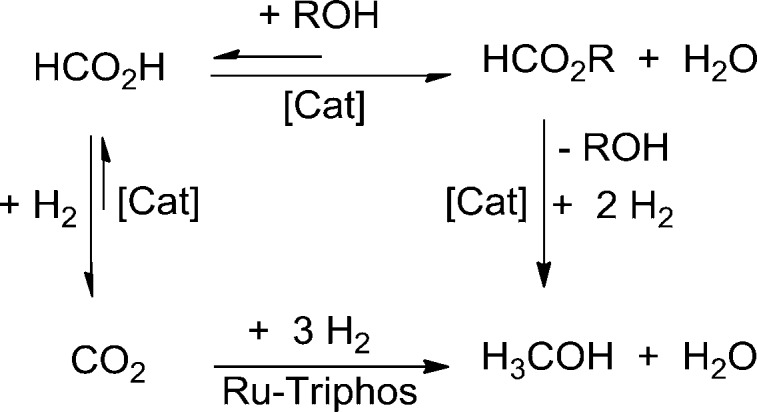
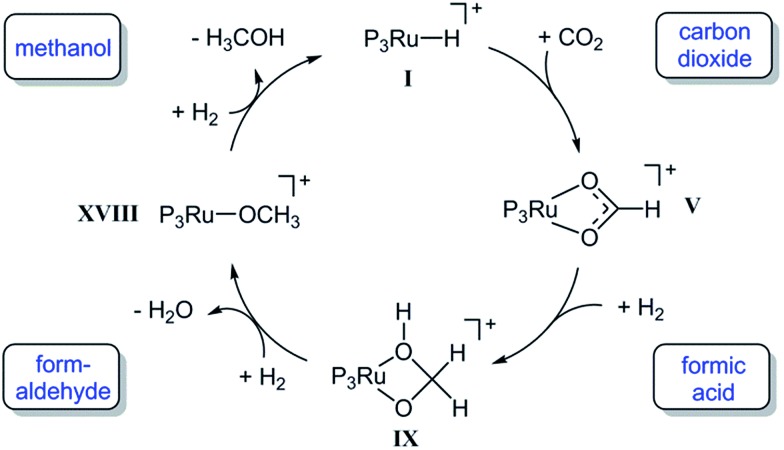
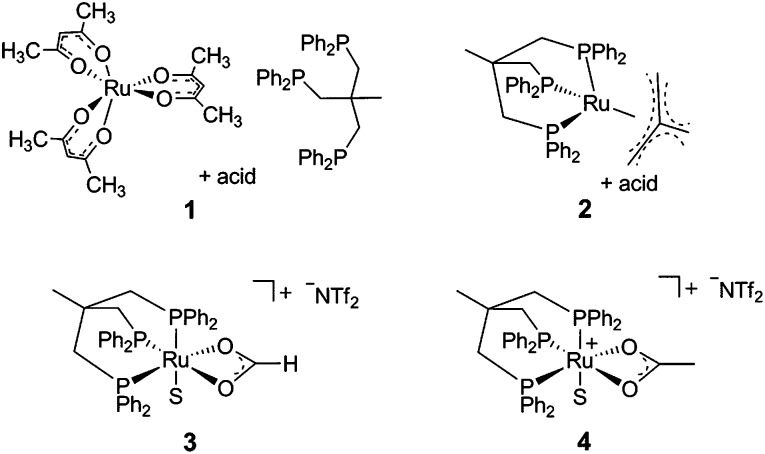
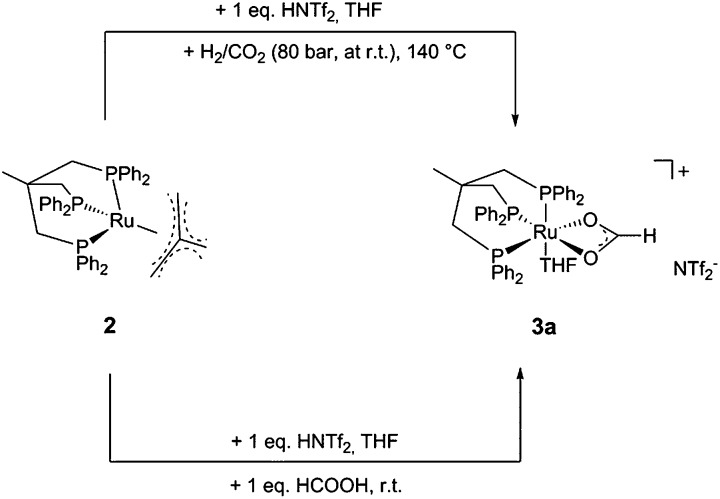
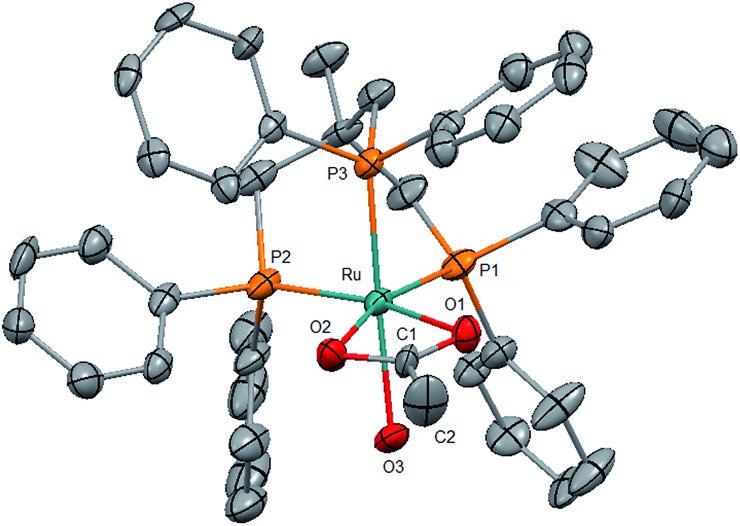
The hydrogenation of CO to methanol can be achieved using a single molecular organometallic catalyst. Whereas homogeneous catalysts were previously believed to allow the hydrogenation only formate esters as stable intermediates, the present mechanistic study demonstrates that the multistep transformation can occur directly on the Ru-Triphos (Triphos = 1,1,1-tris(diphenylphosphinomethyl)ethane) centre. The cationic formate complex [(Triphos)Ru(η-OCH)(S)] (S = solvent) was identified as the key intermediate, leading to the synthesis of the analogous acetate complex as a robust and stable precursor for the catalytic transformation. A detailed mechanistic study using DFT calculations shows that a sequential series of hydride transfer and protonolysis steps can account for the transformation of CO formate/formic acid to hydroxymethanolate/formaldehyde and finally methanolate/methanol within the coordination sphere of a single Ru-Triphos-fragment. All experimental results of the systematic parameter optimisation are fully consistent with this mechanistic picture. Based on these findings, a biphasic system consisting of HO and 2-MTHF was developed, in which the active cationic Ru-complex resides in the organic phase for recycling and methanol is extracted with the aqueous phase.
使用单一分子有机金属催化剂可实现将一氧化碳氢化为甲醇。虽然此前认为均相催化剂仅能使甲酸酯作为稳定中间体进行氢化反应,但目前的机理研究表明,多步转化可直接在钌-三膦(三膦=1,1,1-三(二苯基膦甲基)乙烷)中心发生。阳离子甲酸配合物[(三膦)钌(η-OCH)(S)](S=溶剂)被确定为关键中间体,从而合成了类似的乙酸配合物,作为催化转化的一种稳定且强健的前体。使用密度泛函理论计算进行的详细机理研究表明,一系列连续的氢化物转移和质子解步骤可解释在单个钌-三膦片段的配位球内一氧化碳从甲酸酯/甲酸转化为羟基甲醇盐/甲醛,最终转化为甲醇盐/甲醇的过程。系统参数优化的所有实验结果与这一机理图景完全一致。基于这些发现,开发了一种由水和2-甲基四氢呋喃组成的双相体系,其中活性阳离子钌配合物存在于有机相中以便循环利用,而甲醇则用水相萃取。