Yang Ya-Lin, Lee Meng-Tse Gabriel, Lee Chien-Chang, Su Pei-I, Chi Chien-Yu, Liu Cheng-Heng, Wu Meng-Che, Yen Zui-Shen, Chen Shyr-Chyr
Department of Emergency Medicine, National Taiwan University Hospital and College of Medicine, Taipei, Taiwan.
PeerJ. 2018 Aug 24;6:e5434. doi: 10.7717/peerj.5434. eCollection 2018.
Intra-abdominal adhesions develop after nearly every abdominal surgery, commonly causing female infertility, chronic pelvic pain, and small bowel obstruction. Pentoxifylline (PTX) is a methylxanthine compound with immunomodulatory and antifibrotic properties. The aim of this study was to investigate whether PTX can reduce post-operative intra-abdominal adhesion formation via collagen deposition, tissue plasminogen activator (tPA) level, inflammation, angiogenesis, and fibrosis.
Seventy male BALB/c mice were randomized into one of three groups: (1) sham group without peritoneal adhesion model; (2) peritoneal adhesion model (PA group); (3) peritoneal adhesion model with PTX (100 mg/kg/day i.p.) administration was started on preoperative day 2 and continued daily (PA + PTX group). On postoperative day 3 and day 7, adhesions were assessed using the Lauder scoring system. Parietal peritoneum was obtained for histological evaluation with hematoxylin and eosin (HE) and picrosirius red staining. Fibrinolysis was analyzed by tPA protein levels in the peritoneum by ELISA. Immunohistological analysis was also conducted using markers for angiogenesis (ki67/CD31), inflammation (F4/80) and fibrosis (FSP-1 and -SMA). All the comparisons were made by comparing the PA group with the PTX treated PA group, and < 0.05 was considered statistically significant.
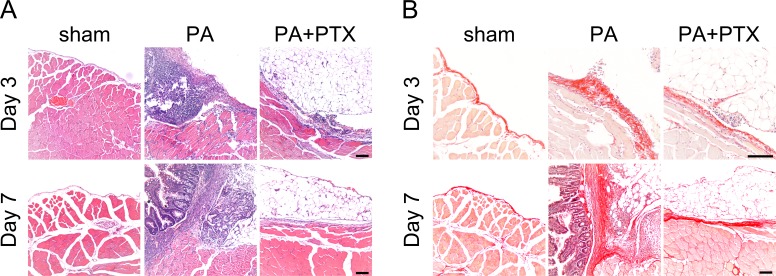
Intra-abdominal adhesions were markedly reduced by PTX treatment. Compared with the PA group, PTX treatment had lower adhesion scores than the PA group on both day 3 and day 7 ( < 0.05). Histological evaluations found that PTX treatment reduced collagen deposition and adhesion thickening. ELISA analysis showed that PTX treatment significantly increased the level of tPA in the peritoneum. In addition, in the immunohistological analysis, PTX treatment was found to significantly decrease the number of ki67/CD31 cells at the site of adhesion. Finally, we also observed that in the PTX treated group, there was a reduction in the expression of F4/80, FSP-1, and -SMA cells at the site of adhesion.
PTX may decrease intra-abdominal adhesion formation via increasing peritoneal fibrinolytic activity, suppressing angiogenesis, decreasing collagen synthesis, and reducing peritoneal fibrosis. Our findings suggest that PTX can be used to decrease post-operative intra-abdominal adhesion formation.
几乎每次腹部手术后都会形成腹腔粘连,通常会导致女性不孕、慢性盆腔疼痛和小肠梗阻。己酮可可碱(PTX)是一种具有免疫调节和抗纤维化特性的甲基黄嘌呤化合物。本研究的目的是调查PTX是否能通过胶原蛋白沉积、组织型纤溶酶原激活剂(tPA)水平、炎症、血管生成和纤维化来减少术后腹腔粘连的形成。
70只雄性BALB/c小鼠被随机分为三组之一:(1)无腹膜粘连模型的假手术组;(2)腹膜粘连模型组(PA组);(3)术前第2天开始腹腔注射PTX(100mg/kg/天)并持续每日给药的腹膜粘连模型组(PA + PTX组)。术后第3天和第7天,使用劳德评分系统评估粘连情况。获取壁层腹膜进行苏木精和伊红(HE)染色及天狼星红染色的组织学评估。通过ELISA法分析腹膜中tPA蛋白水平来分析纤维蛋白溶解情况。还使用血管生成标志物(ki67/CD31)、炎症标志物(F4/80)和纤维化标志物(FSP-1和α-SMA)进行免疫组织学分析。所有比较均通过将PA组与PTX治疗的PA组进行比较,P < 0.05被认为具有统计学意义。
PTX治疗显著减少了腹腔粘连。与PA组相比,PTX治疗在第3天和第7天的粘连评分均低于PA组(P < 0.05)。组织学评估发现PTX治疗减少了胶原蛋白沉积和粘连增厚。ELISA分析表明PTX治疗显著提高了腹膜中tPA的水平。此外免疫组织学分析发现,PTX治疗显著减少了粘连部位ki67/CD31细胞的数量。最后,我们还观察到在PTX治疗组中,粘连部位F4/80、FSP-1和α-SMA细胞的表达减少。
PTX可能通过增加腹膜纤维蛋白溶解活性、抑制血管生成、减少胶原蛋白合成和降低腹膜纤维化来减少腹腔粘连的形成。我们的研究结果表明PTX可用于减少术后腹腔粘连的形成。