Division of Nephrology and Hypertension, 1st Department of Internal Medicine, Medical School, Aristotle University of Thessaloniki, 54124 Thessaloniki, Greece.
Center for Pediatric and Adolescent Medicine, University Hospital Heidelberg, 69120 Heidelberg, Germany.
Int J Mol Sci. 2019 Nov 16;20(22):5765. doi: 10.3390/ijms20225765.
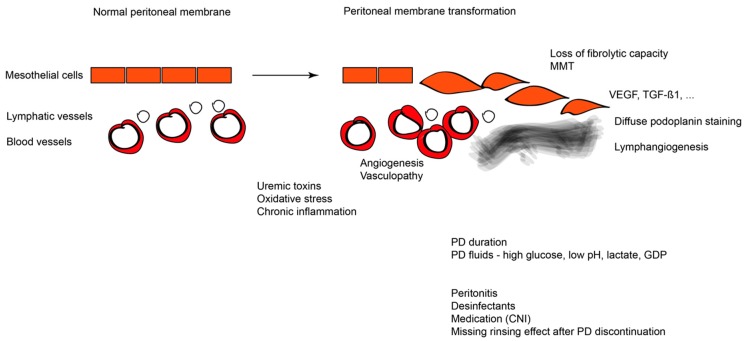
Encapsulating peritoneal sclerosis (EPS) is a life-threatening complication of long-term peritoneal dialysis (PD), which may even occur after patients have switched to hemodialysis (HD) or undergone kidney transplantation. The incidence of EPS varies across the globe and increases with PD vintage. Causative factors are the chronic exposure to bioincompatible PD solutions, which cause long-term modifications of the peritoneum, a high peritoneal transporter status involving high glucose concentrations, peritonitis episodes, and smoldering peritoneal inflammation. Additional potential causes are predisposing genetic factors and some medications. Clinical symptoms comprise signs of intestinal obstruction and a high peritoneal transporter status with incipient ultrafiltration failure. In radiological, macro-, and microscopic studies, a massively fibrotic and calcified peritoneum enclosed the intestine and parietal wall in such cases. Empirical treatments commonly used are corticosteroids and tamoxifen, which has fibrinolytic properties. Immunosuppressants like azathioprine, mycophenolate mofetil, or mTOR inhibitors may also help with reducing inflammation, fibrin deposition, and collagen synthesis and maturation. In animal studies, N-acetylcysteine, colchicine, rosiglitazone, thalidomide, and renin-angiotensin system (RAS) inhibitors yielded promising results. Surgical treatment has mainly been performed in severe cases of intestinal obstruction, with varying results. Mortality rates are still 25-55% in adults and about 14% in children. To reduce the incidence of EPS and improve the outcome of this devastating complication of chronic PD, vigorous consideration of the risk factors, early diagnosis, and timely discontinuation of PD and therapeutic interventions are mandatory, even though these are merely based on empirical evidence.
包裹性腹膜硬化症 (Encapsulating Peritoneal Sclerosis, EPS) 是长期腹膜透析 (Peritoneal Dialysis, PD) 的一种危及生命的并发症,甚至在患者转为血液透析 (Hemodialysis, HD) 或接受肾移植后也可能发生。EPS 的发病率在全球范围内有所不同,并随着 PD 年限的增加而增加。致病因素是长期接触生物不相容的 PD 溶液,导致腹膜长期发生变化、高腹膜转运体状态(涉及高葡萄糖浓度)、腹膜炎发作和慢性腹膜炎症。其他潜在的原因是易感遗传因素和一些药物。临床症状包括肠梗阻迹象和高腹膜转运体状态,伴有初始超滤衰竭。在放射学、宏观和微观研究中,这种情况下大量纤维化和钙化的腹膜将肠和壁腹膜包裹起来。常用的经验性治疗方法包括具有纤维蛋白溶解特性的皮质类固醇和他莫昔芬。免疫抑制剂如硫唑嘌呤、霉酚酸酯或 mTOR 抑制剂也有助于减轻炎症、纤维蛋白沉积和胶原合成与成熟。在动物研究中,N-乙酰半胱氨酸、秋水仙碱、罗格列酮、沙利度胺和肾素-血管紧张素系统 (Renin-Angiotensin System, RAS) 抑制剂取得了有希望的结果。手术治疗主要在严重肠梗阻的情况下进行,但结果各不相同。成人的死亡率仍为 25-55%,儿童约为 14%。为了降低 EPS 的发病率并改善慢性 PD 这一破坏性并发症的预后,必须积极考虑风险因素、早期诊断以及及时停止 PD 和治疗干预,即使这些仅仅基于经验证据。