Brandies Parice A, Grueber Catherine E, Ivy Jamie A, Hogg Carolyn J, Belov Katherine
School of Life and Environmental Sciences, University of Sydney, Sydney, NSW, Australia.
San Diego Zoo Global, San Diego, CA, USA.
PeerJ. 2018 Aug 21;6:e5438. doi: 10.7717/peerj.5438. eCollection 2018.
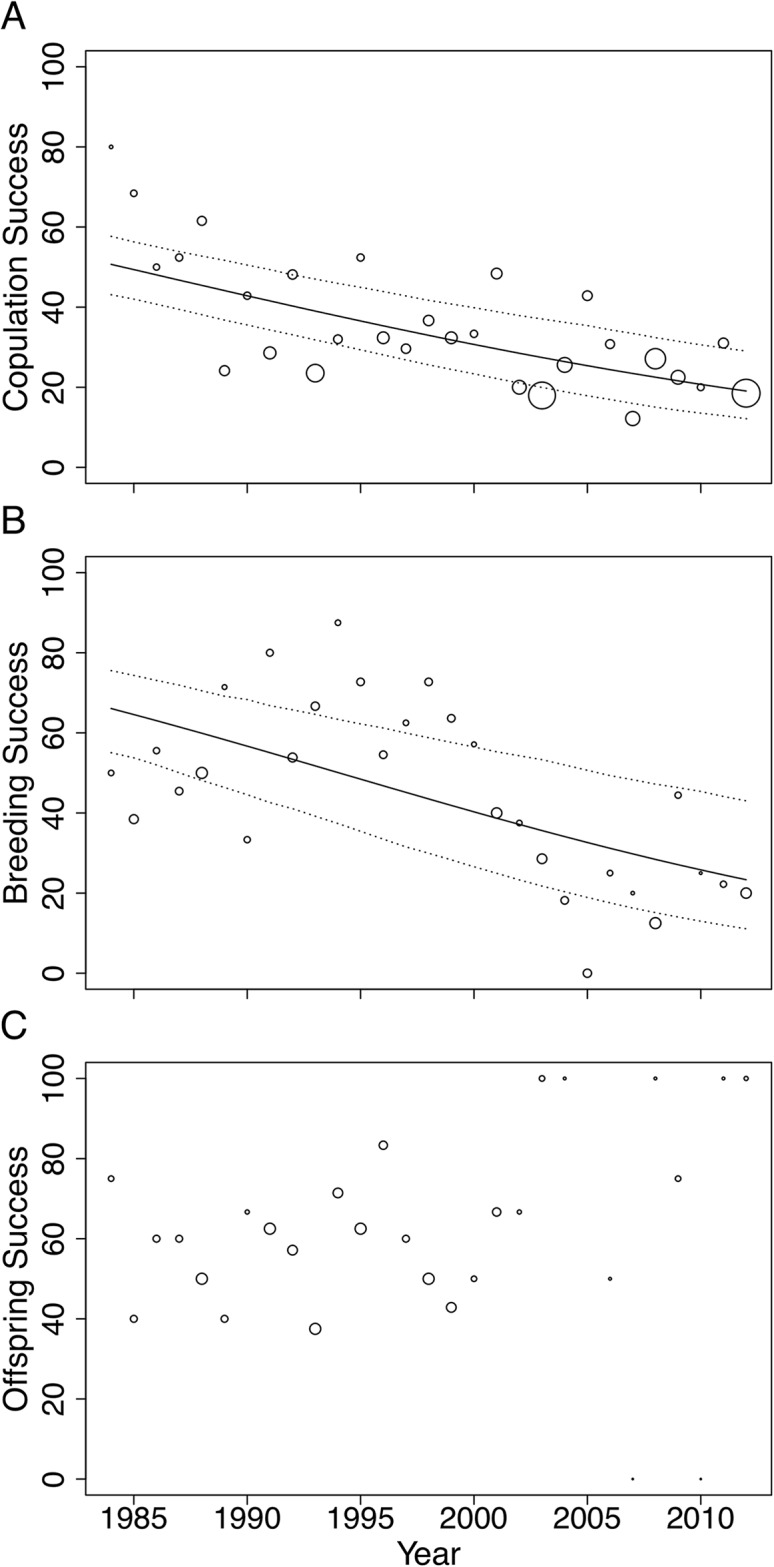
Successful captive breeding programs are crucial to the long-term survival of many threatened species. However, pair incompatibility (breeding failure) limits sustainability of many captive populations. Understanding whether the drivers of this incompatibility are behavioral, genetic, or a combination of both, is crucial to improving breeding programs. We used 28 years of pairing data from the San Diego Zoo koala colony, plus genetic analyses using both major histocompatibility complex (MHC)-linked and non-MHC-linked microsatellite markers, to show that both genetic and non-genetic factors can influence mating success. Male age was reconfirmed to be a contributing factor to the likelihood of a koala pair copulating. This trend could also be related to a pair's age difference, which was highly correlated with male age in our dataset. Familiarity was reconfirmed to increase the probability of a successful copulation. Our data provided evidence that females select mates based on MHC and genome-wide similarity. Male heterozygosity at MHC class II loci was associated with both pre- and post-copulatory female choice. Genome-wide similarity, and similarity at the MHC class II DAB locus, were also associated with female choice at the post-copulatory level. Finally, certain MHC-linked alleles were associated with either increased or decreased mating success. We predict that utilizing a variety of behavioral and MHC-dependent mate choice mechanisms improves female fitness through increased reproductive success. This study highlights the complexity of mate choice mechanisms in a species, and the importance of ascertaining mate choice mechanisms to improve the success of captive breeding programs.
成功的圈养繁殖计划对于许多濒危物种的长期生存至关重要。然而,配对不相容(繁殖失败)限制了许多圈养种群的可持续性。了解这种不相容的驱动因素是行为性的、遗传性的还是两者的结合,对于改进繁殖计划至关重要。我们使用了圣地亚哥动物园考拉种群28年的配对数据,以及使用主要组织相容性复合体(MHC)相关和非MHC相关微卫星标记的遗传分析,以表明遗传和非遗传因素都可以影响交配成功率。再次证实雄性年龄是考拉配对交配可能性的一个促成因素。这种趋势也可能与配对的年龄差异有关,在我们的数据集中,年龄差异与雄性年龄高度相关。再次证实熟悉程度会增加成功交配的概率。我们的数据提供了证据,表明雌性根据MHC和全基因组相似性选择配偶。MHC II类基因座的雄性杂合性与交配前和交配后的雌性选择都有关联。全基因组相似性以及MHC II类DAB基因座的相似性,在交配后水平也与雌性选择有关。最后,某些与MHC相关的等位基因与交配成功率的增加或降低有关。我们预测,利用各种行为和依赖MHC的配偶选择机制,通过提高繁殖成功率来提高雌性的适应性。这项研究突出了一个物种中配偶选择机制的复杂性,以及确定配偶选择机制对于提高圈养繁殖计划成功率的重要性。