• 文献检索
  • 文档翻译
  • 深度研究
  • 学术资讯
  • Suppr Zotero 插件Zotero 插件
  • 邀请有礼
  • 套餐&价格
  • 历史记录
应用&插件
Suppr Zotero 插件Zotero 插件浏览器插件Mac 客户端Windows 客户端微信小程序
定价
高级版会员购买积分包购买API积分包
服务
文献检索文档翻译深度研究API 文档MCP 服务
关于我们
关于 Suppr公司介绍联系我们用户协议隐私条款
关注我们

Suppr 超能文献

核心技术专利:CN118964589B侵权必究
粤ICP备2023148730 号-1Suppr @ 2026

文献检索

告别复杂PubMed语法,用中文像聊天一样搜索,搜遍4000万医学文献。AI智能推荐,让科研检索更轻松。

立即免费搜索

文件翻译

保留排版,准确专业,支持PDF/Word/PPT等文件格式,支持 12+语言互译。

免费翻译文档

深度研究

AI帮你快速写综述,25分钟生成高质量综述,智能提取关键信息,辅助科研写作。

立即免费体验

爬行动物鲜味/甜味味觉受体基因的分子进化

Molecular evolution of umami/sweet taste receptor genes in reptiles.

作者信息

Feng Ping, Liang Shichu

机构信息

Key Laboratory of Ecology of Rare and Endangered Species and Environmental Protection (Guangxi Normal University), Ministry of Education, Guilin, China.

Guangxi Key Laboratory of Rare and Endangered Animal Ecology, Guangxi Normal University, Guilin, China.

出版信息

PeerJ. 2018 Aug 24;6:e5570. doi: 10.7717/peerj.5570. eCollection 2018.

DOI:10.7717/peerj.5570
PMID:30155374
原文链接:https://pmc.ncbi.nlm.nih.gov/articles/PMC6110252/
Abstract

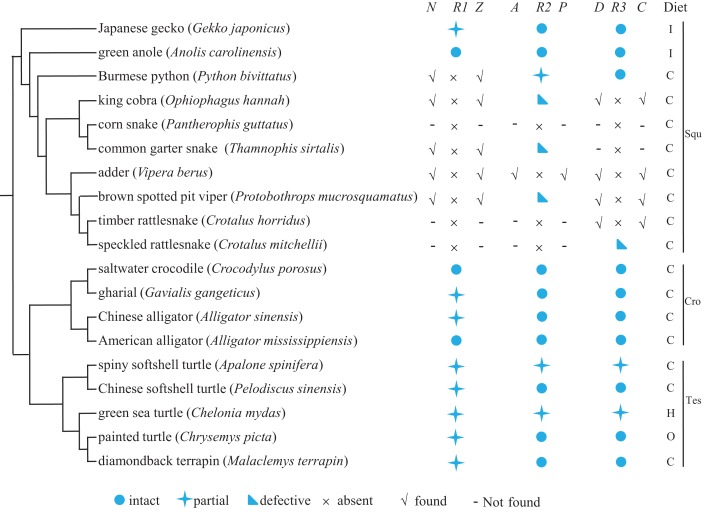
Sensory systems play an important role in animal survival. Changes to these systems may be critical in evolution of species in new environments. Previous studies exploring the correlation between feeding ecology and evolution mainly focused on mammals and birds, and found that the relationship was complex. However, in reptiles, the correlation between evolution and dietary preferences is still unclear. Here, we attempted to explore this relationship in representative species of the major groups of reptiles (turtles, snakes, lizards, crocodilians), for which the genome information is known. We first predicted the functionality (intact, partial, or defective) of , and then related it to the feeding preferences. As a result, we identified 11 , 12 , and 12 genes to be partial or intact and another 22 genes to be absent or pseudogenized in the 19 reptiles. We found that, as it was revealed in some other vertebrate groups, no correlation existed between feeding ecology and evolution in reptiles: genomic prediction indicated that the genes possibly have been lost or pseudogenized in snakes, but in crocodylia and testudines genes are either intact or partial, regardless of their feeding habits. Thus, we suggest that the driving force of evolution in reptiles is complex, and the feeding habit of swallowing food whole without chewing or the absence of taste buds in certain species may account for the possible umami/sweet perception loss. In addition, we propose that caution should be taken when predicting gene functionality from the publicly available genome database.

摘要

感觉系统在动物生存中起着重要作用。这些系统的变化在新环境中物种的进化过程中可能至关重要。先前探索觅食生态学与进化之间相关性的研究主要集中在哺乳动物和鸟类上,并发现这种关系很复杂。然而,在爬行动物中,进化与饮食偏好之间的相关性仍不清楚。在这里,我们试图在基因组信息已知的主要爬行动物类群(龟、蛇、蜥蜴、鳄鱼)的代表性物种中探索这种关系。我们首先预测了[具体基因名称]的功能(完整、部分或有缺陷),然后将其与觅食偏好联系起来。结果,我们在19种爬行动物中鉴定出11个、12个和12个基因是部分或完整的,另外22个基因缺失或假基因化。我们发现,正如在其他一些脊椎动物类群中所揭示的那样,爬行动物的觅食生态学与[具体基因名称]进化之间不存在相关性:基因组预测表明,[具体基因名称]在蛇类中可能已经丢失或假基因化,但在鳄目和龟鳖目中,[具体基因名称]基因要么是完整的,要么是部分的,无论它们的饮食习惯如何。因此,我们认为爬行动物中[具体基因名称]进化的驱动力很复杂,某些物种整个吞食食物而不咀嚼的饮食习惯或味蕾的缺失可能导致鲜味/甜味感知的丧失。此外,我们建议在从公开可用的基因组数据库预测基因功能时应谨慎。
https://cdn.ncbi.nlm.nih.gov/pmc/blobs/a0bc/6110252/98e8fe1a2275/peerj-06-5570-g001.jpg

相似文献

1
Molecular evolution of umami/sweet taste receptor genes in reptiles.爬行动物鲜味/甜味味觉受体基因的分子进化
PeerJ. 2018 Aug 24;6:e5570. doi: 10.7717/peerj.5570. eCollection 2018.
2
Evolutionary insights into umami, sweet, and bitter taste receptors in amphibians.对两栖动物鲜味、甜味和苦味味觉受体的进化见解。
Ecol Evol. 2021 Dec 3;11(24):18011-18025. doi: 10.1002/ece3.8398. eCollection 2021 Dec.
3
Role of feeding specialization in taste receptor loss: insights from sweet and umami receptor evolution in Carnivora.摄食特化在味觉受体丢失中的作用:以食肉目甜鲜味受体演化为例的见解。
Chem Senses. 2022 Jan 1;47. doi: 10.1093/chemse/bjac033.
4
Major taste loss in carnivorous mammals.主要的肉食性哺乳动物味觉丧失。
Proc Natl Acad Sci U S A. 2012 Mar 27;109(13):4956-61. doi: 10.1073/pnas.1118360109. Epub 2012 Mar 12.
5
Genomic and genetic evidence for the loss of umami taste in bats.基因组和遗传证据表明蝙蝠失去了鲜味。
Genome Biol Evol. 2012;4(1):73-9. doi: 10.1093/gbe/evr126. Epub 2011 Nov 24.
6
Genes from the TAS1R and TAS2R Families of Taste Receptors: Looking for Signatures of Their Adaptive Role in Human Evolution.味觉受体 TAS1R 和 TAS2R 家族的基因:寻找其在人类进化中适应性作用的特征。
Genome Biol Evol. 2018 Apr 1;10(4):1139-1152. doi: 10.1093/gbe/evy071.
7
Variation in the human TAS1R taste receptor genes.人类TAS1R味觉受体基因的变异
Chem Senses. 2006 Sep;31(7):599-611. doi: 10.1093/chemse/bjj065. Epub 2006 Jun 26.
8
Variations in TAS1R taste receptor gene family modify food intake and gastric cancer risk in a Korean population.TAS1R味觉受体基因家族的变异会改变韩国人群的食物摄入量和胃癌风险。
Mol Nutr Food Res. 2016 Nov;60(11):2433-2445. doi: 10.1002/mnfr.201600145. Epub 2016 Aug 16.
9
Differentiated adaptive evolution, episodic relaxation of selective constraints, and pseudogenization of umami and sweet taste genes TAS1Rs in catarrhine primates.旧世界猴类灵长动物中鲜味和甜味味觉基因TAS1Rs的分化适应性进化、选择性限制的阶段性放松及假基因化
Front Zool. 2014 Oct 29;11(1):79. doi: 10.1186/s12983-014-0079-4. eCollection 2014.
10
Loss of sweet taste despite the conservation of sweet receptor genes in insectivorous bats.尽管食虫蝙蝠的甜味受体基因得以保留,但它们却丧失了对甜味的感知。
Proc Natl Acad Sci U S A. 2021 Jan 26;118(4). doi: 10.1073/pnas.2021516118.

引用本文的文献

1
A vertebrate-wide catalogue of T1R receptors reveals diversity in taste perception.脊椎动物 T1R 受体目录揭示了味觉感知的多样性。
Nat Ecol Evol. 2024 Jan;8(1):111-120. doi: 10.1038/s41559-023-02258-8. Epub 2023 Dec 13.
2
Role of feeding specialization in taste receptor loss: insights from sweet and umami receptor evolution in Carnivora.摄食特化在味觉受体丢失中的作用:以食肉目甜鲜味受体演化为例的见解。
Chem Senses. 2022 Jan 1;47. doi: 10.1093/chemse/bjac033.
3
Evolutionary insights into umami, sweet, and bitter taste receptors in amphibians.

本文引用的文献

1
Genomic evidence of bitter taste in snakes and phylogenetic analysis of bitter taste receptor genes in reptiles.蛇类苦味的基因组证据及爬行动物苦味受体基因的系统发育分析
PeerJ. 2017 Aug 18;5:e3708. doi: 10.7717/peerj.3708. eCollection 2017.
2
How phylogeny and foraging ecology drive the level of chemosensory exploration in lizards and snakes.系统发育和觅食生态学如何驱动蜥蜴和蛇类的化学感应探索水平。
J Evol Biol. 2017 Mar;30(3):627-640. doi: 10.1111/jeb.13032. Epub 2017 Jan 10.
3
Contrasting Patterns of Evolutionary Diversification in the Olfactory Repertoires of Reptile and Bird Genomes.
对两栖动物鲜味、甜味和苦味味觉受体的进化见解。
Ecol Evol. 2021 Dec 3;11(24):18011-18025. doi: 10.1002/ece3.8398. eCollection 2021 Dec.
爬行动物和鸟类基因组嗅觉基因库中进化多样化的对比模式。
Genome Biol Evol. 2016 Feb 9;8(3):470-80. doi: 10.1093/gbe/evw013.
4
Olfactory Receptor Subgenomes Linked with Broad Ecological Adaptations in Sauropsida.嗅受体亚基因组与蜥形纲动物广泛的生态适应性相关联。
Mol Biol Evol. 2015 Nov;32(11):2832-43. doi: 10.1093/molbev/msv155. Epub 2015 Jul 28.
5
Molecular evidence for the loss of three basic tastes in penguins.企鹅失去三种基本味觉的分子证据。
Curr Biol. 2015 Feb 16;25(4):R141-2. doi: 10.1016/j.cub.2015.01.026.
6
Three crocodilian genomes reveal ancestral patterns of evolution among archosaurs.三个鳄鱼基因组揭示了主龙类动物进化的祖先模式。
Science. 2014 Dec 12;346(6215):1254449. doi: 10.1126/science.1254449. Epub 2014 Dec 11.
7
Whole-genome analyses resolve early branches in the tree of life of modern birds.全基因组分析解决了现代鸟类生命之树早期分支的问题。
Science. 2014 Dec 12;346(6215):1320-31. doi: 10.1126/science.1253451.
8
Comparative genomics reveals insights into avian genome evolution and adaptation.比较基因组学揭示了鸟类基因组进化和适应的见解。
Science. 2014 Dec 12;346(6215):1311-20. doi: 10.1126/science.1251385. Epub 2014 Dec 11.
9
Differentiated adaptive evolution, episodic relaxation of selective constraints, and pseudogenization of umami and sweet taste genes TAS1Rs in catarrhine primates.旧世界猴类灵长动物中鲜味和甜味味觉基因TAS1Rs的分化适应性进化、选择性限制的阶段性放松及假基因化
Front Zool. 2014 Oct 29;11(1):79. doi: 10.1186/s12983-014-0079-4. eCollection 2014.
10
Sensory biology. Evolution of sweet taste perception in hummingbirds by transformation of the ancestral umami receptor.感觉生物学。通过改造祖先鲜味受体,蜂鸟中甜味感知的进化。
Science. 2014 Aug 22;345(6199):929-33. doi: 10.1126/science.1255097.