Love Susan M, Berg Wendie A, Podilchuk Christine, López Aldrete Ana Lilia, Gaxiola Mascareño Aarón Patricio, Pathicherikollamparambil Krishnamohan, Sankarasubramanian Ananth, Eshraghi Leah, Mammone Richard
Susan M. Love and Leah Eshraghi, Dr Susan Love Research Foundation, Encino, CA; Wendie A. Berg, Magee-Womens Hospital, University of Pittsburgh School of Medicine, Pittsburgh, PA; Christine Podilchuk, Krishnamohan Pathicherikollamparambil, Ananth Sankarasubramanian, and Richard Mammone, AI Strategy, Warren, NJ; Richard Mammone, Rutgers University, New Brunswick, NJ; and Ana Lilia López Aldrete and Aarón Patricio Gaxiola Mascareño, Instituto de Seguridad y Servicios Sociales de los Trabajadores del Estado Hospital Regional Valentin Gomez Farias, Jalisco, Mexico.
J Glob Oncol. 2018 Aug;4:1-9. doi: 10.1200/JGO.17.00222.
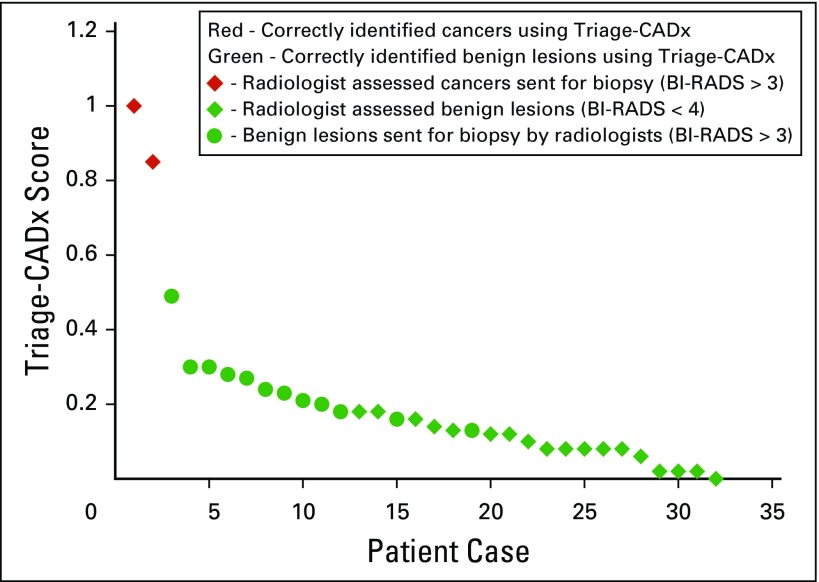
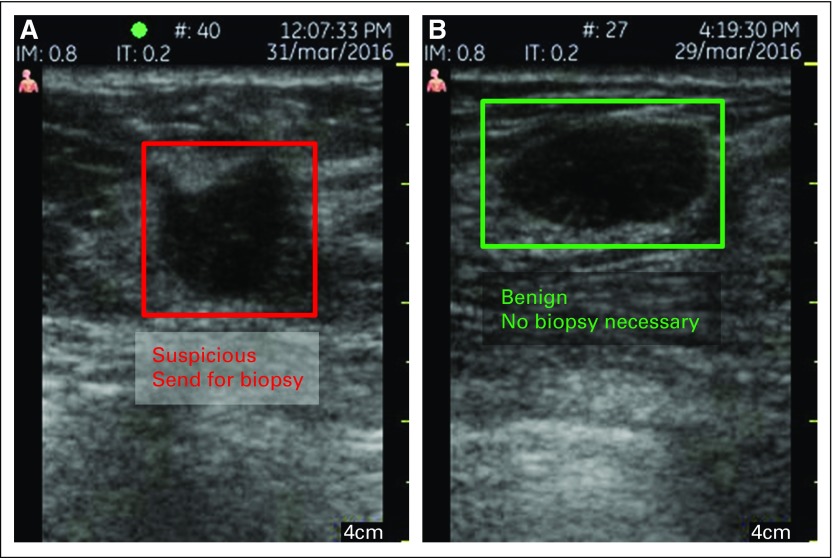
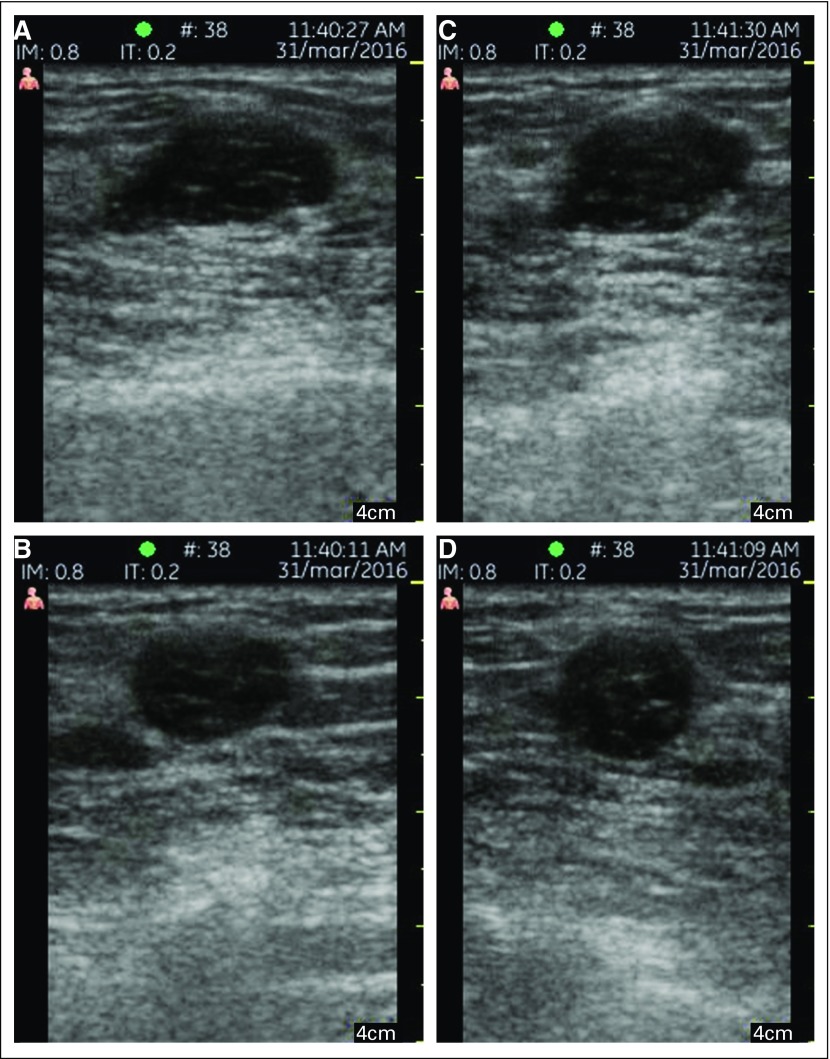
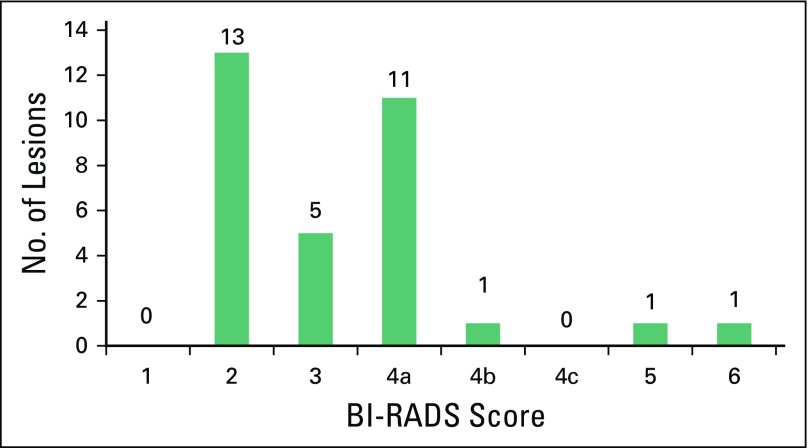
Purpose In low- to middle-income countries (LMICs), most breast cancers present as palpable lumps; however, most palpable lumps are benign. We have developed artificial intelligence-based computer-assisted diagnosis (CADx) for an existing low-cost portable ultrasound system to triage which lumps need further evaluation and which are clearly benign. This pilot study was conducted to demonstrate that this approach can be successfully used by minimally trained health care workers in an LMIC country. Patients and Methods We recruited and trained three nonradiologist health care workers to participate in an institutional review board-approved, Health Insurance Portability and Accountability Act-compliant pilot study in Jalisco, Mexico, to determine whether they could use portable ultrasound (GE Vscan Dual Probe) to acquire images of palpable breast lumps of adequate quality for accurate computer analysis. Images from 32 women with 32 breast masses were then analyzed with a triage-CADx system, generating an output of benign or suspicious (biopsy recommended). Triage-CADx outputs were compared with radiologist readings. Results The nonradiologists were able to acquire adequate images. Triage by the CADx software was as accurate as assessment by specialist radiologists, with two (100%) of two cancers considered suspicious and 30 (100%) of 30 benign lesions classified as benign. Conclusion A portable ultrasound system with CADx software can be successfully used by first-level health care workers to triage palpable breast lumps. These results open up the possibility of implementing practical, cost-effective triage of palpable breast lumps, ensuring that scarce resources can be dedicated to suspicious lesions requiring further workup.
目的 在低收入和中等收入国家(LMICs),大多数乳腺癌表现为可触及的肿块;然而,大多数可触及的肿块是良性的。我们为现有的低成本便携式超声系统开发了基于人工智能的计算机辅助诊断(CADx),以对哪些肿块需要进一步评估以及哪些明显是良性的进行分类。本试点研究旨在证明这种方法可以被LMIC国家中受过最少培训的医护人员成功使用。
患者与方法 我们招募并培训了三名非放射科医护人员,参与在墨西哥哈利斯科州进行的一项经机构审查委员会批准、符合《健康保险流通与责任法案》的试点研究,以确定他们是否能够使用便携式超声(GE Vscan双探头)获取质量足够的可触及乳腺肿块图像,用于准确的计算机分析。然后使用分类CADx系统分析来自32名患有32个乳腺肿块的女性的图像,生成良性或可疑(建议活检)的输出结果。将分类CADx的输出结果与放射科医生的诊断结果进行比较。
结果 非放射科医生能够获取足够的图像。CADx软件的分类与专科放射科医生的评估一样准确,2个癌症中有2个(100%)被认为可疑,30个良性病变中有30个(100%)被分类为良性。
结论 配备CADx软件的便携式超声系统可以被一级医护人员成功用于对可触及乳腺肿块进行分类。这些结果为实施实用、经济有效的可触及乳腺肿块分类开辟了可能性,确保稀缺资源能够用于需要进一步检查的可疑病变。