University of Groningen, University Medical Center Groningen, Beatrix Children's Hospital, 9700, RB, Groningen, The Netherlands.
Department of Gastroenterology, Radboud University Medical Center, Nijmegen, The Netherlands.
Orphanet J Rare Dis. 2018 Aug 29;13(1):149. doi: 10.1186/s13023-018-0890-7.
Phenylketonuria (PKU) is often considered as the classical example of a genetic disorder in which severe symptoms can nowadays successfully be prevented by early diagnosis and treatment. In contrast, untreated or late-treated PKU is known to result in severe intellectual disability, seizures, and behavioral disturbances. Rarely, however, untreated or late-diagnosed PKU patients with high plasma phenylalanine concentrations have been reported to escape from intellectual disability. The present study aimed to review published cases of such PKU patients.
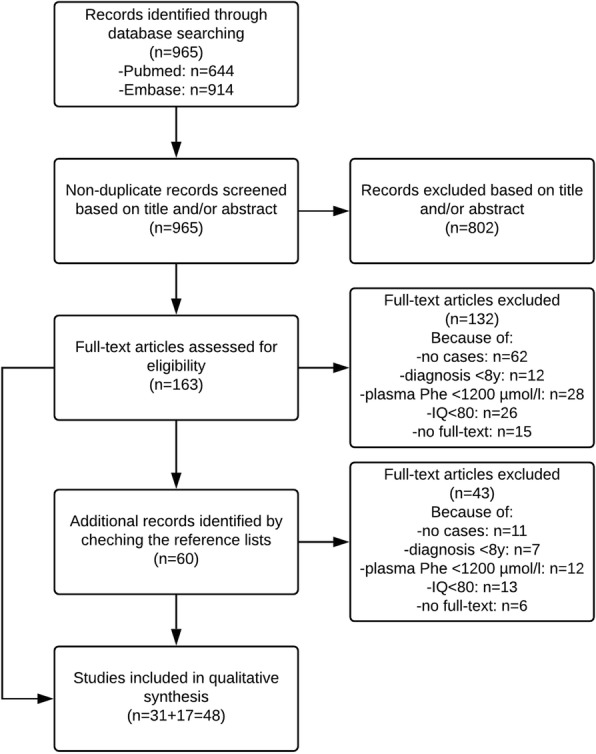
To this purpose, we conducted a literature search in PubMed and EMBASE up to 8th of September 2017 to identify cases with 1) PKU diagnosis and start of treatment after 7 years of age; 2) untreated plasma phenylalanine concentrations ≥1200 μmol/l; and 3) IQ ≥80. Literature search, checking reference lists, selection of articles, and extraction of data were performed by two independent researchers.
In total, we identified 59 published cases of patients with late-diagnosed PKU and unexpected favorable outcome who met the inclusion criteria. Although all investigated patients had intellectual functioning within the normal range, at least 19 showed other neurological, psychological, and/or behavioral symptoms.
Based on the present findings, the classical symptomatology of untreated or late-treated PKU may need to be rewritten, not only in the sense that intellectual dysfunction is not obligatory, but also in the sense that intellectual functioning does not (re)present the full picture of brain damage due to high plasma phenylalanine concentrations. Further identification of such patients and additional analyses are necessary to better understand these differences between PKU patients.
苯丙酮尿症(PKU)通常被认为是一种遗传疾病的典型范例,通过早期诊断和治疗,可以成功预防严重症状。相比之下,未经治疗或治疗不及时的 PKU 会导致严重的智力残疾、癫痫发作和行为障碍。然而,很少有未经治疗或诊断较晚、血浆苯丙氨酸浓度较高的 PKU 患者被报道能够避免智力残疾。本研究旨在回顾已发表的此类 PKU 患者病例。
为此,我们在 PubMed 和 EMBASE 上进行了文献检索,检索时间截至 2017 年 9 月 8 日,以确定符合以下条件的病例:1)PKU 诊断,并在 7 岁后开始治疗;2)未治疗的血浆苯丙氨酸浓度≥1200μmol/l;3)智商≥80。文献检索、参考文献列表检查、文章选择和数据提取由两名独立研究人员完成。
总共确定了 59 例符合纳入标准的迟发性 PKU 患者和意外良好预后的已发表病例。尽管所有被调查的患者的智力功能均处于正常范围内,但至少有 19 例患者存在其他神经、心理和/或行为症状。
基于目前的发现,未经治疗或治疗不及时的 PKU 的经典症状可能需要改写,不仅因为智力功能障碍不是强制性的,而且因为智力功能并不代表由于高血浆苯丙氨酸浓度而导致的大脑损伤的全貌。进一步确定这些患者并进行额外的分析,对于更好地理解 PKU 患者之间的这些差异是必要的。