da Cunha Ribeiro Roberta P, Franco Tathiane C, Pinto Ana J, Pontes Filho Marco A G, Domiciano Diogo S, de Sá Pinto Ana L, Lima Fernanda R, Roschel Hamilton, Gualano Bruno
Rheumatology Division, Hospital das Clinicas HCFMUSP, Faculdade de Medicina, University of São Paulo, São Paulo, Brazil.
Applied Physiology and Nutrition Group, Faculdade de Medicina, University of São Paulo, São Paulo, Brazil.
Front Physiol. 2018 Aug 10;9:1097. doi: 10.3389/fphys.2018.01097. eCollection 2018.
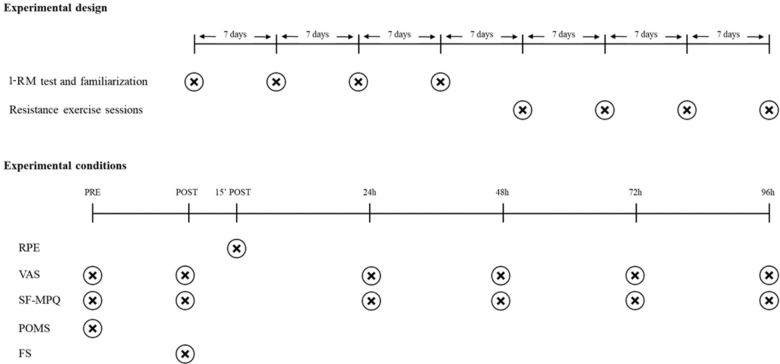
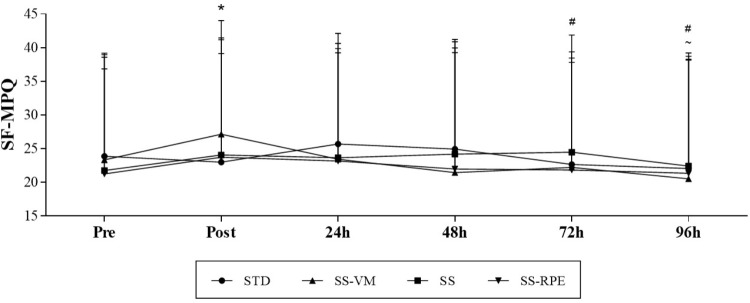
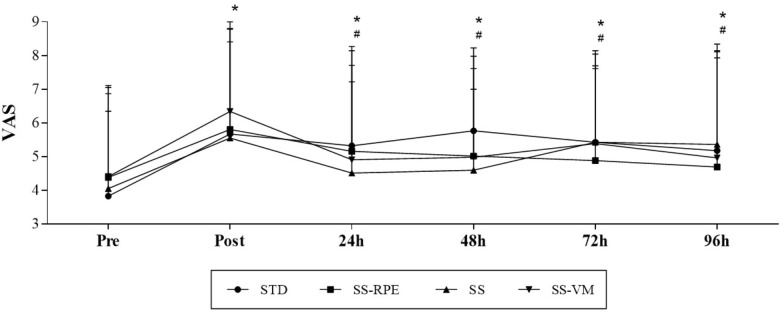
Exercise is the treatment of choice for fibromyalgia (FM), but little is known about resistance exercise prescription to modulate pain in this condition. This study aimed to compare the effects of different resistance exercise models, comprising self-selected or prescribed intensity, on pain in FM patients. In a cross-over fashion, 32 patients underwent the following sessions: (i) standard prescription (STD; 3 × 10 repetitions at 60% of maximal strength); (ii) self-selected load with fixed number of repetitions (SS); (iii) self-selected load with volume load (i.e., load × sets × repetitions) matched for STD (SS-VM); and (iv) self-selected load with a free number of repetitions until achieving score 7 of rating perceived exertion (SS-RPE). Pain, assessed by Visual Analogic Scale (VAS) and Short-Form McGill Pain Questionnaire (SF-MPQ), was evaluated before and 0, 24, 48, 72, and 96 h after the sessions. Load was significantly lower in SS, SS-VM, SS-RPE than in STD, whereas rating perceived exertion and volume load were comparable between sessions. VAS scores increased immediately after all sessions ( < 0.0001), and reduced after 48, 72, 96 h ( < 0.0001), remaining elevated compared to pre-values. SF-MPQ scores increased immediately after all exercise sessions ( = 0.025), then gradually reduced across time, reaching baseline levels at 24 h. No significant differences between sessions were observed. Both prescribed and preferred intensity resistance exercises failed in reducing pain in FM patients. The recommendation that FM patients should exercise at preferred intensities to avoid exacerbated pain, which appears to be valid for aerobic exercise, does not apply to resistance exercise.
运动是纤维肌痛(FM)的首选治疗方法,但对于通过抗阻运动处方来调节这种情况下的疼痛却知之甚少。本研究旨在比较不同抗阻运动模式(包括自我选择或规定强度)对FM患者疼痛的影响。32名患者以交叉方式接受了以下训练:(i)标准处方(STD;以最大力量的60%进行3组,每组10次重复);(ii)固定重复次数的自我选择负荷(SS);(iii)与STD匹配的自我选择负荷且总负荷量(即负荷×组数×重复次数)相等(SS-VM);以及(iv)自我选择负荷且重复次数自由直至达到自感用力度7分(SS-RPE)。在训练前以及训练后0、24、48、72和96小时,通过视觉模拟量表(VAS)和简短麦吉尔疼痛问卷(SF-MPQ)评估疼痛情况。SS、SS-VM、SS-RPE组的负荷显著低于STD组,而各训练之间的自感用力度和总负荷量相当。所有训练后VAS评分立即升高(P<0.0001),并在48、72、96小时后降低(P<0.0001),但与训练前相比仍高于基线。所有运动训练后SF-MPQ评分立即升高(P = 0.025),然后随时间逐渐降低,在24小时达到基线水平。各训练之间未观察到显著差异。规定强度和偏好强度的抗阻运动均未能减轻FM患者的疼痛。对于有氧运动似乎有效的建议,即FM患者应以偏好强度进行运动以避免疼痛加剧,并不适用于抗阻运动。