Department of Kinesiology, University of Wisconsin-Madison, Madison, WI 53706-1121, USA.
Med Sci Sports Exerc. 2011 Jun;43(6):1106-13. doi: 10.1249/MSS.0b013e3182061b49.
The purpose of this study was to examine the influence of a preferred- versus a prescribed-intensity exercise session on pain in women with fibromyalgia (FM).
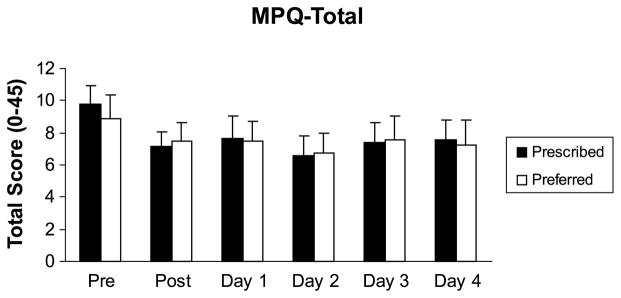
Twenty-one women with FM (mean age = 44 yr) completed two randomly assigned exercise sessions consisting of 20 min of cycle ergometry at a self-selected intensity and a prescribed intensity. Experimental pain perception was assessed before and after aerobic exercise. During exercise, HR, watts, RPE, and muscle pain were assessed every 5 min. Clinical pain was assessed with the Short-Form McGill Pain Questionnaire (SF-MPQ) immediately and 24, 48, 72, and 96 h after exercise. Data were analyzed with repeated-measures ANOVA.
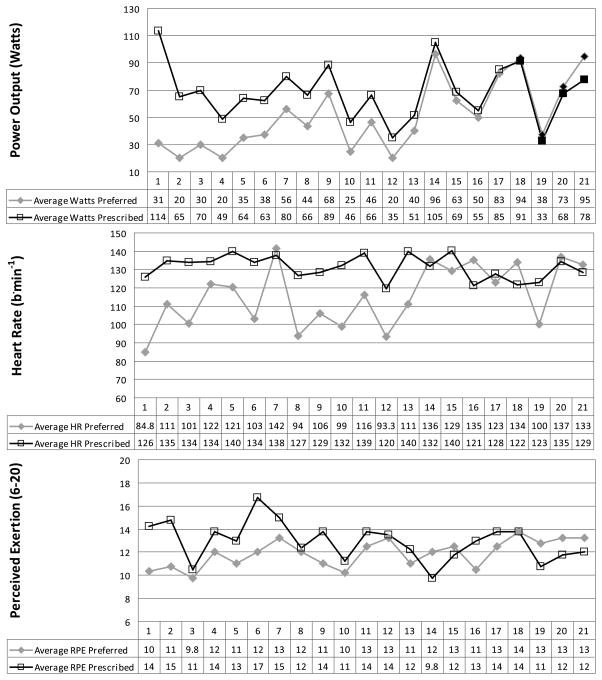
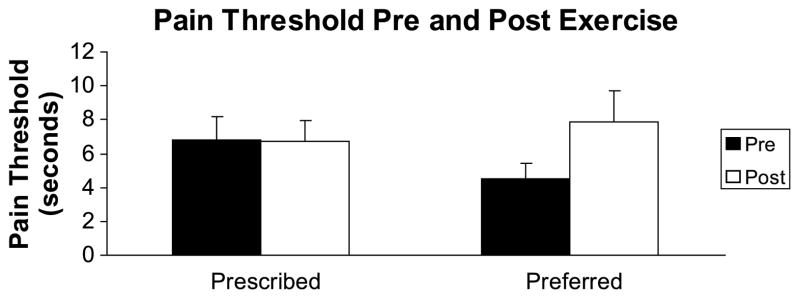
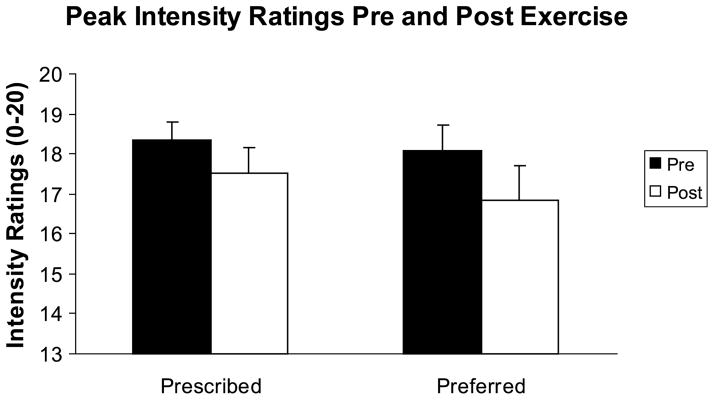
Women with FM preferred a lower intensity of exercise than what was prescribed as indicated by significantly lower HR, watts, and RPE responses (P < 0.05). Muscle pain in the legs, however, was similar in the two conditions and significantly increased during exercise (P < 0.05). Pain thresholds and pain tolerances increased significantly after exercise, whereas peak pain ratings decreased after exercise (P < 0.05). Furthermore, pain (SF-MPQ) in the follow-up period was found to be lower than baseline (P < 0.05).
It is concluded that the women with FM who participated in this study experienced significant improvements in pain after exercise. The results from this study are novel and indicate that recommendations for exercise prescription for individuals with FM should consider the preferred-intensity exercise model as a strategy to reduce pain.
本研究旨在探讨在患有纤维肌痛(FM)的女性中,选择强度和规定强度的运动对疼痛的影响。
21 名患有 FM 的女性(平均年龄=44 岁)完成了两次随机分配的运动,包括 20 分钟的自行选择强度和规定强度的自行车测功计运动。运动前后评估实验性疼痛感知。运动期间,每 5 分钟评估一次 HR、瓦特、RPE 和肌肉疼痛。运动后立即和 24、48、72 和 96 小时使用简短 McGill 疼痛问卷(SF-MPQ)评估临床疼痛。采用重复测量方差分析进行数据分析。
FM 患者选择的运动强度低于规定强度,这表明 HR、瓦特和 RPE 反应明显较低(P<0.05)。然而,腿部肌肉疼痛在两种情况下相似,运动时明显增加(P<0.05)。运动后疼痛阈值和疼痛耐受力显著增加,而运动后峰值疼痛评分降低(P<0.05)。此外,随访期的疼痛(SF-MPQ)低于基线(P<0.05)。
本研究表明,参加本研究的 FM 患者在运动后疼痛明显减轻。研究结果是新颖的,表明 FM 患者的运动处方建议应考虑首选强度运动模式,作为减轻疼痛的策略。