Jang Hye-Young, Ahn Jung-Won, Jeon Mi-Kyeong
College of Nursing, Hanyang University, Seoul, Korea.
Red Cross College of Nursing, Chung-Ang University, Seoul, Korea.
Osong Public Health Res Perspect. 2018 Aug;9(4):197-206. doi: 10.24171/j.phrp.2018.9.4.09.
This study was designed to investigate factors affecting the discordance between body image and body mass index amongst Korean adults aged 19-39 years.
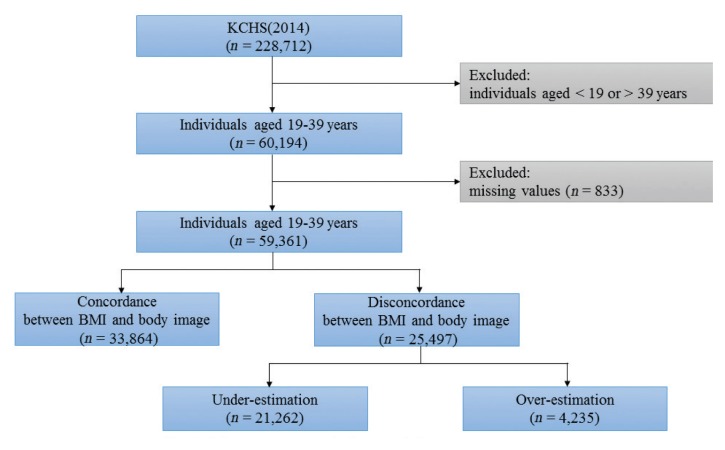
Data ( = 59,361) from the 2014 Korean Community Health Survey was analyzed using descriptive analysis, chi-square test, and logistic regression analysis.
To examine the factors affecting body image discordance as observed in 43.1% of participants, the group was subdivided into underestimation and overestimation. There were 36.0% of participants that were body image discordant underestimators and 7.1% were overestimators. Multivariate logistic regression analysis showed that the underestimators tended to be men, graduated from high school, married, current/ex-smokers, ex-drinkers, had between 5 to 9 hours sleep (inclusive), had fair to good self-rated health, and demonstrated healthy weight control behavior, relative to the reference group. In comparison, overestimators tended to be in the 19-29 year group and had signs of depression. The OR of individuals who were men, married, and had healthy weight control behavior was significantly lower in the overestimators group.
These findings show that tailored interventions to promote accurate body awareness should be based on the type of body image discordance. In addition, it is necessary to develop and implement a program of body image improvement that considers the factors affecting body weight discordance.
本研究旨在调查影响19 - 39岁韩国成年人身体意象与体重指数不一致的因素。
使用描述性分析、卡方检验和逻辑回归分析对2014年韩国社区健康调查的数据(n = 59,361)进行分析。
为了研究影响43.1%参与者所表现出的身体意象不一致的因素,将该组分为低估组和高估组。36.0%的参与者为身体意象不一致低估者,7.1%为高估者。多变量逻辑回归分析表明,相对于参照组,低估者倾向于为男性、高中毕业、已婚、当前吸烟者/曾经吸烟者、曾经饮酒者、睡眠5至9小时(含)、自我评估健康状况为中等至良好,并且表现出健康的体重控制行为。相比之下,高估者倾向于年龄在19 - 29岁组且有抑郁迹象。在高估者组中,男性、已婚且有健康体重控制行为的个体的比值比显著更低。
这些发现表明,促进准确身体意识的针对性干预应基于身体意象不一致的类型。此外,有必要制定并实施一个考虑影响体重不一致因素的身体意象改善计划。