Department for BioMedical Research (DBMR), University of Bern, Bern, Switzerland.
Graduate School for Cellular and Biomedical Sciences, University of Bern, Bern, Switzerland.
PLoS One. 2018 Aug 30;13(8):e0203409. doi: 10.1371/journal.pone.0203409. eCollection 2018.
Local drug delivery systems that adjust the release of immunosuppressive drug in response to the nature and intensity of inflammation represent a promising approach to reduce systemic immunosuppression and its side effects in allotransplantation. Here we aimed to demonstrate that release of tacrolimus from triglycerol monostearate hydrogel is inflammation-dependent in vivo. We further report that by loading the hydrogel with a near-infrared dye, it is possible to monitor drug release non-invasively in an in vivo model of vascularized composite allotransplantation.
Inflammation was induced by local challenge with lipopolysaccharides in naïve rats 7 days after injection of tacrolimus-loaded hydrogel in the hind limb. Tacrolimus levels in blood and tissues were measured at selected time points. A near-infrared dye was encapsulated in the hydrogel together with tacrolimus in order to monitor hydrogel deposits and drug release in vitro and in vivo in a model of vascularized composite allotransplantation.
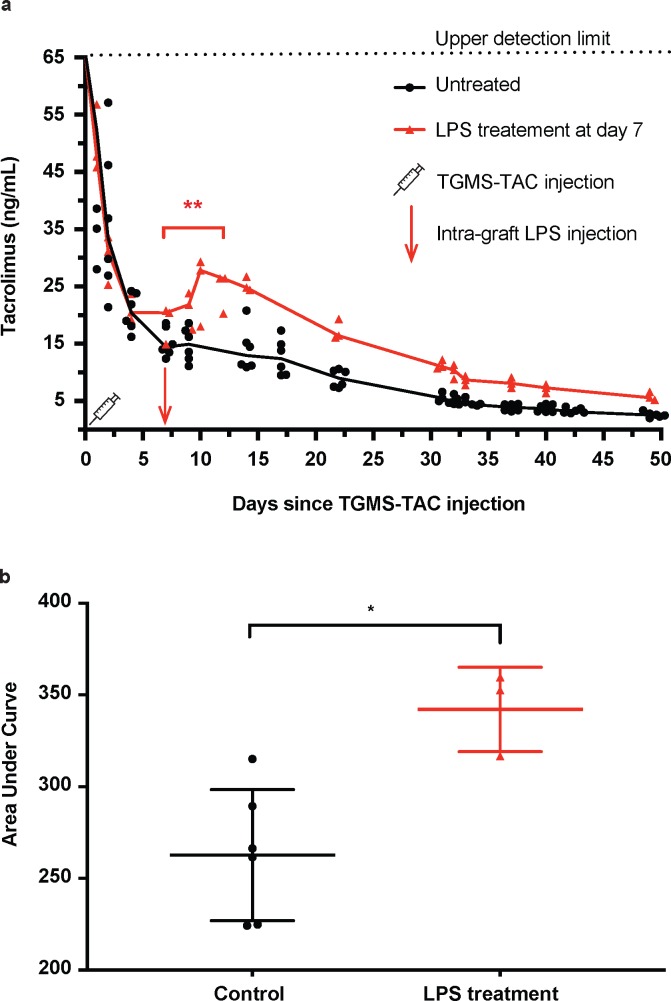
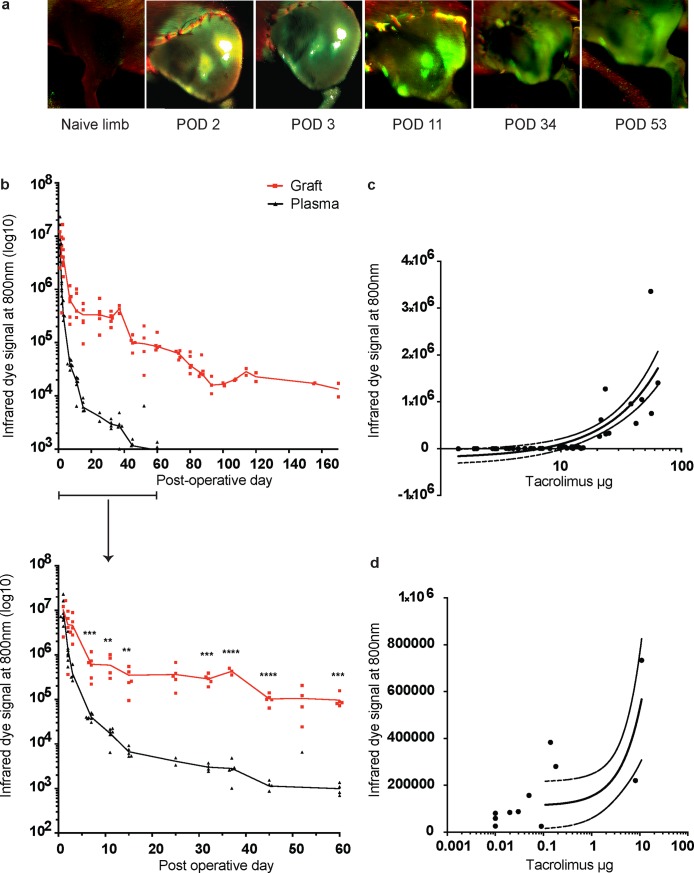
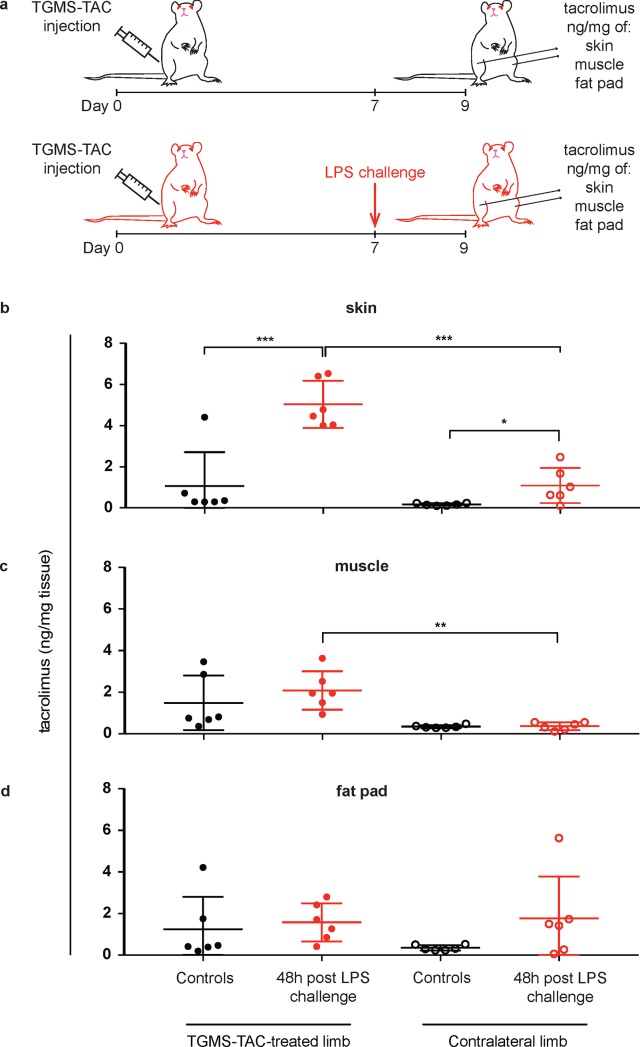
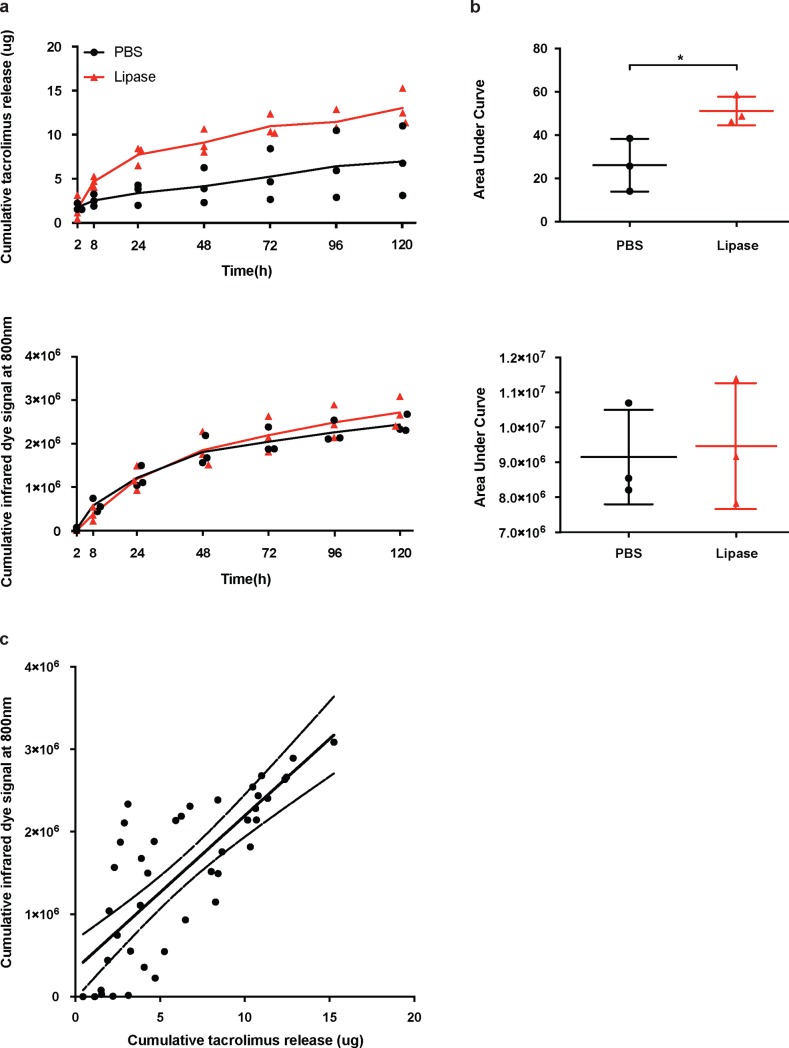
Injection of lipopolysaccharides led to increased blood and skin tacrolimus levels (p = 0.0076, day 7 vs. day 12 in blood, and p = 0.0007 in treated limbs, 48 h after injection compared to controls). Moreover, lipopolysaccharides-injected animals had higher tacrolimus levels in treated limbs compared to contralateral limbs (p = 0.0003 for skin and p = 0.0053 for muscle). Imaging of hydrogel deposits and tacrolimus release was achieved by encapsulating near-infrared dye in the hydrogel for 160 days. The correlation of tacrolimus and near-infrared dye release from hydrogel was R2 = 0.6297 and R2 = 0.5619 in blood and grafts of transplanted animals respectively and R2 = 0.6066 in vitro.
Here we demonstrate the inflammation-responsiveness of a tacrolimus-loaded hydrogel in vivo. Moreover, we show that encapsulating a near-infrared dye in the hydrogel provides a reliable correlation of tacrolimus and dye release from the hydrogel, and an accessible non-invasive method for monitoring drug release from hydrogel deposits.
局部药物递送系统可以根据炎症的性质和强度来调节免疫抑制剂的释放,这是一种很有前途的方法,可以减少同种异体移植中全身免疫抑制及其副作用。在这里,我们旨在证明甘油单硬脂酸酯水凝胶中他克莫司的释放是依赖于炎症的。我们进一步报告说,通过将近红外染料载入水凝胶中,可以在血管化复合同种异体移植的体内模型中进行非侵入性监测药物释放。
在注射载他克莫司水凝胶后 7 天,通过局部给予脂多糖诱导炎症,在新生大鼠的后肢中诱导炎症。在选定的时间点测量血液和组织中的他克莫司水平。将近红外染料与他克莫司一起封装在水凝胶中,以便在血管化复合同种异体移植模型中体外和体内监测水凝胶沉积和药物释放。
注射脂多糖导致血液和皮肤中他克莫司水平升高(p = 0.0076,第 7 天与第 12 天相比,血液中 p = 0.0007,第 48 小时与对照组相比,注射部位 p = 0.0003)。此外,脂多糖注射动物的治疗肢体中他克莫司水平高于对侧肢体(皮肤 p = 0.0003,肌肉 p = 0.0053)。通过在水凝胶中封装近红外染料,实现了水凝胶沉积和他克莫司释放的成像,持续了 160 天。在移植动物的血液和移植物中,他克莫司和近红外染料从水凝胶中的释放的相关性分别为 R2 = 0.6297 和 R2 = 0.5619,在体外为 R2 = 0.6066。
在这里,我们证明了载他克莫司水凝胶在体内的炎症反应性。此外,我们表明,在水凝胶中封装近红外染料提供了一种可靠的方法来关联水凝胶中他克莫司和染料的释放,并提供了一种可访问的非侵入性方法来监测水凝胶沉积中的药物释放。