Medizinische Klinik und Poliklinik I, Ludwig Maximilians-Universität, Munich, Germany.
DZHK (German Center for Cardiovascular Research), Partner Site Munich Heart Alliance, Munich, Germany.
Eur Heart J. 2018 Nov 1;39(41):3715-3723. doi: 10.1093/eurheartj/ehy546.
Advances of cardiac computed tomography angiography (CTA) have been developed for dose reduction, but their efficacy in clinical practice is largely unknown. This study was designed to evaluate radiation dose exposure and utilization of dose-saving strategies for contrast-enhanced cardiac CTA in daily practice.
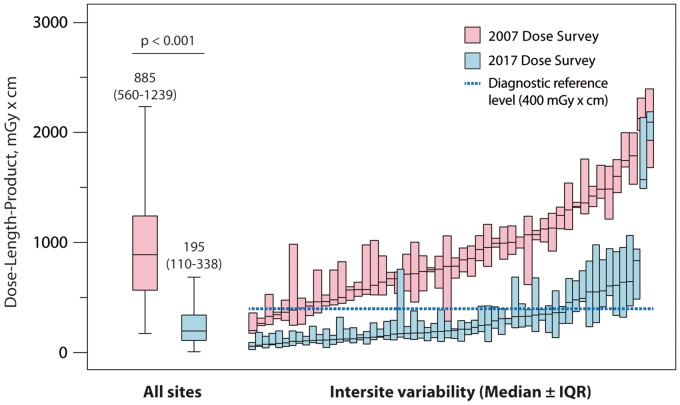
Sixty one hospitals from 32 countries prospectively enrolled 4502 patients undergoing cardiac CTA during one calendar month in 2017. Computed tomography angiography scan data and images were analysed in a central core lab and compared with a similar dose survey performed in 2007. Linear regression analysis was performed to identify independent predictors associated with dose. The most frequent indication for cardiac CTA was the evaluation of coronary artery disease in 89% of patients. The median dose-length product (DLP) of coronary CTA was 195 mGycm (interquartile range 110-338 mGycm). When compared with 2007, the DLP was reduced by 78% (P < 0.001) without an increase in non-diagnostic coronary CTAs (1.7% in 2007 vs. 1.9% in 2017 surveys, P = 0.55). A 37-fold variability in median DLP was observed between the hospitals with lowest and highest DLP (range of median DLP 57-2090 mGy*cm). Independent predictors for radiation dose of coronary CTA were: body weight, heart rate, sinus rhythm, tube voltage, iterative image reconstruction, and the selection of scan protocols.
This large international radiation dose survey demonstrates considerable reduction of radiation exposure in coronary CTA during the last decade. However, the large inter-site variability in radiation exposure underlines the need for further site-specific training and adaptation of contemporary cardiac scan protocols.
心脏计算机断层扫描血管造影术(CTA)的进步已经实现了剂量降低,但它们在临床实践中的效果在很大程度上尚不清楚。本研究旨在评估在日常实践中使用对比增强心脏 CTA 时的辐射剂量暴露和剂量节约策略的应用。
来自 32 个国家的 61 家医院前瞻性地纳入了 2017 年一个日历月期间进行心脏 CTA 的 4502 例患者。在一个中心核心实验室对 CT 血管造影扫描数据和图像进行分析,并与 2007 年进行的类似剂量调查进行比较。进行线性回归分析以确定与剂量相关的独立预测因素。心脏 CTA 的最常见适应证是 89%的患者评估冠状动脉疾病。冠状动脉 CTA 的中位剂量长度乘积(DLP)为 195mGycm(四分位距 110-338mGycm)。与 2007 年相比,DLP 降低了 78%(P<0.001),同时非诊断性冠状动脉 CTA 没有增加(2007 年调查为 1.7%,2017 年调查为 1.9%,P=0.55)。辐射剂量最低和最高的医院之间 DLP 的中位数差异达 37 倍(中位数 DLP 范围为 57-2090mGy*cm)。冠状动脉 CTA 辐射剂量的独立预测因素为:体重、心率、窦性节律、管电压、迭代图像重建和扫描方案的选择。
这项大型国际辐射剂量调查表明,在过去十年中,冠状动脉 CTA 的辐射暴露显著降低。然而,辐射暴露的站点间差异很大,这突显了进一步针对特定站点的培训和适应当代心脏扫描方案的必要性。