Department of Neurology, The First Affiliated Hospital of Chongqing Medical University, 1st Youyi Road, Yuzhong District, Chongqing, 400016, China.
Laboratory Research Center, The First Affiliated Hospital of Chongqing Medical University, Chongqing, China.
J Neuroinflammation. 2018 Aug 30;15(1):245. doi: 10.1186/s12974-018-1285-3.
The mechanism underlying migraine chronification remains unclear. Central sensitization may account for this progression. The microglia P2X4 receptor (P2X4R) plays a pivotal role in the central sensitization of inflammatory and neuropathic pain, but there is no information about P2X4R in migraine. Therefore, the aim of this study was to identify the precise role of microglia P2X4R in chronic migraine (CM).
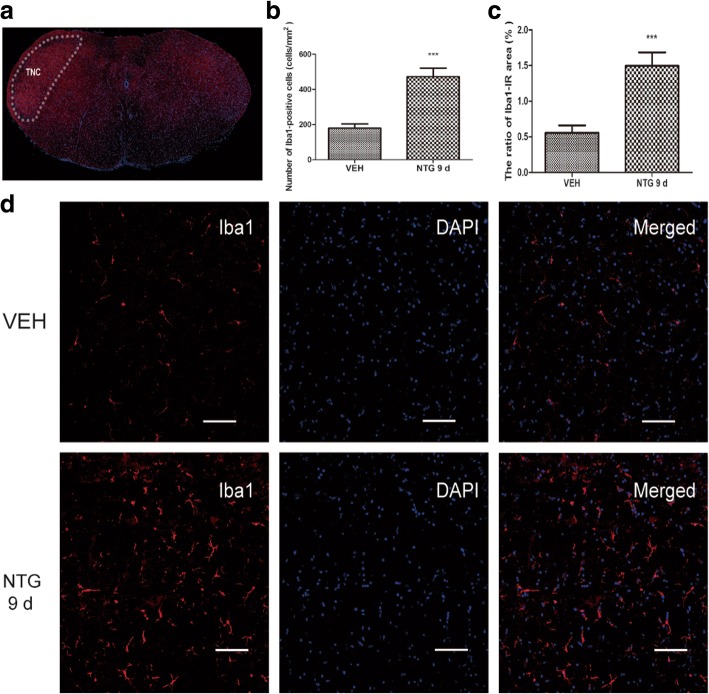
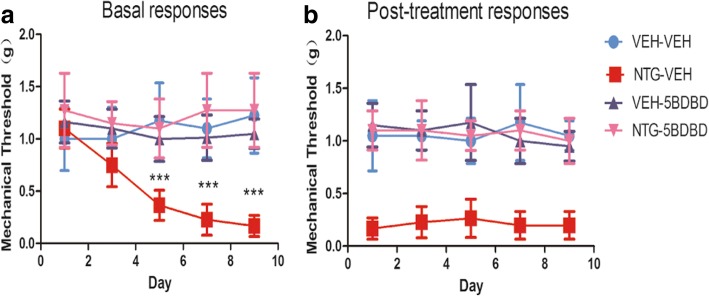
We used an animal model with recurrent intermittent administration of nitroglycerin (NTG), which closely mimics CM. NTG-induced basal and acute mechanical hypersensitivity were evaluated using the von Frey filament test. Then, we detected Iba1 immunoreactivity (Iba1-IR) and P2X4R expression in the trigeminal nucleus caudalis (TNC). To understand the effect of microglia and P2X4R on central sensitization of CM, we examined whether minocycline, an inhibitor of microglia activation, and 5-BDBD, a P2X4R antagonist, altered NTG-induced mechanical hyperalgesia. In addition, we also evaluated the effect of 5-BDBD on c-Fos and calcitonin gene-related peptide (CGRP) expression within the TNC.
Chronic intermittent administration of NTG resulted in acute and chronic basal mechanical hyperalgesia, accompanied with microglia activation and upregulation of P2X4R expression. Minocycline significantly decreased basal pain hypersensitivity but did not alter acute NTG-induced hyperalgesia. Minocycline also reduced microglia activation. 5-BDBD completely blocked the basal and acute hyperalgesia induced by NTG. This effect was associated with a significant inhibition of the NTG-induced increase in c-Fos protein and CGRP release in the TNC.
Our results indicate that blocking microglia activation may have an effect on the prevention of migraine chronification. Moreover, we speculate that the P2X4R may be implicated in the microglia-neuronal signal in the TNC, which contributes to the central sensitization of CM.
偏头痛慢性化的机制尚不清楚。中枢敏化可能是其进展的原因。小胶质细胞 P2X4 受体(P2X4R)在炎症性和神经性疼痛的中枢敏化中起关键作用,但偏头痛中尚无 P2X4R 的相关信息。因此,本研究旨在确定小胶质细胞 P2X4R 在慢性偏头痛(CM)中的确切作用。
我们使用了一种反复给予硝酸甘油(NTG)的动物模型,该模型可很好地模拟 CM。使用 von Frey 细丝试验评估 NTG 诱导的基础和急性机械性超敏反应。然后,我们检测了三叉神经尾核(TNC)中的 Iba1 免疫反应性(Iba1-IR)和 P2X4R 表达。为了了解小胶质细胞和 P2X4R 对 CM 中枢敏化的影响,我们研究了小胶质细胞激活抑制剂米诺环素和 P2X4R 拮抗剂 5-BDBD 是否改变了 NTG 诱导的机械性痛觉过敏。此外,我们还评估了 5-BDBD 对 TNC 内 c-Fos 和降钙素基因相关肽(CGRP)表达的影响。
慢性间歇性给予 NTG 导致急性和慢性基础机械性痛觉过敏,伴有小胶质细胞激活和 P2X4R 表达上调。米诺环素显著降低基础疼痛过敏,但不改变急性 NTG 诱导的痛觉过敏。米诺环素还减少了小胶质细胞的激活。5-BDBD 完全阻断了 NTG 诱导的基础和急性痛觉过敏。这种作用与 TNC 中 c-Fos 蛋白和 CGRP 释放的 NTG 诱导增加的显著抑制有关。
我们的结果表明,阻断小胶质细胞激活可能对预防偏头痛慢性化有作用。此外,我们推测 P2X4R 可能参与了 TNC 中小胶质细胞-神经元信号,有助于 CM 的中枢敏化。