Rayner Jennifer, Muldoon Laura, Bayoumi Imaan, McMurchy Dale, Mulligan Kate, Tharao Wangari
Centre for Studies in Family Medicine, The University of Western Ontario, Toronto, Canada.
Department of Research and Evaluation, Association of Ontario's Health, Toronto, Canada.
J Integr Care (Brighton). 2018;26(3):231-241. doi: 10.1108/JICA-02-2018-0014.
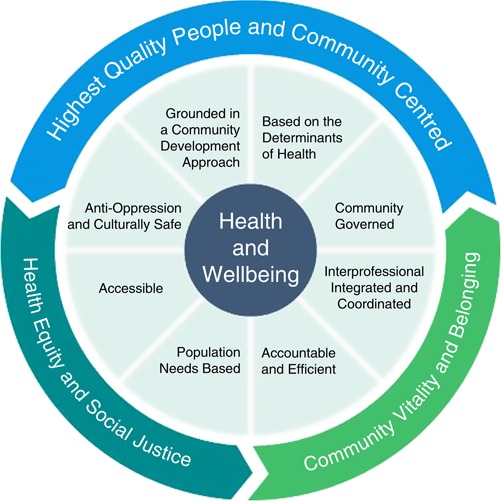
For over 40 years, Canadian and international bodies have endorsed comprehensive primary health care (PHC), yet very little work has been done to describe how services and programs are delivered within these organizations. Because health equity is now of greater interest to policy makers and the public, it is important to describe an evidence-informed framework for the delivery of integrated and equitable PHC. The purpose of this paper is to describe the development of a "Model of Health and Well-being" (MHWB) that provides a roadmap to the delivery of PHC in a successful network of community-governed PHC organizations in Ontario, Canada.
DESIGN/METHODOLOGY/APPROACH: The MHWB was developed through an iterative process that involved members of community-governed PHC organizations in Ontario and key stakeholders. This included literature review and consultation to ensure that the model was evidence informed and reflected actual practice.
The MHWB has three guiding principles: highest quality health and well-being for people and communities; health equity and social justice; and community vitality and belonging. In addition, there are eight attributes that describe how services are provided. There is a reasonable evidence base underpinning the all principles and attributes.
ORIGINALITY/VALUE: As comprehensive, equitable PHC organizations become increasingly recognized as critical parts of the health care system, it is important to have a means to describe their approach to care and the values that drive their care. The MHWB provides a blueprint for comprehensive PHC as delivered by over 100 Community Governed Primary Health Care (CGPHC) organizations in Ontario. All CGPHC organizations have endorsed, adopted and operationalized this model as a guide for optimum care delivery.
四十多年来,加拿大和国际机构一直支持全面初级卫生保健(PHC),但在描述这些组织如何提供服务和项目方面所做的工作却很少。由于健康公平现在受到政策制定者和公众的更大关注,因此描述一个基于证据的综合和公平初级卫生保健提供框架非常重要。本文的目的是描述“健康与福祉模式”(MHWB)的发展,该模式为在加拿大安大略省一个成功的社区治理初级卫生保健组织网络中提供初级卫生保健提供了路线图。
设计/方法/途径:MHWB是通过一个迭代过程开发的,该过程涉及安大略省社区治理初级卫生保健组织的成员和关键利益相关者。这包括文献综述和咨询,以确保该模式基于证据并反映实际做法。
MHWB有三项指导原则:为个人和社区提供最高质量的健康与福祉;健康公平和社会正义;以及社区活力和归属感。此外,有八个属性描述了服务的提供方式。所有原则和属性都有合理的证据基础。
原创性/价值:随着全面、公平的初级卫生保健组织越来越被视为医疗保健系统的关键组成部分,重要的是要有一种方法来描述它们的护理方法和推动其护理的价值观。MHWB为安大略省100多个社区治理初级卫生保健(CGPHC)组织提供的全面初级卫生保健提供了蓝图。所有CGPHC组织都已认可、采用并实施该模式,将其作为最佳护理提供的指南。