Zhao Yi-Cheng, Zhou Wen-Ke, Zhou Xu, Liu Kai-Hui, Yu Da-Peng, Zhao Qing
State Key Laboratory for Mesoscopic Physics and Electron Microscopy Laboratory, School of Physics, Peking University, Beijing 100871, China.
Collaborative Innovation Center of Quantum Matter, Beijing 100084, China.
Light Sci Appl. 2017 May 5;6(5):e16243. doi: 10.1038/lsa.2016.243. eCollection 2017 May.
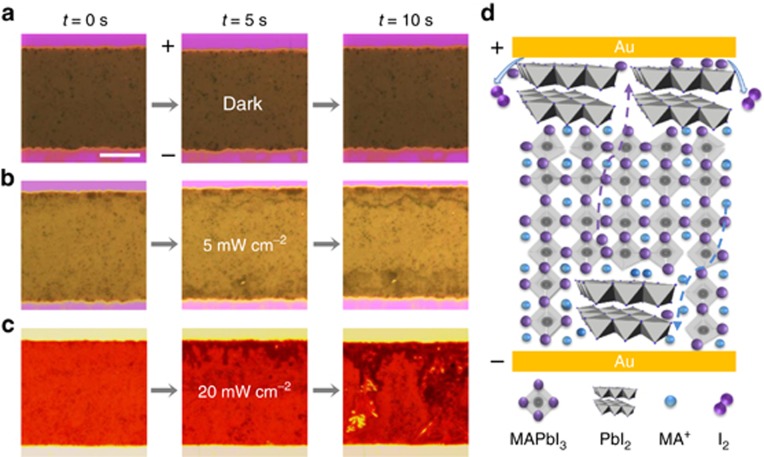
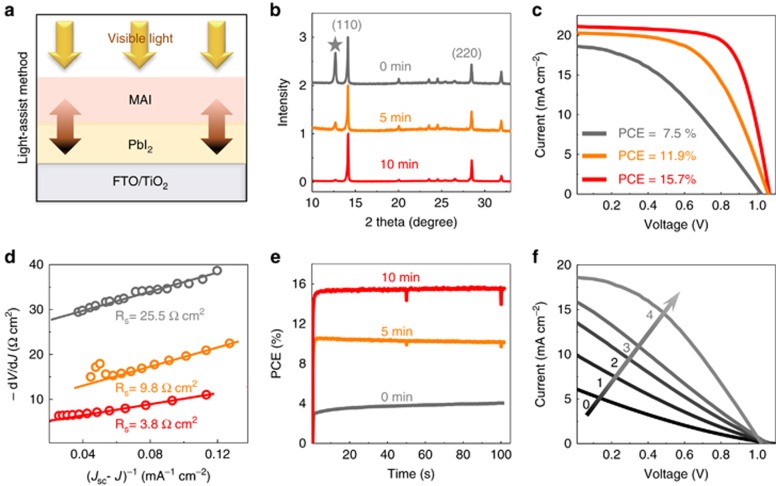
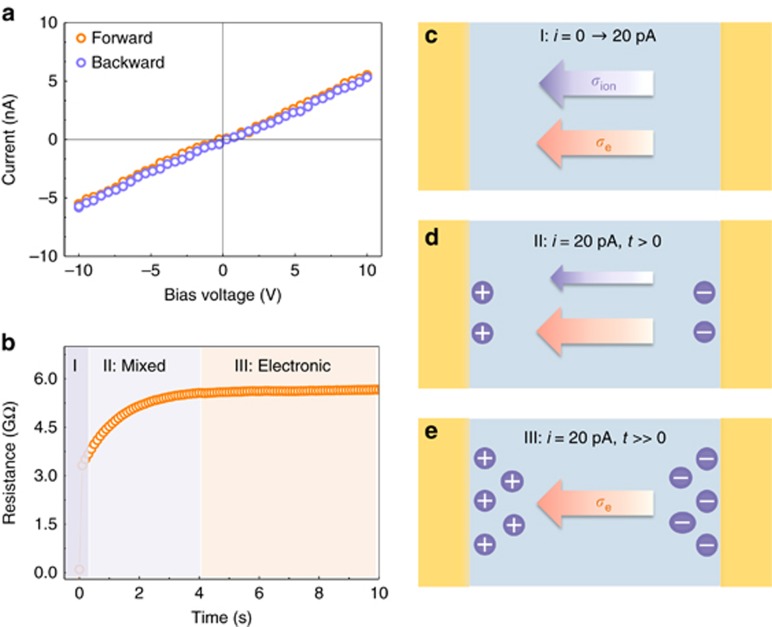
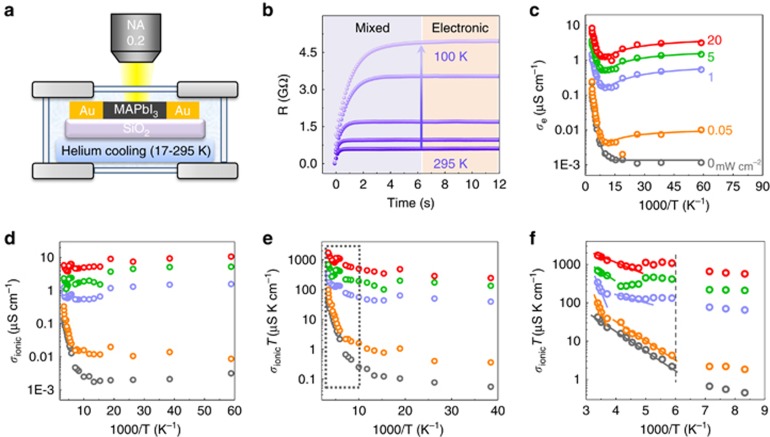
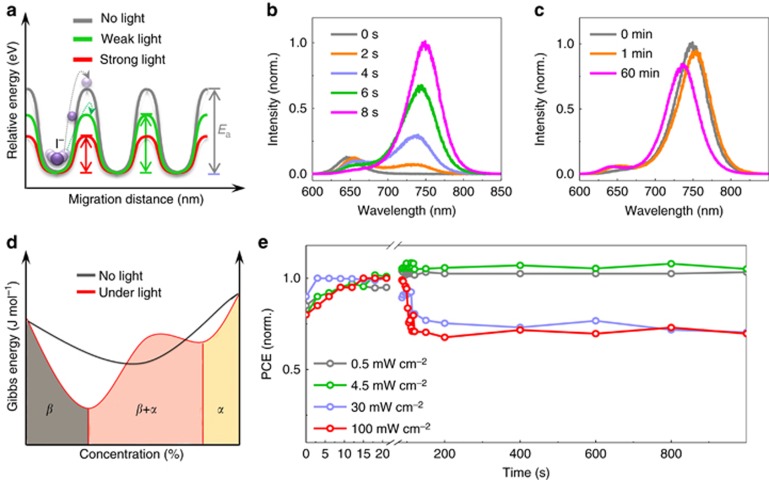
Ionic transport in organometal halide perovskites is of vital importance because it dominates anomalous phenomena in perovskite solar cells, from hysteresis to switchable photovoltaic effects. However, excited state ionic transport under illumination has remained elusive, although it is essential for understanding the unusual light-induced effects (light-induced self-poling, photo-induced halide segregation and slow photoconductivity response) in organometal halide perovskites for optoelectronic applications. Here, we quantitatively demonstrate light-enhanced ionic transport in CHNHPbI over a wide temperature range of 17-295 K, which reveals a reduction in ionic transport activation energy by approximately a factor of five (from 0.82 to 0.15 eV) under illumination. The pure ionic conductance is obtained by separating it from the electronic contribution in cryogenic galvanostatic and voltage-current measurements. On the basis of these findings, we design a novel light-assisted method of catalyzing ionic interdiffusion between CHNHI and PbI stacking layers in sequential deposition perovskite synthesis. X-ray diffraction patterns indicate a significant reduction of PbI residue in the optimized CHNHPbI thin film produced via light-assisted sequential deposition, and the resulting solar cell efficiency is increased by over 100% (7.5%-15.7%) with little PbI residue. This new method enables fine control of the reaction depth in perovskite synthesis and, in turn, supports light-enhanced ionic transport.
有机金属卤化物钙钛矿中的离子传输至关重要,因为它主导着钙钛矿太阳能电池中的异常现象,从滞后现象到可切换的光伏效应。然而,光照下的激发态离子传输仍然难以捉摸,尽管它对于理解有机金属卤化物钙钛矿在光电子应用中的异常光致效应(光致自极化、光致卤化物偏析和缓慢的光电导响应)至关重要。在此,我们定量证明了在17 - 295 K的宽温度范围内,CH₃NH₃PbI₃中光增强的离子传输,这表明光照下离子传输活化能降低了约五倍(从0.82 eV降至0.15 eV)。通过在低温恒电流和电压 - 电流测量中将其与电子贡献分离,获得了纯离子电导。基于这些发现,我们设计了一种新颖的光辅助方法,用于在顺序沉积钙钛矿合成中催化CH₃NH₃I和PbI₂堆叠层之间的离子互扩散。X射线衍射图谱表明,通过光辅助顺序沉积制备的优化CH₃NH₃PbI₃薄膜中PbI₂残留量显著降低,并且所得太阳能电池效率提高了超过100%(从7.5%提高到15.7%),同时PbI₂残留量很少。这种新方法能够精细控制钙钛矿合成中的反应深度,进而支持光增强的离子传输。