Melkemichel M, Bringman S, Widhe B
Department of Clinical Sciences, Karolinska Institutet, Danderyd Hospital, Stockholm, Sweden.
Department of Surgery, Södertälje Hospital, 152 86, Södertälje, Sweden.
Hernia. 2018 Dec;22(6):989-997. doi: 10.1007/s10029-018-1809-x. Epub 2018 Aug 24.
Lightweight meshes (LWM) have shown benefits compared to heavyweight meshes (HWM) in terms of less postoperative pain and stiffness in open inguinal hernia repair. It appears to have similar advantages also in TEP, but concerns exist if it may be associated with higher recurrence rates. The aim of the study was to compare reoperation rate for recurrence of LWM to HWM in laparoscopic totally extra-peritoneal (TEP) repair.
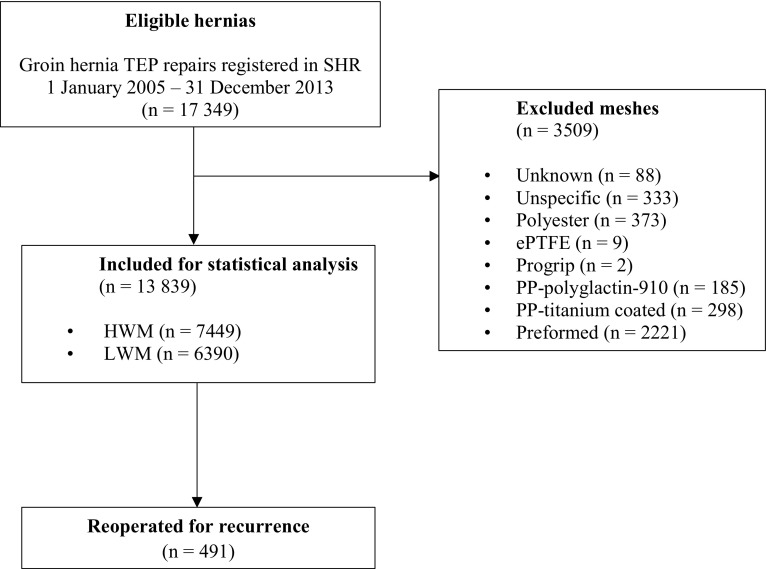
All groin hernias operated on with TEP between 1 January 2005 and 31 December 2013 at surgical units participating in The Swedish Hernia Register were eligible. Data included clinically important hernia variables. Primary endpoint was reoperation for recurrence. Median follow-up time was 6.1 years (0-11.5) with minimum 2.5 years postoperatively.
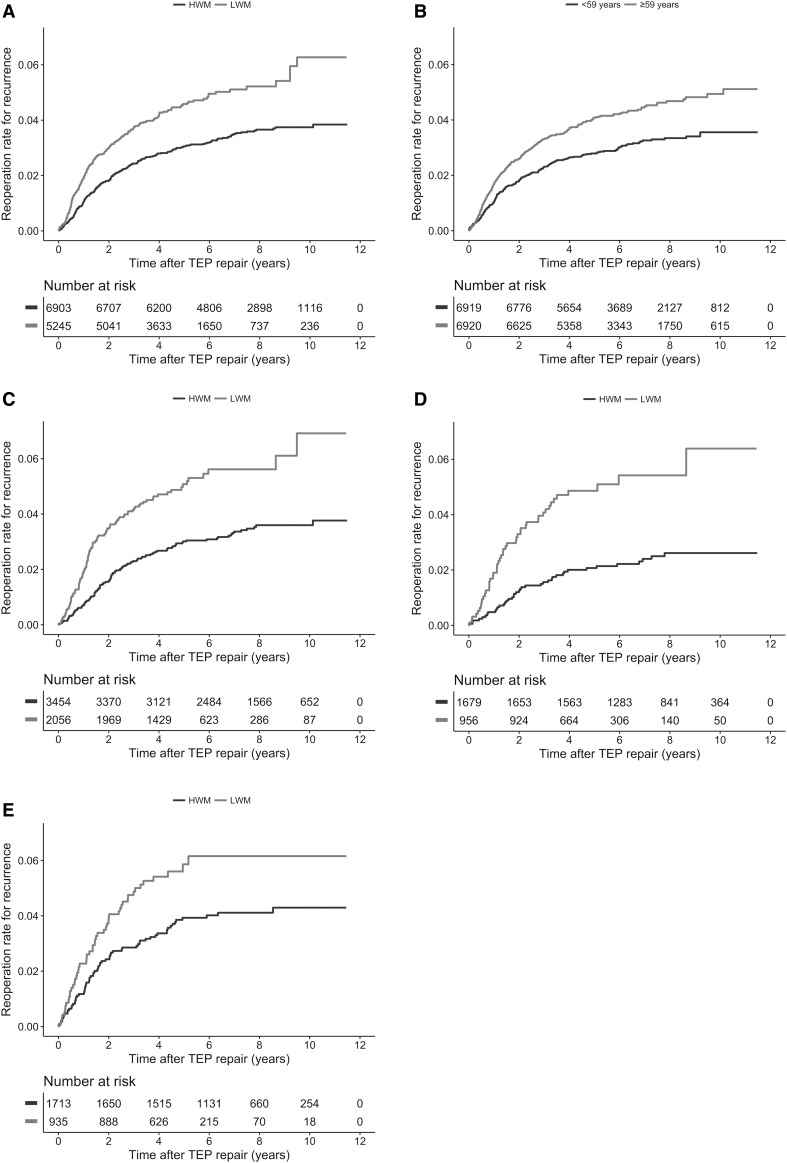
In total, 13,839 repairs were included for statistical analysis and 491 were re-operated for recurrence. Multivariate analysis demonstrated significantly increased risk of reoperation for recurrence in LWM 4.0% (HR 1.56, P < 0.001) compared to HWM 3.2%. This was most evident in direct hernias (HR 1.75, P < 0.001) and in hernia repairs with a defect > 3 cm (HR 1.54, P < 0.021). The risk of recurrence with use of LWM in indirect hernias and in hernia repairs with a defect < 1.5 cm was more comparable to HWM.
Lightweight meshes were associated with an increased risk of reoperation for recurrence compared to HWM. While direct hernias and larger hernia defects may benefit from HWM to avoid increased recurrence rates, LWM is recommended to be used in indirect and smaller hernia defects in TEP repair.
在开放腹股沟疝修补术中,与重磅补片(HWM)相比,轻质补片(LWM)已显示出术后疼痛和僵硬程度较轻的优势。在经腹腹膜前修补术(TEP)中似乎也有类似优势,但人们担心其是否可能与更高的复发率相关。本研究的目的是比较腹腔镜完全腹膜外(TEP)修补术中LWM与HWM复发后的再次手术率。
2005年1月1日至2013年12月31日期间,在参与瑞典疝登记处的外科单位接受TEP手术的所有腹股沟疝患者均符合条件。数据包括临床上重要的疝变量。主要终点是复发后的再次手术。中位随访时间为6.1年(0 - 11.5年),术后至少2.5年。
总共13839例修补术纳入统计分析,491例因复发接受再次手术。多变量分析表明,与HWM的3.2%相比,LWM复发后再次手术的风险显著增加,为4.0%(风险比1.56,P < 0.001)。这在直疝(风险比1.75,P < 0.001)和缺损> 3 cm的疝修补术中最为明显(风险比1.54,P < 0.021)。在斜疝和缺损< 1.5 cm的疝修补术中使用LWM的复发风险与HWM更具可比性。
与HWM相比,轻质补片与复发后再次手术的风险增加相关。虽然直疝和较大的疝缺损可能受益于HWM以避免复发率增加,但建议在TEP修补术中将LWM用于斜疝和较小的疝缺损。