Jung Jae-Hyun, Peli Eli
Schepens Eye Research Institute, Massachusetts Eye and Ear, Department of Ophthalmology, Harvard Medical School, Boston, Massachusetts *
Optom Vis Sci. 2018 Sep;95(9):805-813. doi: 10.1097/OPX.0000000000001271.
Full-field prisms that fill the entire spectacle eye wire have been considered as field expansion devices for homonymous hemianopia (HH) and acquired monocular vision (AMV). Although the full-field prism is used for addressing binocular dysfunction and for prism adaptation training after brain injury as treatment for spatial hemineglect, we show that the full-field prism for field expansion does not effectively expand the visual field in either HH or AMV.
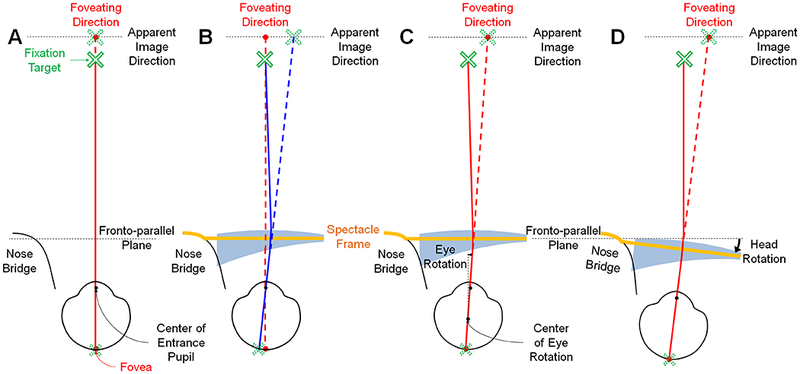
Full-field prisms may shift a portion of the blind side to the residual seeing side. However, foveal fixation on an object of interest through a full-field prism requires head and/or eye rotation away from the blind side, thus negating the shift of the field toward the blind side.
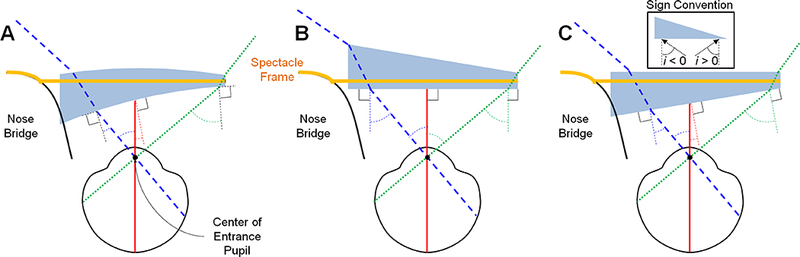
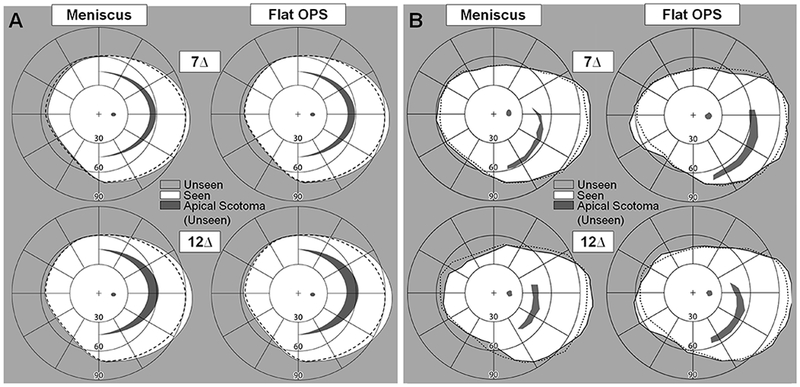
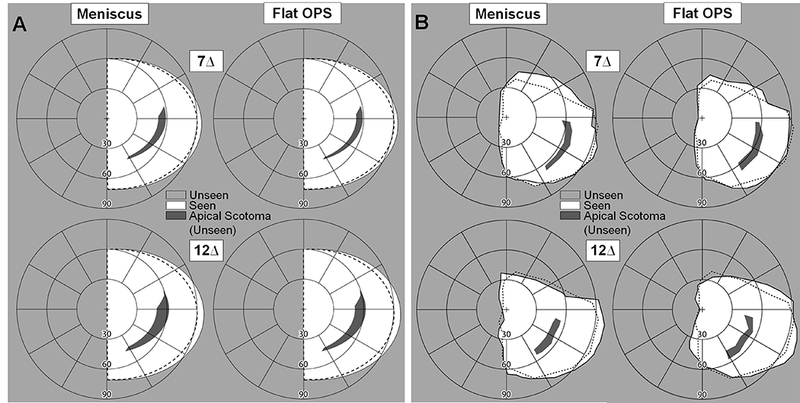
We fit meniscus and flat full-field 7Δ and 12Δ yoked prisms and conducted Goldmann perimetry in HH and AMV. We compared the perimetry results with ray tracing calculations.
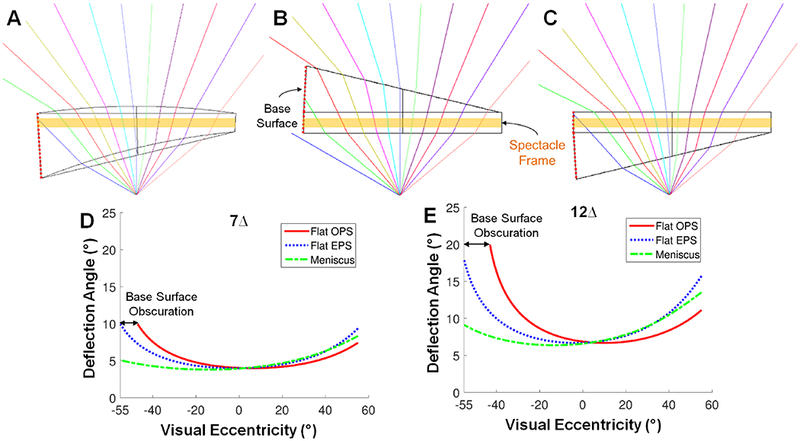
The rated prism power was in effect at the primary position of gaze for all prisms, and the meniscus prisms maintained almost constant power at all eccentricities. To fixate on the perimetry target, the subjects needed to turn their head and/or eyes away from the blind side, which negated the field shift into the blind side. In HH, there was no difference in the perimetry results on the blind side with any of the prisms. In AMV, the lower nasal field of view was slightly shifted into the blind side with the flat prisms, but not with the meniscus prisms.
Full-field prisms are not an effective field expansion device owing to the inevitable fixation shift. There is potential for a small field shift with the flat full-field prism in AMV, but such lenses cannot incorporate refractive correction. Furthermore, in considering the apical scotoma, the shift provides a mere field substitution at best.
填充整个眼镜片视野的全视野棱镜已被视为同向性偏盲(HH)和获得性单眼视力(AMV)的视野扩展装置。尽管全视野棱镜用于解决双眼功能障碍以及脑损伤后的棱镜适应训练以治疗空间半侧忽视,但我们发现用于视野扩展的全视野棱镜在HH或AMV中均不能有效扩展视野。
全视野棱镜可能会将部分盲区转移到残余的可见侧。然而,通过全视野棱镜注视感兴趣的物体需要头部和/或眼睛从盲区旋转开,从而抵消了视野向盲区的转移。
我们为HH和AMV患者佩戴了弯月形和平坦的全视野7Δ和12Δ共轭棱镜,并进行了Goldmann视野检查。我们将视野检查结果与光线追踪计算结果进行了比较。
所有棱镜在主要注视位置的额定棱镜屈光度均有效,并且弯月形棱镜在所有偏心度下的屈光度几乎保持恒定。为了注视视野检查目标,受试者需要将头部和/或眼睛从盲区移开,这抵消了视野向盲区的转移。在HH中,使用任何棱镜时,盲区的视野检查结果均无差异。在AMV中,使用平板棱镜时,较低的鼻侧视野略微向盲区偏移,但使用弯月形棱镜时则没有。
由于不可避免的注视转移,全视野棱镜不是有效的视野扩展装置。在AMV中,平板全视野棱镜可能会有小幅度的视野转移,但这种镜片无法进行屈光矫正。此外,考虑到顶点暗点,这种转移充其量只是一种视野替代。