Department of Rehabilitation, Aged and Extended Care, Flinders University, Adelaide, SA, Australia.
NHMRC Cognitive Decline Partnership Centre, University of Sydney, Sydney, NSW, Australia.
Int J Qual Health Care. 2019 Jul 1;31(6):419-425. doi: 10.1093/intqhc/mzy181.
To compare consumer rated quality of care among individuals living long-term in homelike clustered domestic and standard models of residential care in Australia.
Cross-sectional study.
Seventeen residential aged care facilities in four Australian states providing alternative models of care.
A sample of individuals with high prevalence of cognitive impairment living in residential care for 12 months or longer, not immediately in palliative care and having a proxy available to provide consent and assist with data collection. Of 901 eligible participants, 541 consented and participated in the study.
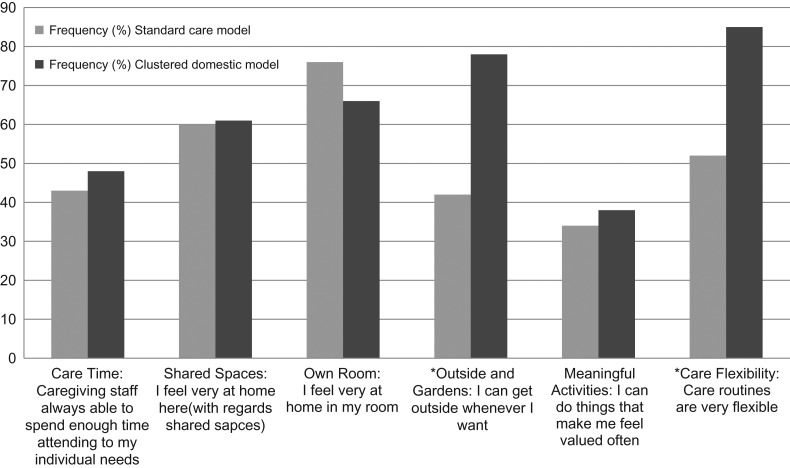
Consumer rated quality of care was measured using the Consumer Choice Index-6 Dimension instrument (CCI-6D) providing a preference weighted summary score ranging from 0 to 1. The six dimensions of care time, shared-spaces, own-room, outside and gardens, meaningful activities and care flexibility were individually evaluated.
Overall consumer rated quality of care (Mean ∆: 0.138, 95% CI 0.073-0.203 P < 0.001) was higher in clustered domestic models after adjusting for potential confounders. Individually, the dimensions of access to outside and gardens (P < 0.001) and flexibility of care (P < 0.001) were rated significantly better compared to those living in standard model of care.
Homelike, clustered domestic models of care are associated with better consumer rated quality of care, specifically the domains of access to outdoors and care flexibility, in a sample of individuals with cognitive impairment. Including consumer views on quality of care is feasible and should be standard in future evaluations of residential care.
比较澳大利亚长期居住在家庭式集群家庭护理和标准护理模式的个体的护理质量。
横断面研究。
澳大利亚四个州的 17 个提供替代护理模式的养老院。
患有认知障碍且长期居住在养老院的个体样本,不在临终关怀中,且有代理人提供同意书并协助数据收集。在 901 名符合条件的参与者中,有 541 名同意并参与了研究。
采用消费者选择指数-6 维度工具(CCI-6D)测量护理质量,提供 0 到 1 之间的偏好加权综合评分。护理时间、共享空间、自有房间、户外和花园、有意义的活动和护理灵活性六个护理维度分别进行评估。
调整潜在混杂因素后,集群式家庭护理模式的整体护理质量(平均差异:0.138,95%置信区间:0.073-0.203,P<0.001)更高。单独来看,与居住在标准护理模式的个体相比,户外和花园的使用(P<0.001)和护理灵活性(P<0.001)维度的评价显著更好。
在患有认知障碍的个体样本中,家庭式集群护理模式与更好的护理质量相关,特别是户外使用和护理灵活性方面。在未来的养老院评估中,包括消费者对护理质量的看法是可行的,应该成为标准。