Oehme Benjamin, Geiger S M, Grund S, Hainke K, Munzel J, Mülling C K W
Institute of Veterinary Anatomy, Histology and Embryology, Faculty of Veterinary Medicine, Leipzig University, Leipzig, Germany.
Institute of Topographic Anatomy, University of Veterinary Medicine Vienna, Vienna, Austria.
BMC Vet Res. 2018 Aug 31;14(1):259. doi: 10.1186/s12917-018-1579-9.
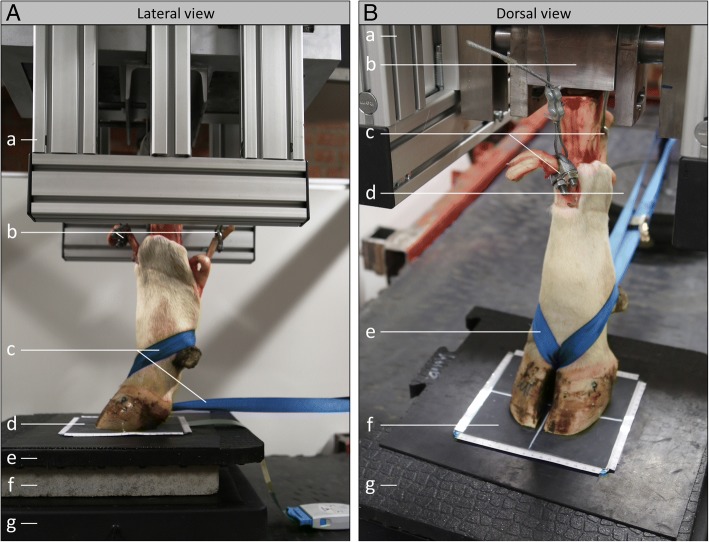
Mechanical interactions between hard floorings and the sole of bovine claws can be reasonable to cause traumatic claw lesions. In this ex vivo study, the direct kinetic impact of concrete and three types of rubber mats on the sole of dairy cattle claws was analyzed. In order to apply uniform loads, isolated distal hind limbs of adult Holstein Friesian dairy cows were functionally trimmed according to the Dutch method and attached to a load applicator. Kinetic data were recorded using a thin, foil-based pressure measurement system (Hoof™ System, Tekscan®).
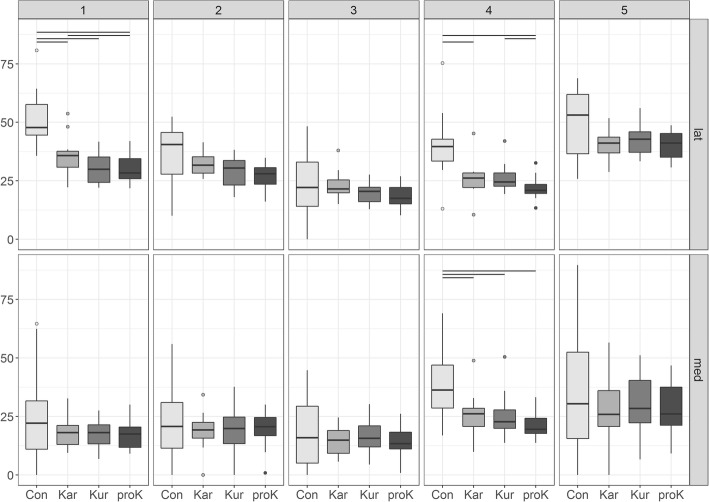
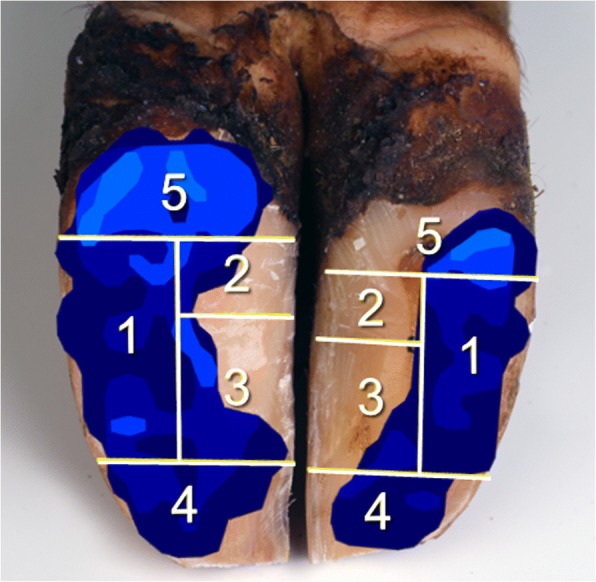
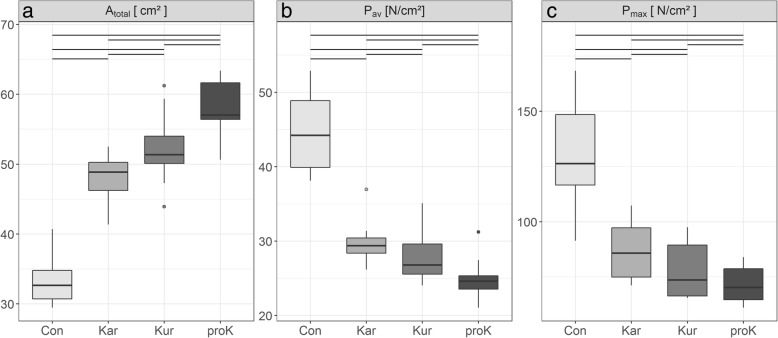
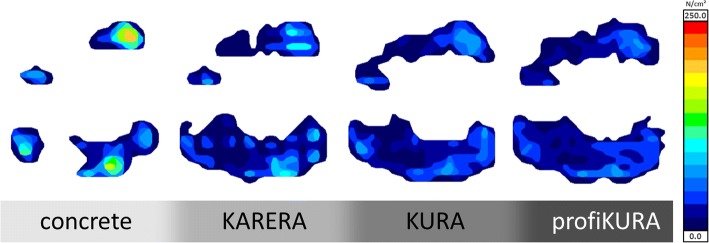
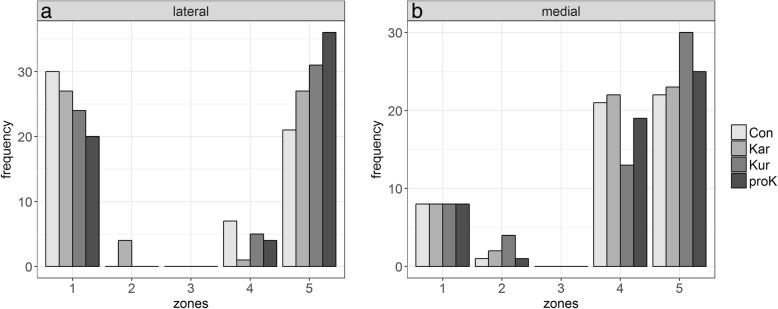
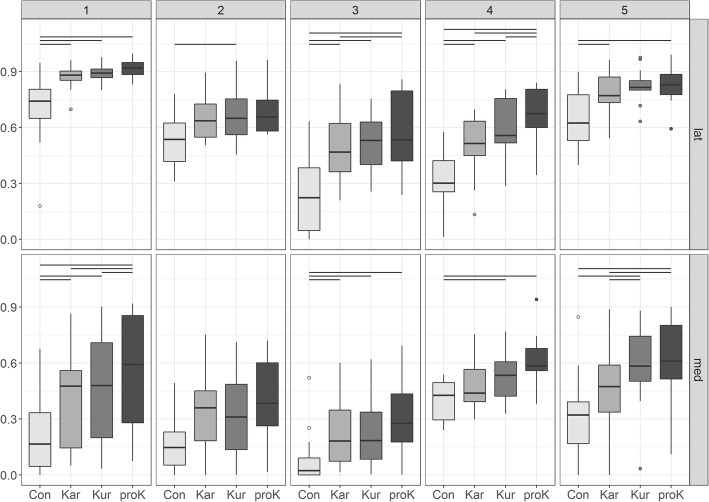
On concrete, the load distribution between the lateral and medial claw was less balanced than on the rubber floorings. The loaded area was significantly smaller on concrete (32.2 cm) compared to all rubber mats (48.3-58.0 cm). Average pressures (P) and maximum pressures (P) were significantly higher on concrete (P 44.7 N/cm; P 130.3 N/cm) compared to the rubber floorings (P 24.9-29.7 N/cm; P 71.9-87.2 N/cm). Pressure peaks occurred mainly in plantar and abaxial parts of the lateral claw and in apical and plantar regions of the medial claw. Load distribution displayed a widely unloaded slope region, but considering the pressure distribution under the claw, none of the zones showed a generally lower pressure exposure.
Altogether, rubber floorings lead to a significant mechanical relief of the sole compared to concrete. Furthermore, relevant differences between the tested rubber mats could be determined. Therefore the used system may be applied to compare further flooring types.
硬地面与牛蹄底部之间的机械相互作用可能会合理地导致创伤性蹄部病变。在这项体外研究中,分析了混凝土和三种橡胶垫对奶牛蹄底的直接动力学影响。为了施加均匀负载,按照荷兰方法对成年荷斯坦弗里生奶牛的离体后肢远端进行功能修剪,并将其连接到负载施加器上。使用基于箔的薄压力测量系统(Hoof™ 系统,Tekscan®)记录动力学数据。
在混凝土上,外侧蹄和内侧蹄之间的负载分布比在橡胶地面上更不均衡。与所有橡胶垫(48.3 - 58.0厘米)相比,混凝土上的负载面积显著更小(32.2厘米)。与橡胶地面(平均压力24.9 - 29.7牛/平方厘米;最大压力71.9 - 87.2牛/平方厘米)相比,混凝土上的平均压力(P)和最大压力(P)显著更高(平均压力44.7牛/平方厘米;最大压力130.3牛/平方厘米)。压力峰值主要出现在外侧蹄的跖侧和远轴部以及内侧蹄的顶端和跖侧区域。负载分布显示出一个广泛的卸载斜坡区域,但考虑到蹄下的压力分布,没有一个区域的压力暴露普遍较低。
总体而言,与混凝土相比,橡胶地面可显著减轻蹄底的机械压力。此外,可以确定测试橡胶垫之间的相关差异。因此,所使用的系统可用于比较更多的地面类型。