Kranidioti Hariklia, Chatzievagelinou Christina, Protopapas Adonis, Papatheodoridi Margarita, Zisimopoulos Konstantinos, Evangelidou Eftychia, Antonakaki Pinelopi, Vlachogiannakos John, Triantos Christos, Elefsiniotis Ioannis, Goulis John, Mela Maria, Anagnostou Olga, Tsoulas Christos, Deutsch Melanie, Papatheodoridis George, Manolakopoulos Spilios
2 Academic Department of Internal Medicine, Hippokration General Hospital, Athens (Hariklia Kranidioti, Pinelopi Antonakaki, Olga Anagnostou, Melanie Deutsch, Spilios Manolakopoulos), Greece.
Department of Gastroenterology, Evangelismos-Opthalmiatrion Athinon-Polykliniki Hospitals, Athens (Christina Chatzievagelinou, Maria Mela), Greece.
Ann Gastroenterol. 2018 Sep-Oct;31(5):598-603. doi: 10.20524/aog.2018.0293. Epub 2018 Jul 19.
It is estimated that 17,000 people who inject drugs (PWID) in Greece have hepatitis C virus (HCV) viremia. The aim of our study was to explore the characteristics of the HCV-infected, direct acting antiviral (DAA)-naïve PWID.
This is a retrospective analysis of PWID with HCV infection. We selected data from six liver clinics during the period from 1 May 2014 to 31 May 2017 in order to record the characteristics of infected PWID.
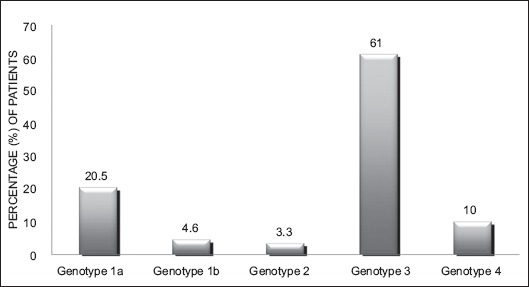
We included 800 PWID with HCV infection (78.5% male, mean age 42±10 years) who had not received DAAs before 1 June 2017. One third of the patients had comorbidities (diabetes mellitus, arterial hypertension and psychological disorders); 70% were smokers, 27% alcohol users, 67% unemployed, 29% married, and 34% had education >12 years; 65% were attending addiction programs; 57% were receiving methadone and 36% buprenorphine. Sporadic or systemic drug use was reported by 37% while 1.4% and 2.9% had HIV and HBV coinfection, respectively. The genotype distribution was 20.5%, 4.6%, 3.3%, 61% and 10% for genotypes 1a, 1b, 2, 3 and 4, respectively. Mean (±SD) liver stiffness was 9±7 kPa and 21% of the patients had cirrhosis. Half of the patients were in the F0-F1 stage of liver disease, defined as stiffness ≤7 kPa.
Our real-life data suggest that HCV genotype 3 remains the predominant genotype among PWID. One third of PWID had comorbidities and one-fifth cirrhosis. Half of PWID had early-stage liver disease and remained without access to DAAs according to the Greek prioritization criteria.
据估计,希腊有17000名注射吸毒者(PWID)感染丙型肝炎病毒(HCV)且存在病毒血症。我们研究的目的是探讨未接受过直接抗病毒药物(DAA)治疗的HCV感染PWID的特征。
这是一项对HCV感染的PWID进行的回顾性分析。我们选取了2014年5月1日至2017年5月31日期间6家肝病诊所的数据,以记录受感染PWID的特征。
我们纳入了800例HCV感染的PWID(78.5%为男性,平均年龄42±10岁),这些患者在2017年6月1日前未接受过DAA治疗。三分之一的患者患有合并症(糖尿病、动脉高血压和心理障碍);70%为吸烟者,27%饮酒,67%失业,29%已婚,34%接受过12年以上教育;65%参加过戒毒项目;57%接受美沙酮治疗,36%接受丁丙诺啡治疗。37%的人报告有偶尔或全身性药物使用情况,1.4%和2.9%的人分别合并感染HIV和HBV。基因1a、1b、2、3和4型的分布分别为20.5%、4.6%、3.3%、61%和10%。平均(±标准差)肝脏硬度为9±7 kPa,21%的患者患有肝硬化。一半的患者处于肝病F0 - F1期,定义为硬度≤7 kPa。
我们的实际数据表明,HCV基因3型仍是PWID中的主要基因型。三分之一的PWID患有合并症,五分之一患有肝硬化。一半的PWID患有早期肝病,根据希腊的优先排序标准,他们仍无法获得DAA治疗。