Gómez-Jordana Luis I, Stafford James, Peper C Lieke E, Craig Cathy M
Department of Human Movement Sciences, Faculty of Behavioral and Movement Sciences, Vrije Universiteit Amsterdam, Amsterdam, Netherlands.
School of Psychology, Queens University Belfast, Belfast, United Kingdom.
Front Neurol. 2018 Aug 17;9:681. doi: 10.3389/fneur.2018.00681. eCollection 2018.
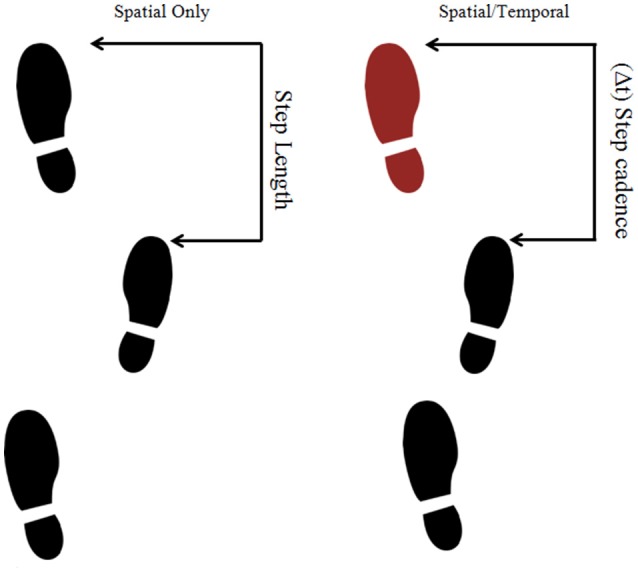
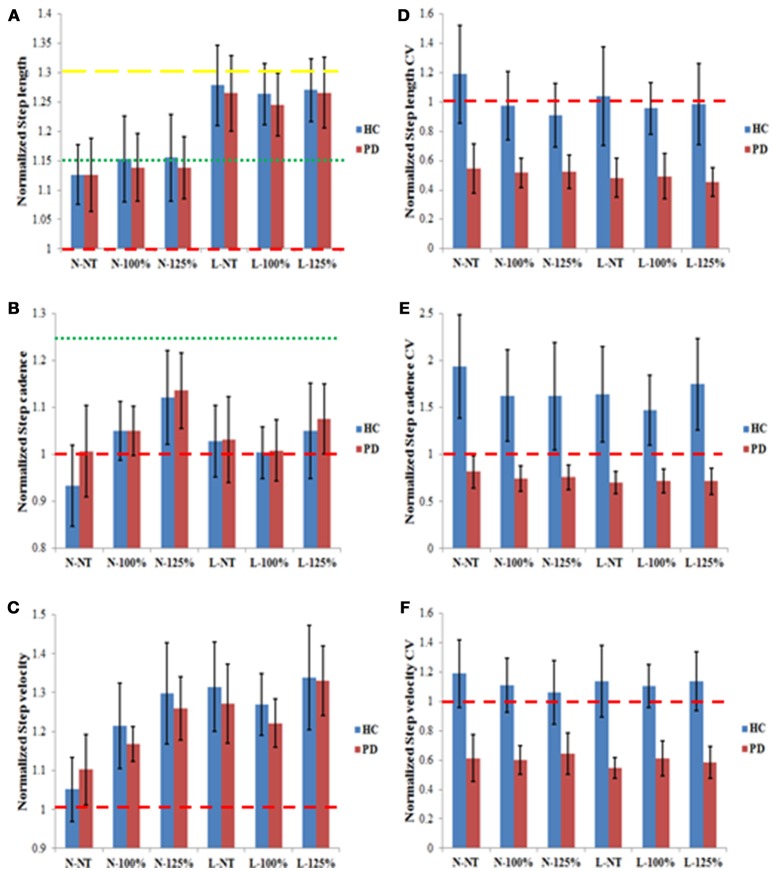
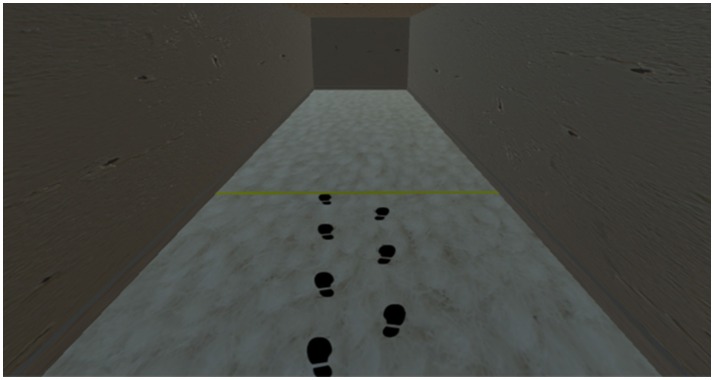
In Parkinson's disease (PD) self-directed movement, such as walking, is often found to be impaired while goal directed movement, such as catching a ball, stays relatively unaltered. This dichotomy is most clearly observed when sensory cueing techniques are used to deliver patterns of sound and/or light which in turn act as an external guide that improves gait performance. In this study we developed visual cues that could be presented in an immersive, interactive virtual reality (VR) environment. By controlling how the visual cues (black footprints) were presented, we created different forms of spatial and temporal information. By presenting the black footprints at a pre-specified distance apart we could recreate different step lengths (spatial cues) and by controlling when the black footprints changed color to red, we could convey information about the timing of the foot placement (temporal cues). A group of healthy controls (HC; = 10) and a group of idiopathic PD patients (PD, = 12) were asked to walk using visual cues that were tailored to their own gait performance [two spatial conditions (115% [N] and 130% [L] of an individual's baseline step length) and three different temporal conditions (spatial only condition [NT], 100 and 125% baseline step cadence)]. Both groups were found to be able to match their gait performance (step length and step cadence) to the information presented in all the visual cue conditions apart from the 125% step cadence conditions. In all conditions the PD group showed reduced levels of gait variability ( < 0.05) while the HC group did not decrease. For step velocity there was a significant increase in the temporal conditions, the spatial conditions and of the interaction between the two for both groups of participants ( < 0.05). The coefficient of variation of step length, cadence, and velocity were all significantly reduced for the PD group compared to the HC group. In conclusion, our results show how virtual footsteps presented in an immersive, interactive VR environment can significantly improve gait performance in participants with Parkinson's disease.
在帕金森病(PD)中,人们常常发现诸如行走等自主运动受损,而诸如接球等目标导向运动相对保持不变。当使用感觉提示技术来传递声音和/或光的模式,进而作为改善步态表现的外部引导时,这种二分法最为明显。在本研究中,我们开发了可在沉浸式、交互式虚拟现实(VR)环境中呈现的视觉提示。通过控制视觉提示(黑色脚印)的呈现方式,我们创建了不同形式的空间和时间信息。通过将黑色脚印以预先指定的距离分开呈现,我们可以重现不同的步长(空间提示),并且通过控制黑色脚印何时变为红色,我们可以传达有关足部着地时间的信息(时间提示)。一组健康对照者(HC;n = 10)和一组特发性PD患者(PD,n = 12)被要求使用根据他们自己的步态表现量身定制的视觉提示行走[两种空间条件(个体基线步长的115% [N]和130% [L])和三种不同的时间条件(仅空间条件[NT]、100%和125%基线步频)]。除了125%步频条件外,发现两组在所有视觉提示条件下都能够使其步态表现(步长和步频)与所呈现的信息相匹配。在所有条件下,PD组的步态变异性水平降低(P < 0.05),而HC组没有降低。对于步速,两组参与者在时间条件、空间条件以及两者之间的相互作用方面均有显著增加(P < 0.05)。与HC组相比,PD组的步长、步频和速度的变异系数均显著降低。总之,我们的结果表明,在沉浸式、交互式VR环境中呈现的虚拟脚印可显著改善帕金森病患者的步态表现。