Moon Myung-Sang, Lee Hohyoung, Kim Seong-Tae, Kim Sang-Jae, Kim Min-Su, Kim Dong-Suk
Department of Orthopedic and Traumatic Surgery, Cheju Halla General Hospital, Jeju, Korea.
Clin Orthop Surg. 2018 Sep;10(3):322-327. doi: 10.4055/cios.2018.10.3.322. Epub 2018 Aug 22.
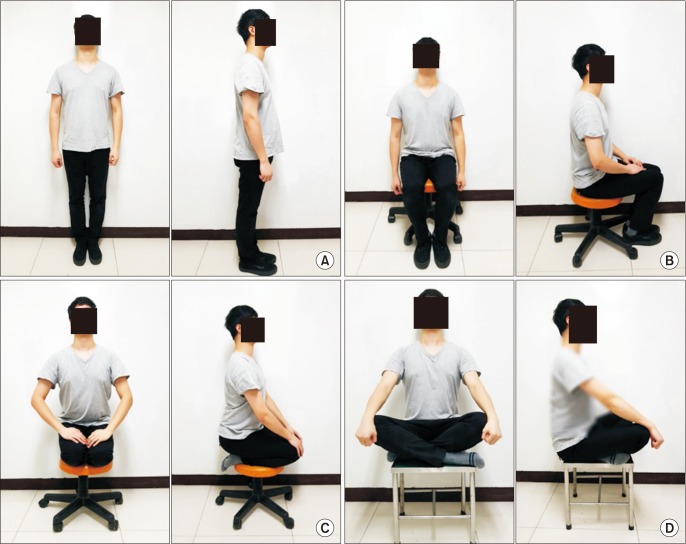
Several previous studies reported on the impact of upright standing and chair sitting on the sagittal spinopelvic alignment. However, there are no studies on the impact of the two Asian (Korean and Japanese) style floor-sitting positions on the sagittal spinopelvic alignment. The purpose of this study was to evaluate the impact of four different body postures (standing, chair sitting, kneel sitting, and cross-legged sitting) on the sagittal spinopelvic alignment.
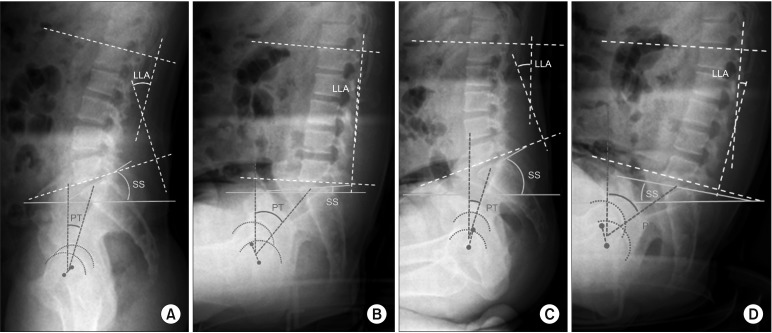
Sixteen selected healthy volunteers (10 males and six females) were subjects of this pilot study. In all subjects, radiographs were taken in comfortable standing and sitting positions. All spinal curvatures including lumbar lordotic angle (LLA), sacral slope (SS), pelvic tilt (PT), and pelvic incidence (PI) were measured on the radiographs.
In standing position, the average LLA, SS, PT, and PI were 37.1°, 35.3°, 15.7°, and 51.0°, respectively. In chair sitting, the average LLA, SS, PT, and PI were 17.9°, 20.3°, 28.2°, and 49.5°, respectively. In kneel sitting (Japanese style), the average LLA, SS, PT, and PI were 31.8°, 38.3°, 14.2°, and 52.5°, respectively. In cross-legged sitting (Korean style), the average LLA, SS, PT, and PI were 9.8°, 13.4°, 38.3°, and 51.7°, respectively. LLA in standing (37.1°) and kneel sitting (31.8°) were very similar. Remarkable reduction in LLA was observed in Korean-style cross-legged sitting (9.8°), and LLA in chair sitting (17.9°) was about half of that in standing. SS was similar in standing (35.3°) and kneel sitting (38.3°), and it was reduced remarkably in cross-legged sitting (13.4°). PT was largest in cross-legged sitting (38.3°), and it was similar between standing (15.7°) and kneel sitting (14.2°). PIs were similar in all positions.
The kneel sitting position did not show significant differences with the standing position when assessed using four parameters related to the sagittal spinopelvic alignment, whereas chair sitting and cross-legged sitting positions significantly altered the spinopelvic alignment compared to the standing position.
先前的几项研究报告了直立站立和坐在椅子上对矢状位脊柱骨盆对线的影响。然而,尚无关于两种亚洲(韩国和日本)风格的地板坐姿对矢状位脊柱骨盆对线影响的研究。本研究的目的是评估四种不同身体姿势(站立、坐在椅子上、跪坐和盘腿坐)对矢状位脊柱骨盆对线的影响。
16名选定的健康志愿者(10名男性和6名女性)参与了这项初步研究。对所有受试者,在舒适的站立和坐姿下拍摄X线片。在X线片上测量所有脊柱曲度,包括腰椎前凸角(LLA)、骶骨倾斜度(SS)、骨盆倾斜度(PT)和骨盆入射角(PI)。
站立位时,LLA、SS、PT和PI的平均值分别为37.1°、35.3°、15.7°和51.0°。坐在椅子上时,LLA、SS、PT和PI的平均值分别为17.9°、20.3°、28.2°和49.5°。跪坐(日本风格)时,LLA、SS、PT和PI的平均值分别为31.8°、38.3°、14.2°和52.5°。盘腿坐(韩国风格)时,LLA、SS、PT和PI的平均值分别为9.8°、13.4°、38.3°和51.7°。站立位(37.1°)和跪坐(31.8°)时的LLA非常相似。在韩式盘腿坐(9.8°)时观察到LLA显著降低,而坐在椅子上时的LLA(17.9°)约为站立位时的一半。站立位(35.3°)和跪坐(38.3°)时的SS相似,而在盘腿坐(13.4°)时显著降低。PT在盘腿坐时最大(38.3°),站立位(15.7°)和跪坐(14.2°)时相似。所有体位下的PI相似。
当使用与矢状位脊柱骨盆对线相关的四个参数进行评估时,跪坐姿势与站立姿势相比没有显著差异,而与站立姿势相比,坐在椅子上和盘腿坐姿势显著改变了脊柱骨盆对线。