Kamgang Basile, Wilson-Bahun Theodel A, Irving Helen, Kusimo Michael O, Lenga Arsene, Wondji Charles S
Medical Entomology, Centre for Research in Infectious Diseases, Yaounde, P.O. Box 13591, Cameroon.
Faculty of Science and Technology, Marien Ngouabi University, Brazzaville, Congo.
Wellcome Open Res. 2018 Dec 28;3:79. doi: 10.12688/wellcomeopenres.14659.3. eCollection 2018.
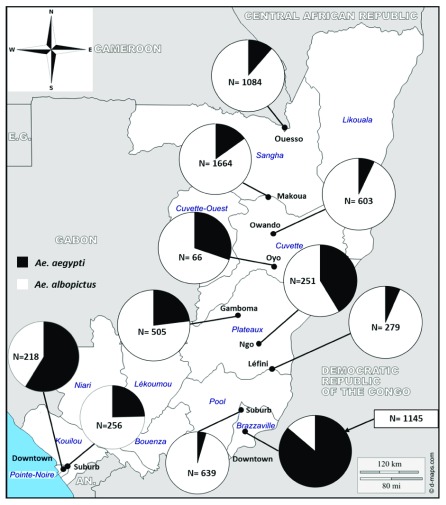
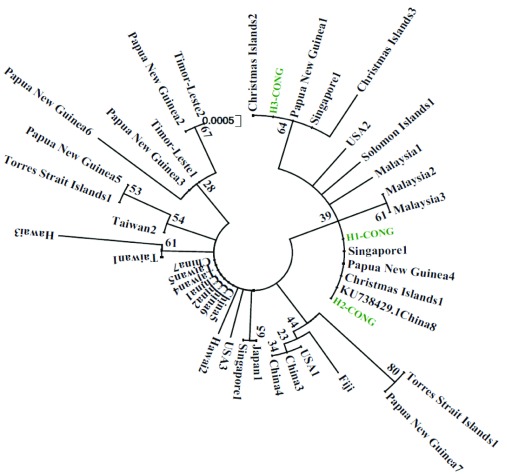
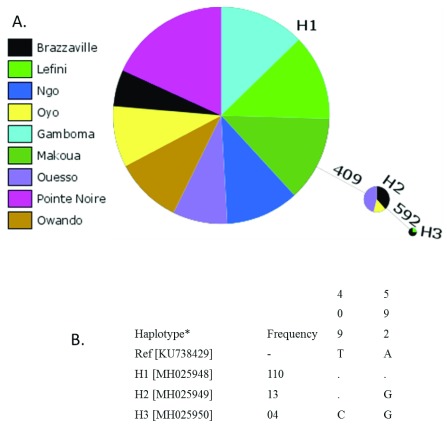
The arbovirus vector, originating from Asia, has recently invaded African countries, including the Republic of the Congo, where it was associated with a chikungunya outbreak. Up until now, little was known about its distribution in relation to the native and how the invasion will modify the epidemiology of arboviral diseases. Here, we assessed the current distribution of and in the Republic of the Congo and explored the genetic diversity of the invading species, . Immature stages of were collected in nine locations in the Republic of the Congo in 2017 following a north-south transect and reared to adult stage. Adults were morphologically identified, counted and grouped according to species and location. Genetic diversity of was assessed by analyzing the cytochrome oxidase I ( ) gene. and were found together across the country in all the locations investigated. The invasive species is predominant over the native species in all locations except Brazzaville, suggesting that is displacing across Congo. When comparing the species distributions across the two largest cities, Brazzaville and Pointe Noire, was more prevalent than in the suburbs whereas the opposite situation was reported in the city centre. Mitochondrial DNA analysis revealed very low genetic diversity of with only three haplotypes recorded across the country supporting the recent introduction of this species in the Republic of the Congo. Phylogenetic tree analysis revealed that from Congo originated from other tropical Asian countries such as China, likely as a result of increasing trade links. These findings are important for the implementation of vector control strategies and can serve as a foundation for further research on these vectors in the country.
这种虫媒病毒载体原产于亚洲,最近侵入了包括刚果共和国在内的非洲国家,在刚果共和国它与基孔肯雅热疫情有关。到目前为止,关于它相对于本地物种的分布情况以及这种入侵将如何改变虫媒病毒疾病的流行病学知之甚少。在此,我们评估了刚果共和国当前的[具体物种1]和[具体物种2]的分布情况,并探索了入侵物种[具体物种1]的遗传多样性。2017年,沿着一条南北走向的样带在刚果共和国的九个地点收集了[具体物种1]的未成熟阶段个体,并饲养至成虫阶段。成虫通过形态学鉴定、计数,并根据物种和地点进行分组。通过分析细胞色素氧化酶I(COI)基因评估[具体物种1]的遗传多样性。在所有调查地点都发现[具体物种1]和[具体物种2]共存。除了布拉柴维尔,在所有地点入侵物种都比本地物种占优势,这表明[具体物种1]正在刚果各地取代[具体物种2]。在比较布拉柴维尔和黑角这两个最大城市的物种分布时,[具体物种1]在郊区比[具体物种2]更普遍,而在市中心则情况相反。线粒体DNA分析显示[具体物种1]的遗传多样性非常低,全国仅记录到三个单倍型,这支持了该物种最近被引入刚果共和国的观点。系统发育树分析表明,来自刚果的[具体物种1]起源于其他热带亚洲国家,如中国,这可能是贸易联系增加的结果。这些发现对于实施病媒控制策略很重要,并且可以作为该国对这些病媒进一步研究的基础。